Allen-Bradley PLC Programming Instruction Sets
Allen-Bradley PLC Programming Instruction Sets
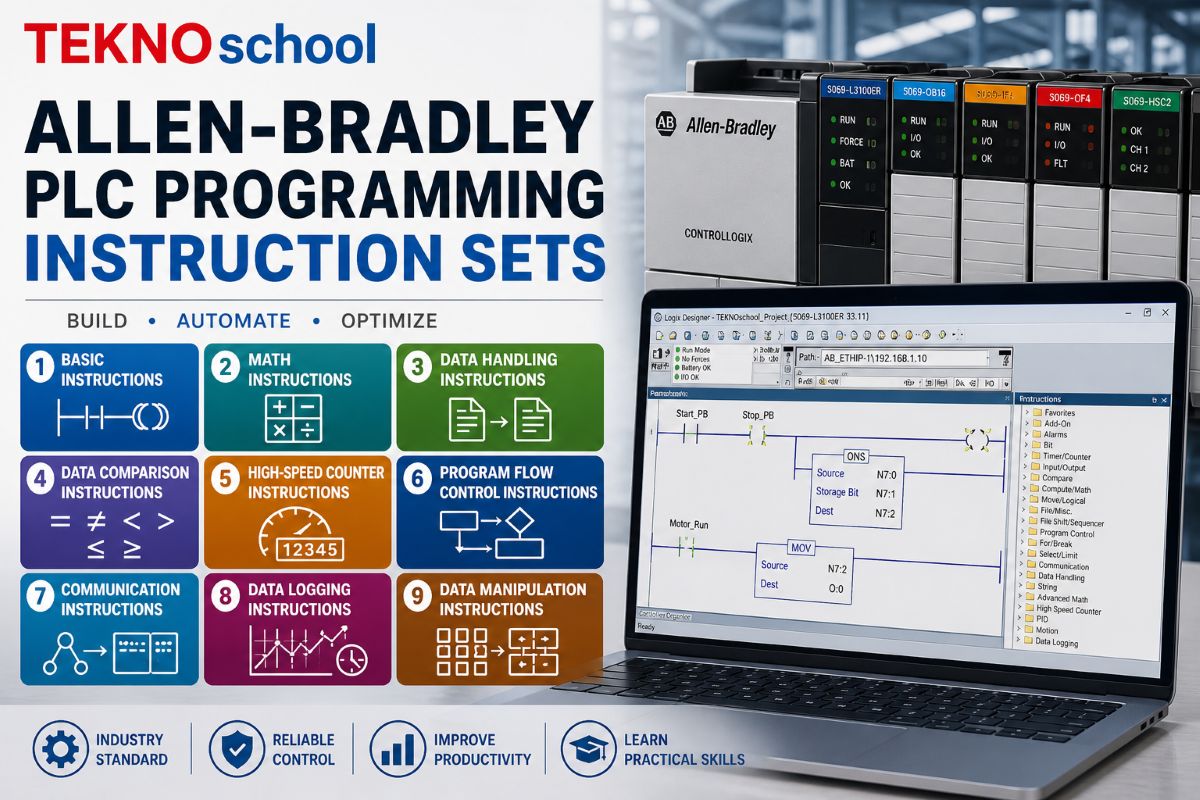
Programmable Logic Controllers from Allen-Bradley (under Rockwell Automation) are widely deployed across process and discrete industries. Their programming environment—primarily RSLogix 500 and Studio 5000 Logix Designer—organizes control logic into well-defined instruction sets. Understanding these categories is essential for writing deterministic, maintainable, and high-performance control programs.
1. Basic Instructions (Bit Logic)
Basic instructions implement Boolean logic and form the backbone of ladder diagrams.
Core instructions:
- XIC (Examine If Closed) – TRUE when bit = 1
- XIO (Examine If Open) – TRUE when bit = 0
- OTE (Output Energize) – writes the result to an output bit
- OTL/OTU (Latch/Unlatch) – retentive set/reset
- ONS (One-Shot Rising) – single-scan pulse
Use cases: motor start/stop circuits, interlocks, permissives, alarms.
Good practice: avoid race conditions with mixed OTE/OTL on the same tag; use seal-in patterns for stable states.
2. Math Instructions
Math instructions process numeric data for control and calculations.
Common set:
- ADD, SUB, MUL, DIV
- MOD (modulo), NEG (negate)
- ABS, SQRT, SQR
- CPT (Compute) – complex expressions
- SCP (Scale with Parameters) – raw-to-engineering units
Applications: analog scaling (e.g., 4–20 mA to °C), flow totals, energy calculations, and PID preprocessing.
Tip: prefer CPT for multi-term expressions to reduce rung count and improve readability.
3. Data Handling Instructions
These instructions move, copy, or initialize data efficiently.
Key instructions:
- MOV (Move) – copy single value
- COP (Copy) – block copy (size-based)
- FLL (Fill File) – initialize arrays/structures
- CLR (Clear) – zero a destination
Applications: initializing recipes, duplicating parameter sets, resetting buffers.
Caution: COP is byte/word-oriented—ensure source/destination data types and lengths align to avoid unintended overwrites.
4. Data Comparison Instructions
Comparison instructions evaluate relationships between values.
Core set:
- EQU (Equal), NEQ (Not Equal)
- LES/LEQ (Less / Less or Equal)
- GRT/GEQ (Greater / Greater or Equal)
- LIM (Limit Test) – inside/outside window
Applications: alarm thresholds, interlocks, range checks, state transitions.
Design note: centralize limits in tags/UDTs for easier tuning and auditability.
5. High-Speed Counter (HSC) Instructions
HSC instructions interface with fast pulse inputs that exceed normal scan capabilities.
Features:
- Hardware-assisted counting (module or built-in)
- Up/Down counting, quadrature (A/B) encoder support
- Presets, rollover handling, latch registers
Applications: encoder-based position/speed, cut-to-length, packaging indexing.
Tip: configure filtering and input modes in hardware; use event tasks where available for precise timing.
6. Program Flow Control Instructions
These manage execution order and modularity.
Important instructions:
- JSR/RET (Jump to Subroutine/Return)
- SBR (Subroutine Start)
- MCR (Master Control Reset) – zone enable/disable
- SQO/SQI/SQC (Sequencers) – step-based control
Applications: machine sequencing, recipe steps, modular code reuse.
Best practice: keep subroutines cohesive (single responsibility) and document entry/exit conditions.
7. Communication Instructions
Communication instructions exchange data with external devices and systems.
Primary instruction:
- MSG (Message) – read/write data over Ethernet/IP, ControlNet, DeviceNet; can be adapted for Modbus via modules/gateways
Use cases: PLC-to-PLC data sharing, SCADA integration, VFD/drive parameter access, remote diagnostics.
Considerations: manage message timing, buffering, and error handling; avoid flooding networks with continuous MSG triggers.
8. Data Logging Instructions
Data logging captures time-stamped process values for analysis and compliance.
Approaches:
- Periodic tasks storing values into arrays/UDTs
- Triggered logs on events/alarms
- Integration with historians (e.g., FactoryTalk)
Applications: energy monitoring, batch records, quality tracking, and troubleshooting.
Tip: decouple logging from the main scan (use periodic/event tasks) to maintain deterministic control.
9. Data Manipulation Instructions
These instructions restructure data for sequencing and buffering.
Key set:
- FFL/FFU (FIFO Load/Unload) – queues
- LFL/LFU (LIFO) – stacks
- BSL/BSR (Bit Shift Left/Right) – tracking parts
- ROL/ROR (Rotate) – circular shifts
Applications: conveyor tracking, inspection reject systems, batch queues, event pipelines.
Design tip: pair queues with status bits (empty/full) and bounds checking to prevent overflow/underflow.
Conclusion
Allen-Bradley instruction sets provide a comprehensive toolkit for deterministic control—from simple bit logic to high-speed motion feedback and enterprise communication. Effective PLC programs combine clear structure (flow control), robust I/O logic (basic + comparison), and efficient data strategies (handling, manipulation, logging). Selecting the right instruction—and applying it with attention to scan time, data types, and safety—yields reliable, scalable automation solutions across industries.