AIC+, DNI, ENI and ENIW Communication Modules: Guide for Industrial Automation
⭐ The Guide to AIC+, DNI, ENI and ENIW
Rockwell Automation communication interfaces AIC+, DNI, ENI, and ENIW
Communication is the lifeline of every industrial automation system. Whether you are running a small machine panel or a multi‑line manufacturing plant, the ability of devices to exchange information reliably determines how efficiently the system performs. Controllers, HMIs, SCADA servers, modems, remote stations, and diagnostic tools all depend on communication links that must be stable, noise‑resistant, and protocol‑compatible.
But the reality inside most plants is far from uniform. You may find a MicroLogix controller speaking RS‑232, an SLC processor using DH‑485, a DeviceNet scanner expecting a node, and a SCADA system running on Ethernet. These devices do not naturally understand each other. They speak different electrical languages, follow different protocols, and operate at different speeds.
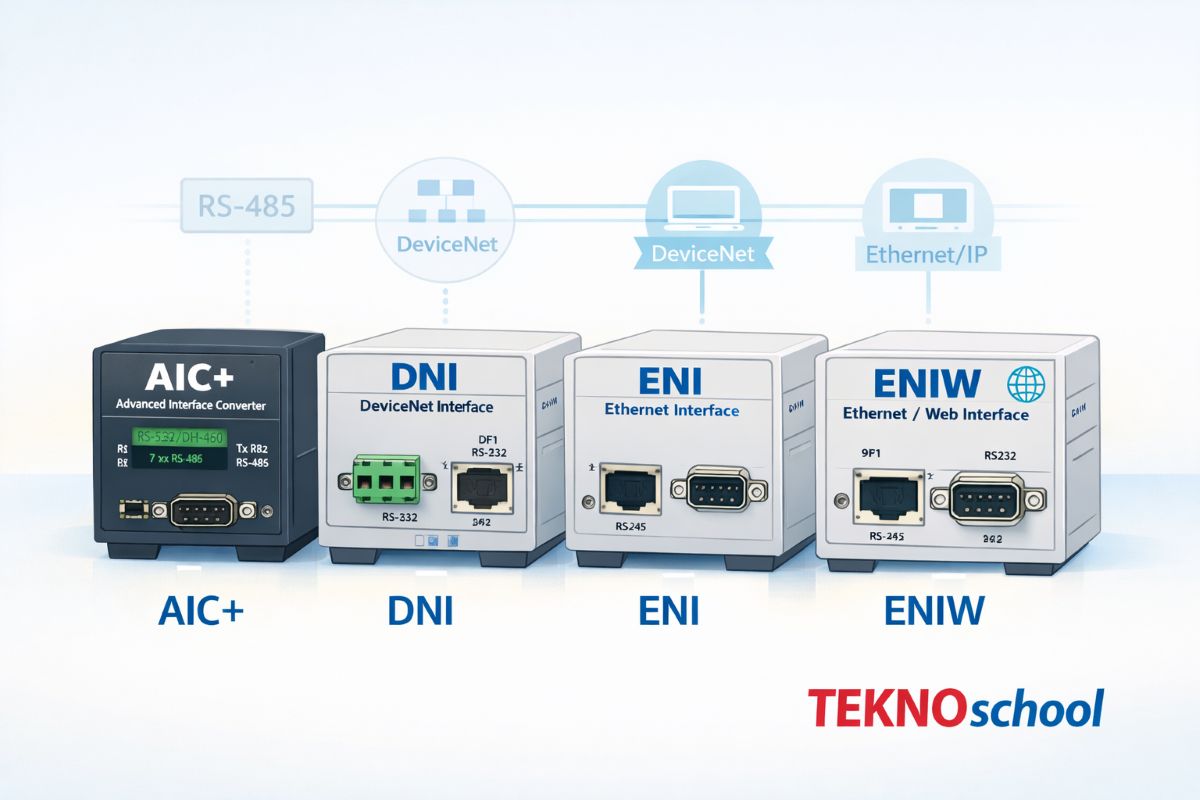
To bridge these gaps, Rockwell Automation created a set of compact yet powerful communication modules: the AIC+ Advanced Interface Converter, the DeviceNet Interface (DNI), and the Ethernet Interface / Web‑Enabled Ethernet Interface (ENI/ENIW). Each of these modules solves a specific communication challenge, and together they form a versatile toolkit for modernizing, extending, and stabilizing industrial networks.
This article takes a professional, in‑depth look at these modules — what they do, why they matter, and how they transform the communication capabilities of MicroLogix and SLC systems. The goal is to give you a clear, practical understanding that you can apply directly in the field.
🔌 AIC+ Advanced Interface Converter – The Industrial Communication Backbone
The AIC+ Advanced Interface Converter is one of the most widely used communication modules in the Rockwell ecosystem. It is designed to interconnect devices that use RS‑232, RS‑485, or DH‑485 communication. In simple terms, it acts as a translator and isolator between different serial communication standards.
Professionally speaking, the AIC+ is not just a converter — it is a protection device, a distance extender, and a network stabilizer. It ensures that communication remains reliable even in harsh industrial environments where electrical noise, ground potential differences, and long cable runs can easily disrupt signals.
What the AIC+ Enables
The AIC+ allows you to:
• Connect MicroLogix controllers to DH‑485 networks
• Convert RS‑232 signals to RS‑485 for long‑distance communication
• Isolate communication ports to protect PLCs from electrical disturbances
• Connect multiple devices in a daisy‑chain RS‑485 network
• Interface PCs, HMIs, modems, and other serial devices with controllers
This makes the AIC+ extremely valuable in plants where legacy systems coexist with newer equipment.
Why the AIC+ Is Still Relevant
Even though modern PLCs come with Ethernet ports, thousands of MicroLogix and SLC systems are still running in factories worldwide. Replacing them is expensive and often unnecessary. The AIC+ extends their life by enabling them to communicate with modern devices and networks.
Powering the AIC+
One of the clever design features of the AIC+ is its flexible power options. When connected to a MicroLogix controller through the 8‑pin mini‑DIN cable, it draws power directly from the controller. But when connected to other devices — such as a PC or another AIC+ — it can be powered using an external 24V DC supply.
This dual‑mode power design makes installation easier and reduces wiring complexity.
Wiring the AIC+ Professionally
RS‑485 wiring is often misunderstood, but when done correctly, it is one of the most robust communication methods available. The AIC+ uses a Phoenix‑style connector with terminals for shield, common, and the differential pair (A and B). Using proper twisted‑pair cable and correct termination ensures stable communication over long distances.
A professional RS‑485 network must follow these rules:
• Only the two ends of the network should have termination resistors
• Only one end of the shield should be grounded
• Cable routing must avoid high‑noise sources like VFDs
• All nodes must maintain consistent polarity
When these guidelines are followed, the AIC+ can support communication distances of several kilometers with excellent reliability.
Where the AIC+ Shines
The AIC+ is ideal for:
• Linking MicroLogix controllers to PanelView terminals
• Connecting PCs to DH‑485 networks for programming
• Creating multi‑node RS‑485 networks in OEM machines
• Isolating communication lines in electrically noisy environments
• Extending communication to remote parts of a plant
In short, the AIC+ is the unsung hero of serial communication in industrial automation.
🔗 DeviceNet Interface (DNI) – Bringing DF1 Devices into DeviceNet Networks
The DeviceNet Interface (DNI) is a specialized communication module that allows DF1‑based devices — particularly MicroLogix controllers — to participate in DeviceNet networks. DeviceNet is a widely used industrial network for distributed I/O, sensors, actuators, and controllers. It is robust, deterministic, and designed for real‑time control.
However, MicroLogix controllers do not natively support DeviceNet. This is where the DNI becomes essential.
What the DNI Does
The DNI acts as a gateway between DF1 (the serial protocol used by MicroLogix) and DeviceNet. It allows a MicroLogix controller to appear as a DeviceNet node, exchange I/O data, and send or receive explicit messages.
This capability is extremely valuable in plants where DeviceNet is still the backbone of distributed control.
Key Professional Capabilities of the DNI
• Allows MicroLogix to function as a DeviceNet slave
• Supports explicit messaging for configuration and diagnostics
• Supports I/O messaging for real‑time control
• Enables DF1 devices to communicate with DeviceNet scanners
• Provides configuration through RS‑232 or DeviceNet tools
Why the DNI Matters
Many manufacturing plants have long‑running DeviceNet infrastructures. Replacing them with Ethernet‑based systems is costly and disruptive. The DNI allows older or simpler controllers to integrate seamlessly into these networks without major hardware changes.
Real‑World Use Cases
• Integrating a MicroLogix‑based machine into a DeviceNet assembly line
• Allowing a DF1‑based device to exchange data with DeviceNet I/O blocks
• Replacing outdated DeviceNet nodes with MicroLogix controllers
• Adding diagnostic or monitoring capabilities to legacy machines
The DNI is a practical, cost‑effective solution for extending the life of DeviceNet systems.
🌐 Ethernet Interface (ENI) & Web‑Enabled Ethernet Interface (ENIW)
The Ethernet Interface (ENI) and Web‑Enabled Ethernet Interface (ENIW) are among the most transformative communication modules for MicroLogix controllers. They convert the RS‑232 port of a MicroLogix into a fully functional EtherNet/IP communication port.
This single capability opens the door to modern SCADA systems, remote monitoring, peer‑to‑peer messaging, and email notifications.
What the ENI Enables
• Uploading and downloading PLC programs over Ethernet
• Connecting MicroLogix to SCADA and HMI systems
• Exchanging messages between controllers
• Sending email alerts through SMTP
• Integrating MicroLogix into Ethernet‑based architectures
What the ENIW Adds
The ENIW includes everything the ENI offers, plus a built‑in web server. This allows engineers and operators to view live PLC data through a standard web browser.
Why ENI/ENIW Is a Major Upgrade
MicroLogix controllers were originally designed with serial communication in mind. Ethernet was not part of their architecture. The ENI/ENIW bridges this gap and brings MicroLogix into the world of modern industrial networking.
Professional Benefits of ENI/ENIW
• Faster programming and troubleshooting
• Remote access without physical presence
• Integration with enterprise networks
• Email‑based maintenance alerts
• Browser‑based monitoring without SCADA
The Power of ENIW Web Pages
The ENIW’s web server provides:
• A customizable home page
• Four data view pages
• Event logs
• Diagnostics pages
These pages allow you to monitor integers, floats, and strings directly from the controller. You can rename fields, set update intervals, and protect write operations with passwords.
This is especially useful for remote pump stations, utility systems, and unmanned installations.
Email Alerts from MicroLogix
One of the most practical features of ENI/ENIW is the ability to send email alerts. This allows a MicroLogix controller to notify maintenance teams when:
• A tank level drops
• A motor overloads
• A compressor trips
• A batch completes
• A temperature exceeds limits
This feature reduces downtime and improves response time in critical systems.
🧭 Choosing the Right Module for Your Application
Here is a professional selection guide:
• Choose AIC+ Advanced Interface Converter when you need RS‑232 to RS‑485 conversion, DH‑485 networking, or long‑distance serial communication.
• Choose DeviceNet Interface (DNI) when integrating MicroLogix or DF1 devices into a DeviceNet network.
• Choose Ethernet Interface (ENI) when you need basic Ethernet and email capabilities.
• Choose Web‑Enabled Ethernet Interface (ENIW) when you need Ethernet plus browser‑based monitoring and data pages.
This ensures compatibility, reliability, and long‑term scalability.
🏭 Real‑World Engineering Scenarios
Scenario 1
A MicroLogix 1200 must connect to SCADA over Ethernet.
Solution: ENI or ENIW.
Scenario 2
A PC must connect to a DH‑485 network for programming.
Solution: AIC+.
Scenario 3
A legacy machine must join a DeviceNet line.
Solution: DNI.
Scenario 4
A remote pump station needs browser‑based monitoring.
Solution: ENIW.
Scenario 5
Communication must run 4000 ft across a plant.
Solution: AIC+ with RS‑485.
🎯 Final Professional Insight
The AIC+, DNI, ENI, and ENIW modules may appear small, but they play a massive role in industrial communication. They extend the life of legacy systems, bridge incompatible networks, and enable modern connectivity without expensive hardware upgrades.
Understanding these modules gives automation engineers a strategic advantage. You can design smarter systems, troubleshoot faster, and integrate technologies that others consider impossible.
These devices are the silent heroes of industrial communication — and mastering them is a mark of true engineering professionalism.