Logix APC Instructions
Elevating the Loop: A Guide to Logix APC Instructions
Logix APC Instructions. For decades, the PID (Proportional-Integral-Derivative) loop has been the “reliable old pickup truck” of the automation world. It gets the job done, it’s easy to understand, and it’s everywhere. But as processes become more complex—with long dead times, multiple interacting valves, and tighter efficiency requirements—the limitations of standard PID start to show.
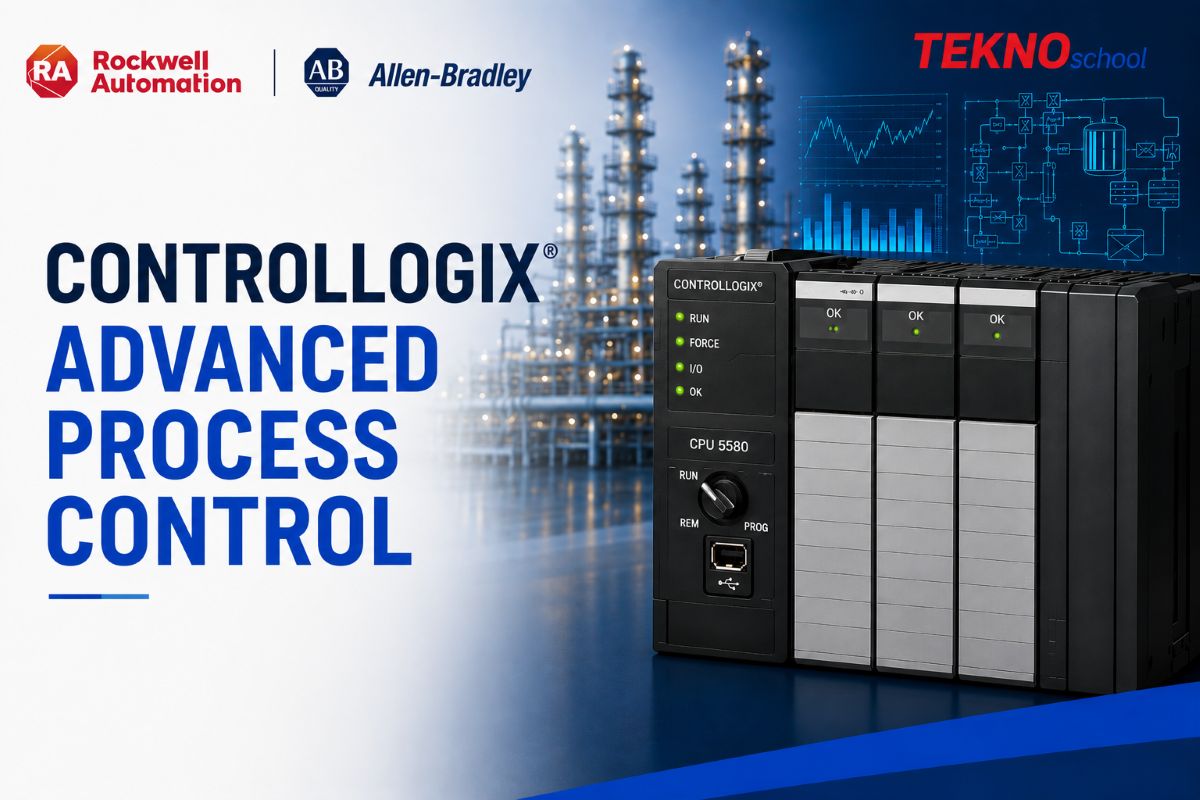
Enter Advanced Process Control (APC). Specifically, the model-based instructions are found in modern Logix-based controllers. These aren’t just faster PIDs; they are predictive engines that use a mathematical “twin” of your process to make smarter decisions.
In this blog, we’ll break down three heavy-hitters in the Logix APC library: IMC (1PV, 1CV), CC (1PV, 3CV), and MMC (2PV, 3CV).
1. IMC: The Dead-Time Slayer (1 PV, 1 CV)
The Internal Model Control (IMC) instruction is the natural evolution for a single-loop system that is driving you crazy. We’ve all seen it: a process with a massive transport delay (dead time). If you tune a PID to be aggressive, it overshoots because it hasn’t “seen” the result of its action yet. If you tune it to be stable, it’s painfully slow.
How it works:
The IMC instruction contains a built-in model of your process. When it moves the Control Variable (CV), it immediately calculates what the Process Variable (PV) should do based on that model. It then compares the real-world PV to the model’s prediction.
Superior Dead-Time Handling: Because the controller “knows” there is a delay, it doesn’t panic when the PV doesn’t move immediately.
Simplified Tuning: Instead of juggling P, I, and D gains, you often focus on a single parameter: the Response Time (or “Lambda”). It’s essentially telling the controller, “How fast do you want to reach the setpoint?”
Robustness: It is significantly more stable than a standard PID when the process lag is greater than the process time constant.
2. Coordinated Control: One Goal, Many Paths (1 PV, 3 CV)
Sometimes, one valve isn’t enough. Imagine a high-pressure header where you have a small, precise vent valve for minor adjustments, a large vent valve for big swings, and perhaps a flare for emergencies.
The Coordinated Control (CC) instruction is designed for exactly this: controlling one PV using up to three CVs.
How it works:
Instead of trying to “split-range” three different PID outputs (which is a nightmare to tune), the CC instruction manages them as a single cohesive unit. You define the hierarchy. You might want Valve A to handle the bulk of the work, while Valve B only kicks in when Valve A is at 90% capacity.
Key Features:
Prioritization: You can set “Control Limits” and “Effort” for each CV. This ensures your most efficient or cheapest asset is used first.
Seamless Transitions: As one CV hits its limit, the CC instruction smoothly ramps up the next CV without causing a bump in the process.
Constraint Management: If one of your three valves is taken offline for maintenance, the CC instruction automatically re-calculates how to use the remaining two to maintain the setpoint.
3. Modular Multivariable Control: Handling the “Cross-Talk” (2 PV, 3 CV)
This is where we move into the big leagues. In many industrial processes, nothing happens in isolation. If you increase the fuel to a boiler (CV1), it affects both the steam pressure (PV1) and the stack temperature (PV2). If you then try to adjust the air intake (CV2) to fix the temperature, you accidentally mess up the pressure. This “cross-talk” or interaction causes PID loops to fight each other, leading to constant oscillation.
The Modular Multivariable Control (MMC) instruction handles two PVs and up to three CVs simultaneously.
How it works:
The MMC uses a Matrix Model. It understands that CV1 affects both PV1 and PV2, and it accounts for those relationships in real-time. When it makes a move to fix a deviation in PV1, it simultaneously calculates the necessary adjustment to other CVs to ensure PV2 stays stable.
Why use MMC?
Decoupling: It effectively “unties” the interaction between loops. This allows the plant to run much closer to its physical limits without breaking stability.
Efficiency: By reducing oscillations, you reduce wear and tear on valves and save significantly on energy or raw materials.
Compact Sophistication: Historically, this kind of multivariable control required a separate, expensive PC-based server. Now, it lives directly on your Logix controller.
The Secret Sauce: The Step Test
You can’t just drop an IMC or MMC instruction into a routine and hit “Start.” Because these are model-based, they are only as good as the model you give them.
The implementation process always begins with a Step Test. You manually move the CV, wait, and record how the PV responds (How much did it move? How long did it take to start moving? How fast did it get there?). You then feed this data into the instruction’s configuration. Modern Logix environments often include “Autotuners” or “Data Extractors” to help build these models, but the engineering principle remains: Know thy process.
Conclusion
Moving from PID to APC is like moving from a manual typewriter to a word processor. There is a learning curve, yes, but the increase in capability is transformative.
Use IMC when your dead time is killing your PID performance.
Use CC when you have multiple valves or pumps serving a single purpose.
Use MMC when your loops are fighting each other and “stability” feels like a distant dream.
By leveraging these built-in Logix instructions, you aren’t just controlling a process—you’re optimizing it.
What’s the most “stubborn” loop in your facility that could benefit from a model-based approach?