Basics of Process Control
Welcome to the ultimate deep dive into the fascinating world of industrial automation! 🏭✨
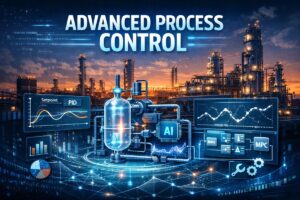
Whether you are refining oil, brewing beer, or manufacturing pharmaceuticals, Process Control is the invisible brain keeping your operations safe, efficient, and profitable. Today, we are going on a journey from the humble beginnings of basic regulatory loops all the way to the bleeding edge of AI-driven, plant-wide supervisory control (like Rockwell’s Pavilion8).
🚀 The Ultimate Guide to Process Control: From Basic Feedback to Pavilion8 MPC
🧱 Level 1: The Foundations – Basic Regulatory Control-PID control
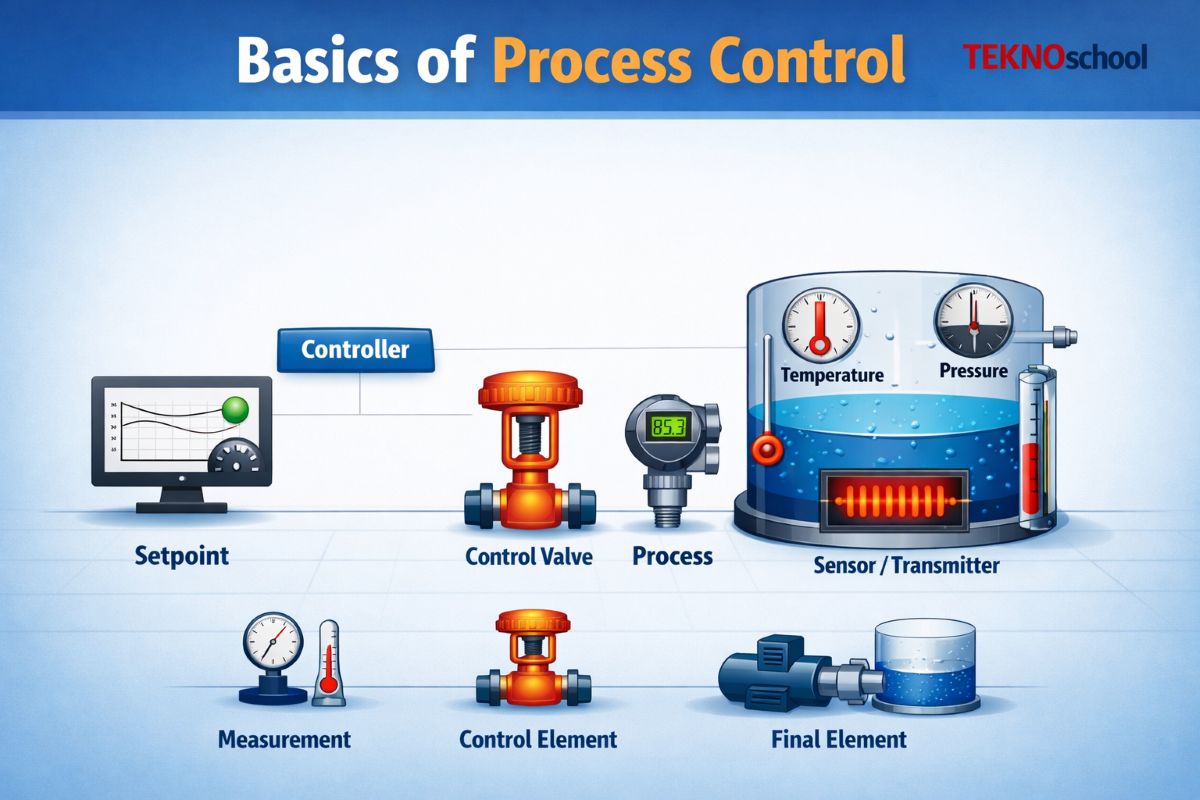
At the lowest level, we have regulatory control. Its job is simple: hold a process variable (like temperature, pressure, or flow) at a specific target (the setpoint) despite minor chaotic disturbances.
🔄 Feedback Control (The Classic)
How it works: It measures the output, compares it to the target, and calculates an error. It then adjusts the input to fix that error.
Analogy: Driving a car and looking out the windshield. If you drift right, you steer left.
The Catch: It requires an error to act. It only fixes the problem after it has already happened.
🔮 Feedforward Control (The Psychic)
How it works: It measures a disturbance before it hits the process and preemptively adjusts the control valve to cancel out the effect.
Analogy: Seeing a steep hill approaching and pressing the gas pedal before the car actually slows down.
The Catch: It can’t catch everything. It’s almost always paired with Feedback control to clean up any leftover errors.
🪆 Cascade Control (Loops within Loops)
How it works: A “Master” controller looks at the big picture (e.g., Tank Temperature) and sends its output as the setpoint to a “Slave” controller (e.g., Steam Flow valve), which reacts much faster.
Why use it? It isolates fast-moving disturbances so they don’t mess up the slower, more important main process.
⚖️ Ratio Control (The Mixologist)
How it works: Keeps two flowing streams at a precise mathematical ratio, regardless of how fast the main stream is moving.
Use Case: Blending two chemicals, or ensuring the perfect air-to-fuel ratio in a combustion furnace to prevent an explosion! 💥
📈 Level 2: Stepping It Up – Advanced Regulatory Control (ARC)
When basic PID (Proportional-Integral-Derivative) loops aren’t enough, we upgrade to ARC.
🔀 Multivariable Control (Basic)
Sometimes, changing one valve messes up three different temperatures. Multivariable control uses “Decouplers.” It mathematically breaks the invisible links between interacting variables, allowing multiple PID loops to run in harmony without fighting each other.
🧠 Level 3: The Brains – Advanced Process Control (APC)
APC is where we stop just “reacting” and start mathematically dominating the physics of the plant.
🦎 Adaptive Control
Process dynamics change. A heat exchanger gets fouled with gunk over time, or a catalyst degrades. Adaptive controllers automatically monitor these changes and re-tune themselves on the fly, ensuring peak performance year-round.
🌫️ Fuzzy & Inferential Control
Fuzzy Logic: Uses human-like rules (“If temperature is very hot and pressure is rising fast, then open valve a lot“) instead of rigid math. Great for complex, poorly understood processes.
Inferential (Soft Sensors): What if you need to control the chemical composition of a product, but the lab takes 4 hours to give you a result? Inferential control uses a mathematical model of temperatures and flows to guess the composition in real-time, creating a “virtual sensor.”
♟️ Model Predictive Control (MPC) – The Grandmaster
MPC is the undisputed king of process control. It contains a mathematical clone (model) of the entire plant inside its memory.
Linear MPC: Great for most standard refining and chemical processes. It calculates the exact moves needed for the next 50+ steps to keep all variables within their safe limits while maximizing profit.
Non-linear MPC: Used when the process physics are highly complex and curved (like aggressive chemical reactors or polymer blending).
👑 Level 4: The Overseer – Supervisory Control & Pavilion8
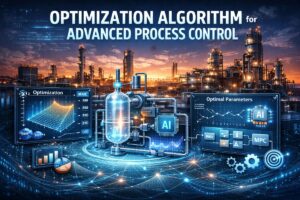
Supervisory control sits at the very top of the pyramid. It doesn’t open or close valves directly. Instead, it looks at the current market prices of electricity, raw materials, and final products, and calculates the absolute most profitable way to run the plant. It then sends those optimized targets down to the MPC and PID controllers.
🏆 Spotlight: Rockwell Automation Pavilion8®
When we talk about top-tier supervisory and APC software, Pavilion8 is a heavy hitter.
Hybrid Modeling: Pavilion8 is famous for its “Hybrid” models. It combines empirical data (neural networks that learn from historical plant data) with first principles (the actual laws of thermodynamics and physics).
The Result: It creates an incredibly robust model that knows exactly how to push the plant to its absolute physical limits without breaking anything—maximizing yield, slashing energy costs, and reducing emissions. 🌱