Thermocouple Vacuum Gauge and Thermionic Vacuum Gauge
Thermocouple Vacuum Gauge and Thermionic Vacuum Gauge
Vacuum gauges are instruments used to measure pressures below atmospheric pressure. Two important types used for low- and high-vacuum measurements are the Thermocouple Vacuum Gauge and the Thermionic Hot Cathode Ionization Vacuum Gauge.
Thermocouple Vacuum Gauge
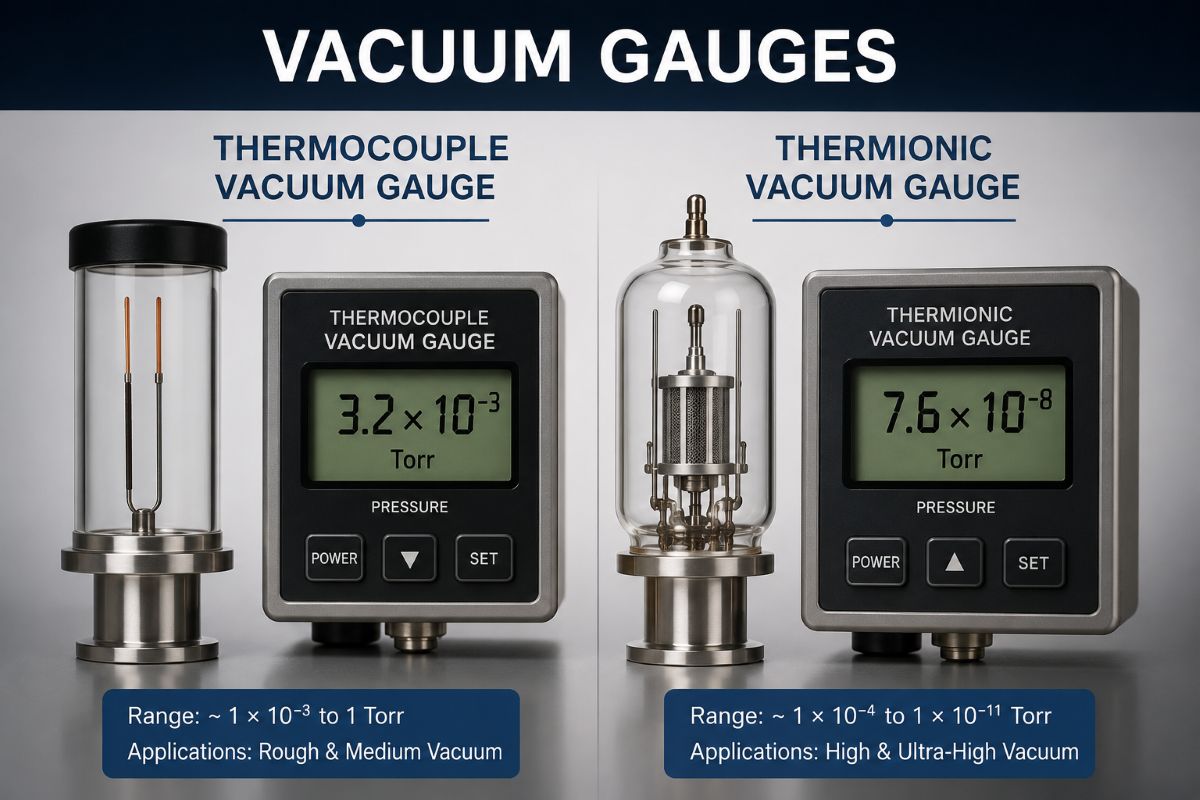
The thermocouple vacuum gauge measures low pressures by exploiting the principle that a gas’s thermal conductivity decreases as its pressure falls. It operates in the range of approximately 10⁻³ to 2 Torr.
Construction and Working
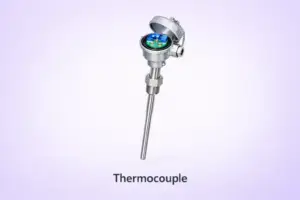
The gauge consists of a sealed envelope connected to the vacuum system. Inside, a tungsten heating filament is powered by a constant current source. A thermocouple is spot-welded directly onto the filament to continuously monitor its temperature.
At lower pressures, fewer gas molecules are present to carry heat away from the filament. As a result, the filament temperature rises. This temperature rise generates a higher thermoelectric EMF in the thermocouple, which is read by a PMMC millivoltmeter calibrated directly in pressure units.
Working Principle
Higher pressure means more gas molecules, more heat transfer, lower filament temperature, and lower EMF output
Lower pressure means fewer molecules, less heat loss, higher filament temperature, and higher EMF output
Filament current is kept constant throughout, and only temperature changes with pressure
Practical Characteristics
Gas species dependent, so a correction factor is needed for gases other than air or nitrogen
Response is slow due to the thermal mass of the filament and thermocouple assembly
The measurement range can be extended by using a thermopile (a series of thermocouples)
Rugged, simple, and low-cost design makes it suitable for industrial vacuum systems
Thermionic (Hot Cathode Ionization) Vacuum Gauge
The thermionic vacuum gauge, also known as the hot cathode ionization gauge or Bayard-Alpert gauge, measures high and ultra-high vacuum levels. It works by ionizing residual gas molecules using thermionically emitted electrons. Its useful range is approximately 10⁻³ to 10⁻⁹ Torr.
Construction and Working
A tungsten filament (cathode) is electrically heated to approximately 1800 degrees Celsius. At this temperature, the filament emits electrons by thermionic emission. These electrons are accelerated toward a helical grid (anode) held at +150 V. As electrons pass through the grid, they collide with the residual gas molecules inside the tube. Each collision ionizes a molecule into a positive ion and a free electron. The positive ions are then collected by a central ion collector electrode held at -30 V, generating a small but measurable ion current proportional to the gas pressure.
Working Principle
Higher pressure means more gas molecules, more ionization collisions, and higher ion collector current
Lower pressure means fewer molecules, less ionization, and lower collector current
Filament emission current is kept constant, and only the ion current changes with pressure
Practical Characteristics
Cannot operate above 10⁻³ Torr because excess ionization overheats and burns the filament
Below 10⁻⁹ Torr, soft X-rays produced by electron-grid collisions cause false photo-electron emission, limiting accuracy
The Bayard-Alpert design minimizes the X-ray error by using a fine wire collector inside the grid
Sensitivity is gas-species dependent, and calibration correction is required for gases other than nitrogen
Used widely in semiconductor manufacturing, surface science, and high vacuum research
Comparison Table
Both gauges are indirect pressure-measuring instruments. They do not measure the force of pressure directly but instead infer pressure from a physical property of the gas, either its thermal conductivity or its ionizability. For a complete vacuum measurement system covering the full range from atmospheric pressure down to ultra-high vacuum, these gauges are commonly used alongside Pirani gauges and Bourdon tube gauges.