Types of Industrial Valves
Industrial Valves: Types, Working Principles & Applications
(Globe, Gate, Plug, Ball, Needle, Butterfly, Diaphragm, Pinch, Check, Safety/Relief & Reducing Valves)
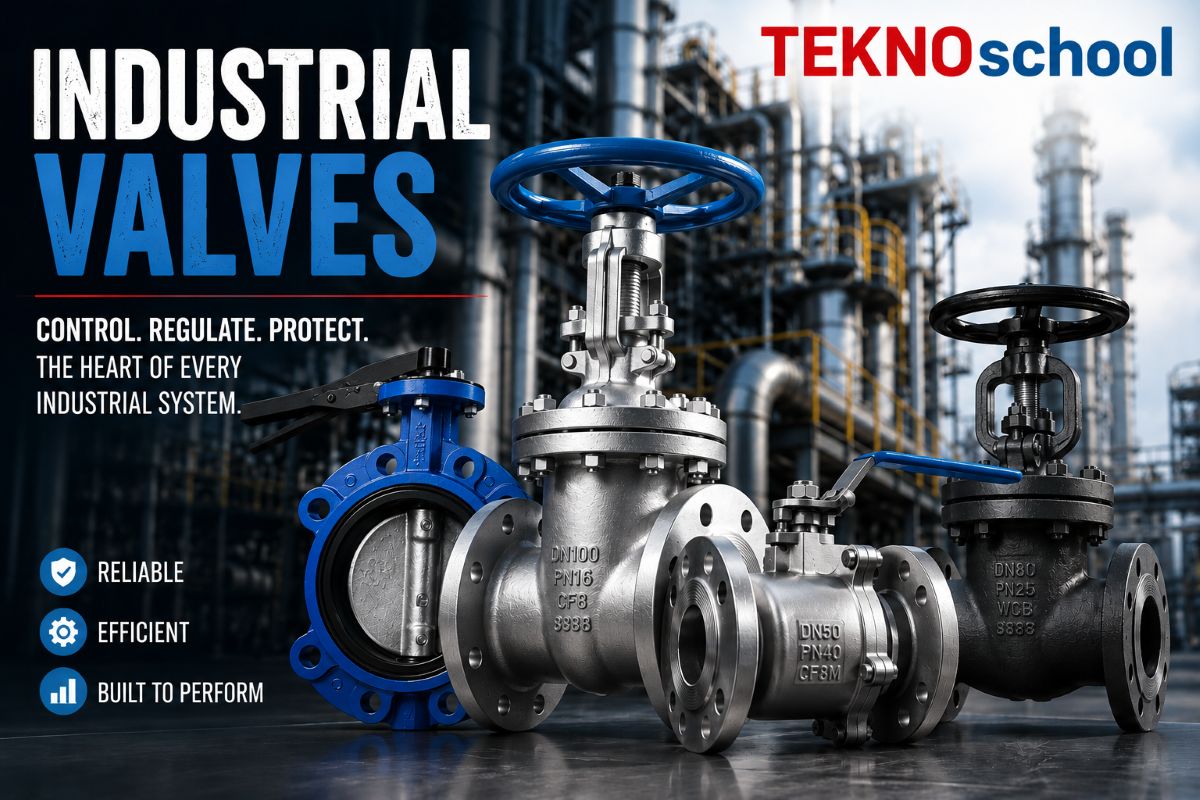
Industrial valves are the backbone of every fluid‑handling system—whether in power plants, refineries, chemical units, water treatment, or manufacturing. They regulate, isolate, throttle, protect, and direct the flow of liquids, gases, steam, and slurries. Understanding how each valve type works is essential for selecting the right one for safety, efficiency, and long‑term reliability.
1. Gate Valve
Gate valves are linear‑motion isolation valves designed for full open/full close service. They use a flat or wedge‑shaped gate that moves perpendicular to flow. When fully open, they offer full‑bore, minimal pressure drop.
Working Principle:
Turning the handwheel raises/lowers the gate via a threaded stem. Rising‑stem designs provide visual position indication.
Applications:
Oil & gas pipelines, water distribution, steam lines, fire protection, refineries.
Advantages:
- Minimal pressure drop
- Bidirectional flow
- Wide size/pressure range
Limitations:
- Slow operation
- Not suitable for throttling (causes erosion)
2. Globe Valve
Globe valves are throttling and isolation valves with a disc that moves linearly onto a seat. The flow path makes an S‑turn, enabling precise control but causing higher pressure drop.
Working Principle:
The disc moves up/down to vary the gap between disc and seat, regulating flow.
Applications:
Cooling water regulation, boiler feedwater, chemical dosing, and steam control.
Advantages:
- Excellent throttling
- Good shutoff
- Seat easily maintained
Limitations:
- High pressure drop
- Heavier than gate valves
3. Plug Valve
Plug valves are quarter‑turn isolation valves using a cylindrical or tapered plug with a hole that aligns with the flow path. They are robust, simple, and suitable for on/off and limited throttling.
Chemical plants, gas lines, corrosive services (PTFE‑lined versions).
Advantages:
- Simple design
- Quick operation
- Good for viscous fluids
4. Ball Valve
Ball valves use a rotating ball with a bore to provide bubble‑tight shutoff. They are the most widely used industrial valves due to their reliability and fast operation.
Working Principle:
A 90° rotation aligns or blocks the bore. Floating and trunnion designs suit different pressures.
Applications:
Oil & gas pipelines, LNG, chemical plants, instrument isolation.
Advantages:
- Zero leakage
- Fast quarter‑turn
- Full‑bore options
5. Needle Valve
Needle valves are precision metering valves used for fine flow control in small lines. They use a cone‑shaped needle that moves into an orifice.
Applications:
Instrumentation, sampling, calibration lines.
Advantages:
- Excellent fine control
- High accuracy
6. Butterfly Valve
Butterfly valves are quarter‑turn valves using a rotating disc to regulate or isolate flow. They are compact, lightweight, and ideal for large diameters.
Applications:
Water supply, HVAC, fire systems, and chemical service.
Advantages:
- Low cost
- Fast operation
- Suitable for DN300+
7. Diaphragm Valve
Diaphragm valves use a flexible diaphragm pressed onto a weir to stop flow. They excel in corrosive, erosive, and dirty services.
Applications:
Chemical dosing, slurry handling, wastewater, and pharmaceuticals.
Advantages:
- No contamination
- Good for corrosive media
- Leak‑tight
8. Pinch Valve
Pinch valves use a rubber sleeve that is pinched to stop flow. They are ideal for slurries and solids‑laden fluids.
Applications:
Mining, minerals, wastewater, abrasive slurries.
Advantages:
- No clogging
- Full‑bore flow
- Excellent for solids
9. Check Valve
Check valves are self‑actuated non‑return valves that prevent backflow. Flow opens the valve; reverse flow closes it.
Applications:
Pumps, compressors, pipelines, water systems.
Advantages:
- Automatic operation
- Protects equipment
10. Safety / Relief Valve
Safety and relief valves protect systems from over‑pressure by releasing excess pressure automatically. They are mandatory in boilers, pressure vessels, and high‑pressure lines.
A spring‑loaded disc lifts when pressure exceeds the setpoint and reseats when pressure drops.
Applications:
Steam, gas, air, chemical reactors, compressors.
11. Pressure Reducing Valve
Pressure-reducing valves (PRVs) automatically reduce high inlet pressure to a stable, lower outlet pressure. They are essential in steam, water, and gas distribution.
Applications:
Steam lines, water supply networks, compressed air systems.
Comparison Table of Valve Types
| Valve Type | Motion | Primary Function | Throttling | Pressure Drop | Typical Use |
|---|---|---|---|---|---|
| Gate | Linear | Isolation | Poor | Very Low | Pipelines, steam |
| Globe | Linear | Throttling/Isolation | Excellent | High | Flow control |
| Ball | Quarter‑turn | Isolation | Fair | Very Low | Oil & gas |
| Plug | Quarter‑turn | Isolation | Fair | Low | Chemicals |
| Needle | Linear | Fine control | Excellent | High | Instrumentation |
| Butterfly | Quarter‑turn | Isolation/Control | Good | Low | Water, HVAC |
| Diaphragm | Linear | Isolation | Good | Medium | Corrosive fluids |
| Pinch | Linear | Slurry isolation | Poor | Low | Slurries |
| Check | Self‑actuated | Non‑return | N/A | Low | Pumps |
| Safety/Relief | Self‑actuated | Over‑pressure protection | N/A | N/A | Boilers |
| Reducing | Self‑actuated | Pressure regulation | N/A | Medium | Steam/water |
Conclusion
Industrial valves are diverse, each engineered for a specific purpose—whether isolation, throttling, non‑return, or safety. Selecting the right valve requires understanding flow characteristics, pressure class, media type, actuation needs, and maintenance requirements. With the right choice, plants achieve higher safety, efficiency, and reliability.