International Electrical Safety standards
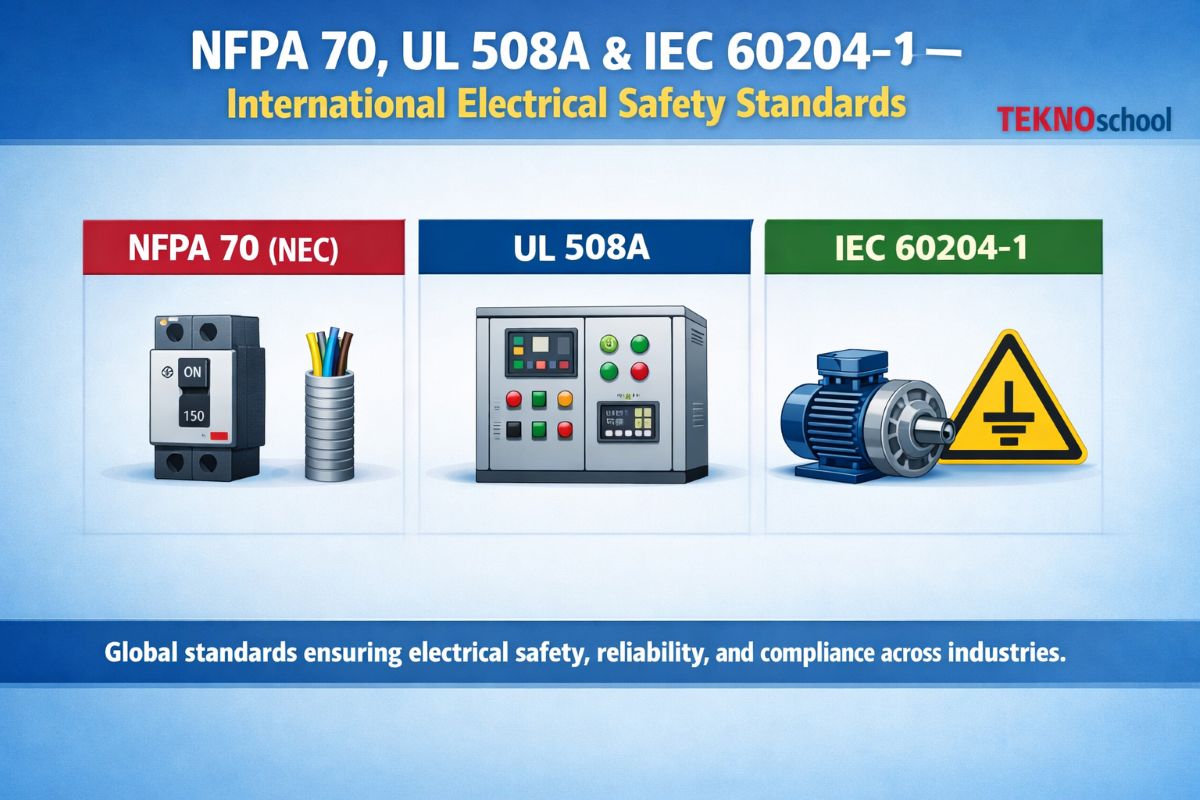
The world of industrial engineering is a web of complex acronyms and numeric designations. To the uninitiated, a list like NFPA 70, UL 508A, and IEC 60204-1 looks like a confusing soup of alphabet blocks. To an engineer, however, these are the guardrails of civilization, Electrical Safety standards. They ensure that the factory floor doesn’t become a lightning hazard, that the control panel in a Canadian brewery is as safe as one in a Texas refinery, and that workers go home to their families at the end of the shift.
In this deep dive, we will unpack the “Big Eight” of electrical and automation standards, exploring how they interact to create a global framework for safety and performance.
🌎 The Foundation: National Electrical Codes
NFPA 70 (National Electrical Code – NEC)
In the United States, NFPA 70 is the “Bible” of electrical work. Published by the National Fire Protection Association, the NEC governs the safe installation of electrical wiring and equipment.
Scope: Residential, commercial, and industrial buildings.
Focus: It dictates how power enters a building, how it is grounded, and how circuits are protected by breakers.
Key Concept: If you are running conduit through a factory wall to a machine, you are in NFPA 70 territory.
CSA C22.1 (Canadian Electrical Code – CEC)
North of the border, the CEC performs the same function as the NEC. While the two codes are increasingly harmonized, the CEC remains the definitive legal standard in Canada.
Differences: Subtle but critical differences exist in conductor ampacity calculations, grounding requirements, and the “Rule of Six” for service disconnects.
Compliance: Compliance with C22.1 is mandatory for any installation to be passed by a Canadian provincial inspector.
🏗️ The Build: Industrial Control Panels
Once power reaches the machine, it enters a control panel. This is where the “brains” of the operation live (PLCs, VFDs, and relays). Two standards reign supreme here.
UL 508A (Standard for Industrial Control Panels – USA)
If you build a control panel in the US, it generally needs a UL 508A label to satisfy inspectors.
SCCR (Short Circuit Current Rating): This is the most famous part of UL 508A. It requires builders to calculate the maximum “fault current” the panel can withstand without exploding or causing a fire.
Component Listing: Every component inside—from the wire to the terminal block—must be UL-recognized or listed.
CSA C22.2 No. 14 (Industrial Control Equipment – Canada)
This is the Canadian counterpart to UL 508A. It specifies the requirements for control equipment like motor starters and switches.
The “Rule of Equivalent”: In many cases, equipment certified to UL standards is accepted in Canada if it bears the “cUL” mark, but C22.2 No. 14 remains the specific technical standard for domestic manufacturing.
🤖 The Machine: Safety of Machinery
A machine is more than just a box of wires; it’s a moving, breathing entity. These standards govern the electrical equipment on the machine itself.
NFPA 79 (Electrical Standard for Industrial Machinery)
If NFPA 70 covers the building, NFPA 79 covers the machine sitting on the floor.
Operator Interface: It defines how Emergency Stops (E-Stops) must behave. For example, an E-Stop must be a “self-latching” mushroom head that is red on a yellow background.
Color Coding: It mandates specific wire colors (e.g., Red for AC control circuits, Blue for DC control circuits).
IEC 60204-1 (Safety of Machinery – International)
While NFPA 79 is primarily North American, IEC 60204-1 is the global gold standard used in Europe and much of Asia.
Harmonization: Thankfully, NFPA 79 and IEC 60204-1 have grown very similar over the last decade.
PELV vs. SELV: IEC 60204-1 places heavy emphasis on “Protective Extra-Low Voltage” (PELV) to ensure that control circuits are safe for operators to touch under fault conditions.
🛡️ The Human Element: Occupational Safety
Equipment can be perfectly designed, but humans are prone to error. This is where safety standards for work practices come in.
NFPA 70E (Standard for Electrical Safety in the Workplace)
NFPA 70E is designed to prevent two things: Electric Shock and Arc Flash.
The Arc Flash Boundary: It establishes distances that unqualified personnel must stay away from energized equipment.
PPE Categories: It defines what level of fire-resistant (FR) clothing a technician must wear based on the incident energy of a potential arc flash.
💾 The Digital Thread: Metadata Standards
IEEE 1685-2002 (IP-XACT)
Moving away from high-voltage cables and into the world of silicon, we find IEEE 1685. This might seem like the odd one out, but it is vital for modern automation.
The Purpose: Known as IP-XACT, this is an XML schema for describing electronic Intellectual Property (IP).
Why it matters: As machines get “smarter” with System-on-Chip (SoC) technology and FPGAs, IEEE 1685 allows different hardware components from different vendors to talk to each other through a standardized metadata format. It is the “software blueprint” that allows the digital components of a control system to integrate seamlessly.
⚖️ Comparison Table: Which Standard Do You Need?
| Category | US Standard | Canadian Standard | International |
| Building Installation | NFPA 70 (NEC) | CSA C22.1 (CEC) | IEC 60364 |
| Control Panels | UL 508A | CSA C22.2 No. 14 | IEC 61439 |
| Machine Wiring | NFPA 79 | CSA C22.2 No. 301 | IEC 60204-1 |
| Worker Safety | NFPA 70E | CSA Z462 | ISO 45001 |
🎯 Conclusion: The Unified Theory of Compliance
In modern engineering, you cannot simply choose one standard. A project might require you to:
Design a chip using IEEE 1685.
Integrate it into a control panel following UL 508A.
Wire that machine according to NFPA 79.
Install it in a facility following NFPA 70.
Maintain it safely using NFPA 70E protocols.
When these standards work together, they create a “safety stack.” This stack reduces liability for manufacturers, insurance costs for owners, and most importantly, risk for the people working on the front lines of industry.
The next time you see a “UL” sticker or a “Certified to CSA” stamp, remember that it represents thousands of pages of collective wisdom, all working to keep the lights on and the world turning safely.