Voltage Stability
Basic Concept of Voltage Stability
Introduction
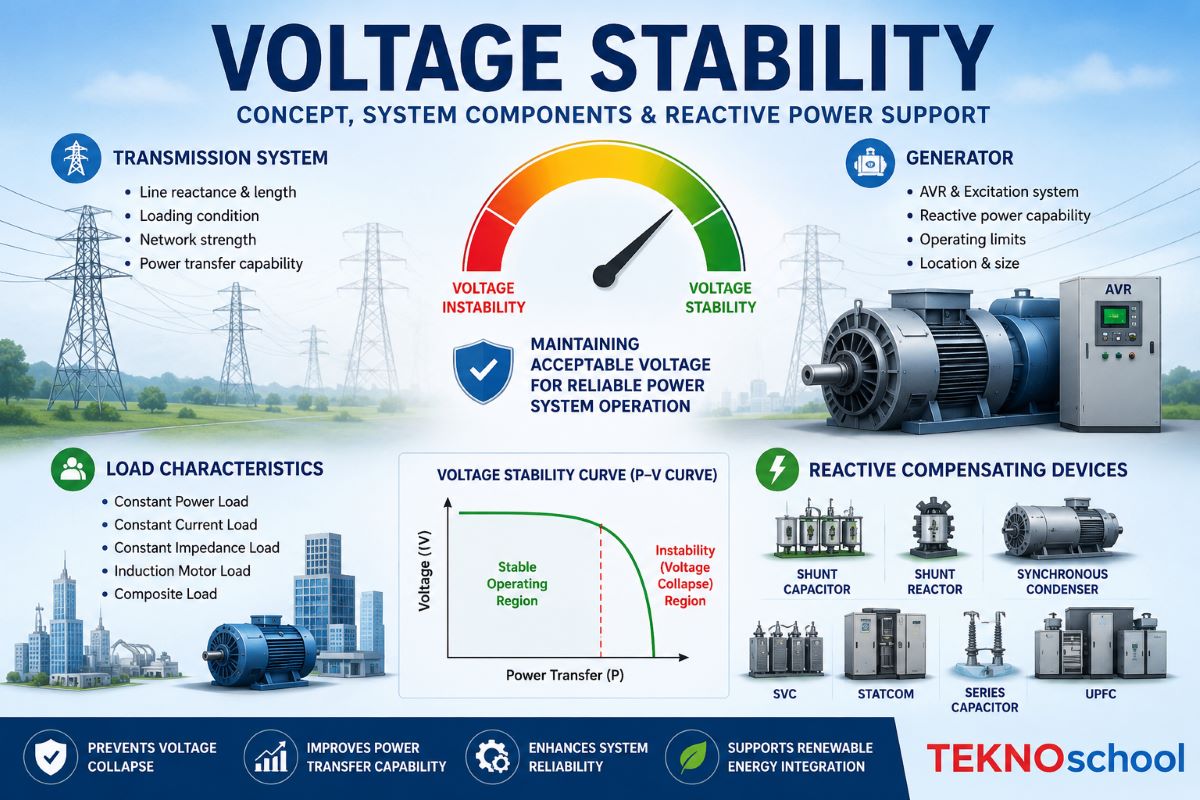
Voltage stability is one of the most important aspects of power system security and reliable operation. It refers to the ability of a power system to maintain acceptable voltage levels at all buses under normal operating conditions and after being subjected to disturbances. A power system is considered voltage stable if, following a disturbance or gradual increase in load, the voltages throughout the system remain within acceptable limits and eventually settle to a steady-state value.
With the continuous growth of electricity demand, long-distance power transmission, and increasing integration of renewable energy sources, maintaining voltage stability has become more challenging. Voltage instability can result in progressive voltage decline, equipment malfunction, transmission line overloading, and even widespread power system blackouts. Therefore, understanding the concepts of voltage stability and the characteristics of generators, transmission systems, loads, and reactive power compensation devices is essential for planning and operating modern electrical power systems.
Basic Concept of Voltage Stability
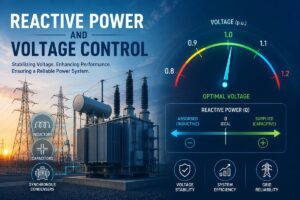
Voltage stability is primarily associated with the balance between reactive power generation and reactive power consumption within a power system. Unlike active power, which performs useful work, reactive power is essential for maintaining the magnetic and electric fields required by generators, transformers, motors, and transmission lines.
When the reactive power demand exceeds the available reactive power supply, bus voltages begin to decrease. If corrective measures are not taken, the voltage continues to decline, eventually leading to voltage collapse.
Voltage stability depends on several factors, including:
- Availability of reactive power sources
- Transmission network strength
- Generator excitation capability
- Load characteristics
- Transmission line loading
- Reactive power compensation
- Transformer tap settings
- System operating conditions
Voltage stability can be categorized into two types:
1. Small-Disturbance Voltage Stability
This refers to the ability of the system to maintain voltage following small changes such as:
- Gradual load increase
- Minor switching operations
- Routine generation changes
The analysis is generally performed using steady-state models.
2. Large-Disturbance Voltage Stability
This concerns the system’s ability to maintain acceptable voltages following severe disturbances such as:
- Three-phase faults
- Generator tripping
- Transmission line outages
- Large load rejection
The analysis requires dynamic simulation because voltage varies rapidly with time.
Importance of Reactive Power in Voltage Stability
Reactive power directly influences system voltage. When reactive power is insufficient:
- Bus voltage decreases.
- Transmission line current increases.
- Power losses increase.
- Generator field current rises.
- System stability margin decreases.
Conversely, adequate reactive power support:
- Maintains bus voltage.
- Improves power transfer capability.
- Reduces transmission losses.
- Enhances system reliability.
- Prevents voltage collapse.
Thus, reactive power management is the key to voltage stability.
Transmission System Characteristics Related to Voltage Stability
The transmission network plays a major role in determining voltage stability because it transfers both active and reactive power from generating stations to load centers.
1. Transmission Line Reactance
Every transmission line has inductive reactance that consumes reactive power.
Long transmission lines require significant reactive power, especially under heavy loading conditions.
Higher reactance results in:
- Larger voltage drop
- Increased reactive power demand
- Reduced voltage stability margin
Reducing line reactance improves voltage stability.
2. Line Length
Long transmission lines have:
- Greater impedance
- Higher voltage drop
- More reactive power absorption
Therefore, long-distance transmission systems require reactive power compensation at intermediate substations.
3. Transmission Line Loading
As loading increases:
- Current increases.
- Reactive power losses increase.
- The voltage drop becomes larger.
Heavily loaded transmission lines are more vulnerable to voltage instability.
4. Network Strength
A strong transmission network has:
- Multiple transmission paths
- Low impedance
- High short-circuit capacity
Strong networks maintain voltage more effectively than weak networks.
Weak networks experience greater voltage fluctuations during disturbances.
5. Power Transfer Capability
Maximum transferable power is limited by:
- Thermal limit
- Stability limit
- Voltage limit
In many practical systems, voltage stability becomes the limiting factor before thermal limits are reached.
Generator Characteristics Related to Voltage Stability
Generators are the primary sources of reactive power in power systems.
Their capability to support voltage depends on several characteristics.
1. Automatic Voltage Regulator (AVR)
The AVR continuously controls generator excitation to maintain terminal voltage.
When system voltage decreases:
- AVR increases field current.
- Internally generated voltage increases.
- More reactive power is supplied.
Fast-response AVRs significantly improve voltage stability.
2. Excitation System
Modern static excitation systems respond within milliseconds.
Advantages include:
- Fast voltage recovery
- Improved reactive power support
- Better dynamic performance
A strong excitation system enhances both transient and voltage stability.
3. Generator Reactive Power Capability Curve
Every synchronous generator has operating limits.
It cannot continuously supply unlimited reactive power because of:
- Rotor heating
- Stator current limit
- End-region heating
These limits are represented by the generator capability curve.
Operating beyond these limits may damage the generator.
4. Generator Operating Point
Generators operating near their reactive power limit have limited capability to support voltage.
Maintaining adequate reactive power reserve improves voltage stability.
5. Generator Location
Generators located close to load centers provide more effective voltage support than remote generators because reactive power cannot be transmitted efficiently over long distances.
Load Characteristics Related to Voltage Stability
Load behavior significantly affects voltage stability because different types of loads respond differently to voltage changes.
1. Constant Power Load
Examples:
- Electronic loads
- Adjustable speed drives
These loads attempt to maintain constant power.
When voltage decreases:
- Current increases.
- Reactive power demand increases.
Such loads worsen voltage instability.
2. Constant Current Load
These loads maintain approximately constant current.
Power decreases as voltage decreases.
Their impact on voltage stability is moderate.
3. Constant Impedance Load
Examples:
- Electric heaters
- Incandescent lamps
Power decreases with voltage.
These loads naturally reduce demand during voltage drops and therefore improve voltage stability.
4. Induction Motor Loads
Induction motors consume significant reactive power.
During voltage reduction:
- Slip increases.
- Current increases.
- Reactive power demand rises sharply.
Large industrial motor loads are one of the primary causes of voltage instability.
5. Composite Loads
Actual power system loads consist of:
- Residential loads
- Commercial loads
- Industrial loads
- Electronic equipment
- Motors
- Lighting
Composite load models are used in modern stability studies because they more accurately represent real system behavior.
Characteristics of Reactive Compensating Devices Related to Voltage Stability
Reactive compensation devices provide local reactive power support and help maintain voltage within permissible limits.
They improve the voltage profile, reduce transmission losses, and increase system stability.
1. Shunt Capacitors
Shunt capacitor banks supply reactive power locally.
Characteristics:
- Increase the bus voltage
- Reduce reactive power flow
- Improve power factor
- Reduce transmission losses
- Economical
- Simple construction
Limitations:
- Reactive output decreases when voltage decreases.
- Stepwise operation.
2. Shunt Reactors
Shunt reactors absorb excess reactive power during light-load conditions.
Characteristics:
- Prevent overvoltage
- Improve voltage regulation
- Reduce the Ferranti effect
They are mainly installed on long EHV transmission lines.
3. Synchronous Condensers
A synchronous condenser is a synchronous machine operating without mechanical load.
Characteristics:
- Generates or absorbs reactive power
- Continuous voltage control
- High overload capability
- Supports short-circuit strength
- Improves voltage stability
Disadvantages:
- High maintenance
- Higher operating cost
4. Static VAR Compensator (SVC)
An SVC uses thyristor-controlled reactors and switched capacitors.
Characteristics:
- Fast response
- Smooth reactive power control
- Improved voltage regulation
- Oscillation damping
- Increased transmission capability
Widely used in transmission substations.
5. STATCOM (Static Synchronous Compensator)
STATCOM is a voltage source converter-based FACTS device.
Characteristics:
- Extremely fast response
- Supplies rated reactive power even at low voltage
- Excellent voltage regulation
- Compact size
- Better performance than SVC under weak system conditions
STATCOM is highly effective for improving voltage stability.
6. Series Compensation
Series capacitors reduce transmission line reactance.
Characteristics:
- Increase power transfer capability
- Improve the voltage profile
- Reduce voltage drop
- Increase stability margin
Series compensation indirectly supports voltage stability by reducing reactive losses.
7. Unified Power Flow Controller (UPFC)
UPFC is the most versatile FACTS controller.
Characteristics:
- Controls voltage
- Controls power flow
- Controls line impedance
- Provides reactive power support
- Improves both transient and voltage stability
UPFC offers the highest flexibility among FACTS devices.
Comparison of Reactive Compensating Devices
| Device | Reactive Power Function | Response Speed | Voltage Stability Improvement |
|---|---|---|---|
| Shunt Capacitor | Supplies reactive power | Slow | Moderate |
| Shunt Reactor | Absorbs reactive power | Slow | Moderate |
| Synchronous Condenser | Supplies and absorbs reactive power | Moderate | High |
| SVC | Dynamic reactive power control | Fast | High |
| STATCOM | Dynamic reactive power control | Very Fast | Very High |
| Series Capacitor | Reduces line reactance | Fast | High |
| UPFC | Controls voltage, impedance, and power flow | Very Fast | Excellent |
Methods for Improving Voltage Stability
Several techniques are employed to improve voltage stability in modern power systems:
- Installation of shunt capacitor banks
- Use of STATCOM and SVC for dynamic reactive power compensation
- Generator excitation control using fast AVRs
- Installation of synchronous condensers
- Series compensation of transmission lines
- Proper transformer tap changer settings
- Reactive power planning and optimization
- Load shedding during emergency conditions
- Network reinforcement by adding new transmission lines
- Wide Area Monitoring Systems (WAMS) for real-time voltage monitoring
Conclusion
Voltage stability is a fundamental requirement for the secure and reliable operation of modern power systems. It is primarily governed by the balance between reactive power generation and reactive power demand. The transmission system, generator capability, load characteristics, and reactive compensating devices all play crucial roles in maintaining acceptable voltage levels under both normal and disturbed operating conditions. Transmission networks with low reactance, generators equipped with fast excitation systems, and loads with favorable voltage characteristics contribute positively to voltage stability. Modern reactive compensation devices such as SVCs, STATCOMs, synchronous condensers, and UPFCs provide rapid and effective voltage support, enhancing system reliability and increasing power transfer capability. As electrical grids continue to expand and integrate renewable energy sources, efficient voltage stability assessment and reactive power management remain essential for preventing voltage collapse and ensuring continuous, secure, and economical power system operation.