High‑Voltage Direct Current HVDC Systems for Modern Grid Infrastructure
⭐ High‑Voltage Direct Current HVDC Systems for Modern Grid Infrastructure
• Introduction to HVDC and Its Growing Importance
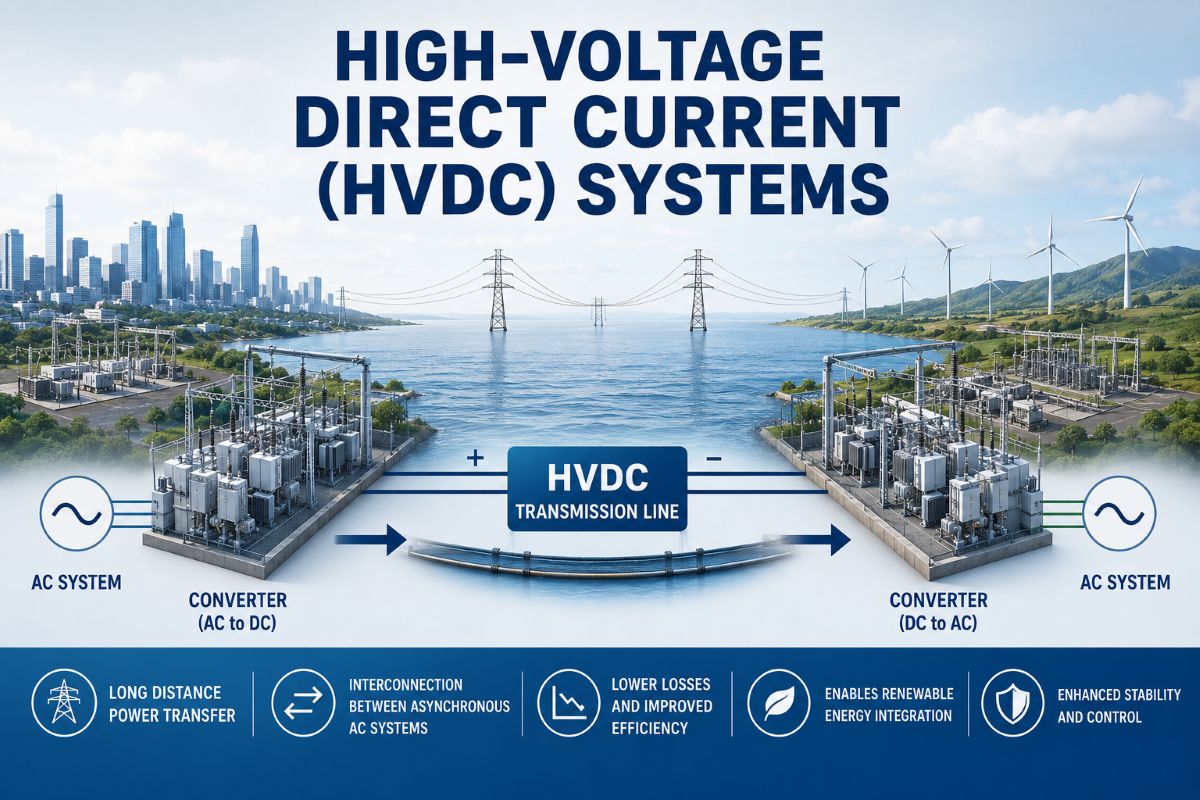
High‑Voltage Direct Current HVDC systems have become the backbone of long‑distance and bulk‑power transfer in modern electrical networks. While High‑Voltage AC continues to dominate regional distribution, the growing need for intercontinental power exchange, renewable integration, and ultra‑long‑distance transmission has elevated HVDC to strategic importance. Its ability to deliver controlled power flow, reduce transmission losses, and interconnect asynchronous grids makes it indispensable for the next generation of global energy infrastructure.
• Why HVAC Falls Short Over Long Distances
HVDC technology addresses several inherent limitations of HVAC systems. Over long distances, AC transmission suffers from reactive power flow, high charging currents, and the skin effect, all of which contribute to increased losses and reduced efficiency. HVDC eliminates these issues, allowing power to be transmitted with significantly lower losses and without the need for intermediate reactive compensation. This advantage becomes particularly evident beyond 600 kilometers for overhead lines and between 50 and 80 kilometers for submarine cables, where HVDC is economically superior to HVAC. The absence of reactive power flow also grants system operators precise control over active power transfer, enabling enhanced stability, improved damping of oscillations, and the ability to support black‑start operations.
• Role of Converter Stations in HVDC Systems
At the core of every HVDC installation lies the converter station, a sophisticated assembly of converter transformers, valve halls, harmonic filters, smoothing reactors, and advanced control systems. The converter transformer plays a pivotal role by providing galvanic isolation, voltage transformation, and the phase‑shifting necessary for harmonic cancellation. HVDC systems employ 12‑pulse converter configurations, created by combining a star–star transformer with a delta–star transformer to achieve a 30‑degree phase shift. This arrangement effectively cancels the 5th and 7th harmonics while significantly reducing the 11th and 13th harmonics, thereby improving overall power quality.
• Multi Pulse Converter Systems
Typically, 24‑pulse converter systems are used with two 12‑pulse groups with a 15‑degree displacement. This configuration neutralizes harmonics up to the 23rd order, drastically reducing the size and cost of AC harmonic filters. The resulting improvement in grid compliance and reduction in station footprint make 24‑pulse systems particularly attractive for large‑scale HVDC corridors.
• Harmonic Challenges and AC Filtering Requirements
Despite the inherent harmonic reduction achieved through multi‑pulse converter arrangements, residual harmonics must still be addressed to protect grid stability and ensure compliance with international standards. On the AC side, utilities install tuned band‑pass filters to target specific lower‑order harmonics, while high‑pass damped filters are used to mitigate higher‑frequency components. These filters also contribute reactive power support to the AC network.
• DC Side Smoothing Reactors and Their Functions
On the DC side, large smoothing reactors are placed in series with the transmission line to reduce current ripple, prevent discontinuous conduction during light‑load conditions, and limit the rate of current rise during fault events. These reactors are essential for maintaining stable converter operation and protecting the system during transients.
• Overview of HVDC Link Topologies
The topology of the DC link plays a crucial role in determining the reliability, cost, and operational flexibility of an HVDC system. Monopolar links, which use a single conductor with earth or sea return, offer a low‑cost entry point but are limited in power capacity and may pose corrosion risks to nearby infrastructure. Bipolar links, which employ both positive and negative conductors, have become the industry standard due to their inherent redundancy. In the event of a pole failure, the system can continue operating in monopolar mode using earth return, maintaining up to 50 percent of the power transfer capability. Homopolar links, which use multiple conductors of the same polarity with earth return, offer high reliability and lower insulation requirements, making them suitable for specific applications where continuous operation is critical.
• Back‑to‑Back HVDC Stations for Asynchronous Grids connection
Back‑to‑back HVDC stations represent a unique topology in which the rectifier and inverter are housed within the same facility, eliminating the need for a transmission line. These installations are particularly valuable for interconnecting asynchronous grids or networks operating at different frequencies. They provide a controlled interface that enhances grid stability, facilitates international power trading, and isolates disturbances between interconnected systems.
• Economic Considerations and Cost Structure
The economic viability of HVDC systems is influenced by the high capital cost of converter stations, which include complex transformers, valve halls, cooling systems, and extensive filtering infrastructure. However, these costs are offset by the significantly lower cost of HVDC transmission lines, reduced losses, and the elimination of reactive power compensation. Over long distances, the overall lifecycle cost of HVDC becomes substantially lower than that of HVAC. Additionally, HVDC lines require narrower right‑of‑way corridors and smaller tower structures, further reducing environmental and land‑use impacts.
• Technical Challenges in HVDC Deployment
Despite its advantages, HVDC technology faces several engineering challenges. One of the most significant is the difficulty of interrupting DC faults. Unlike AC systems, DC networks lack natural current zero‑crossings, causing fault currents to rise extremely rapidly. This necessitates the use of specialized HVDC circuit breakers, which are technologically complex and expensive. The development of reliable and cost‑effective DC breakers is essential for the expansion of multi‑terminal HVDC grids, which represent the future of interconnected renewable energy networks.
• Land Footprint and Multi‑Terminal HVDC Complexity
Another challenge lies in the physical footprint of harmonic filters, which occupy substantial land area despite the harmonic reduction achieved through multi‑pulse converters. Additionally, the design and operation of multi‑terminal HVDC systems require advanced control coordination, high‑speed communication, and sophisticated protection schemes capable of isolating faults within milliseconds. These requirements make multi‑terminal HVDC grids an active area of research and development worldwide.
• HVDC for Renewable Energy Integration
HVDC technology has become indispensable in several high‑impact applications. It plays a central role in integrating remote renewable energy sources such as offshore wind farms, desert solar parks, and remote hydroelectric stations into national grids. These installations are often located far from load centers, making HVDC the most efficient and reliable method of power evacuation.
• Submarine Interconnectors and Long‑Distance Cables
Submarine interconnectors represent another critical application, as HVAC cables suffer from excessive capacitive reactance and charging currents that render them impractical over long distances. HVDC cables, free from these limitations, enable intercontinental power exchange and island interconnections.
• Asynchronous Grid Interconnection and Power Trading
Asynchronous grid interconnections are another domain where HVDC excels. Back‑to‑back stations allow countries or regions with different grid frequencies or stability characteristics to exchange power safely and efficiently. This capability enhances grid resilience, supports energy markets, and enables the sharing of renewable resources across borders.
• Bulk Power Transfer Capabilities
HVDC is also widely used for bulk power transfer, with modern systems capable of transmitting between 3,000 MW and 12,000 MW over distances exceeding 2,000 kilometers. Examples include China’s ultra‑high‑voltage DC corridors, India’s ±800 kV North‑East to Agra link, and Brazil’s Belo Monte HVDC system.
• Future Trends: UHVDC and Global Supergrids
Looking ahead, the future of HVDC is closely tied to the development of global supergrids. Advancements in ultra‑high‑voltage DC technology, multi‑terminal HVDC networks, offshore HVDC hubs, and hybrid AC‑DC smart grids will enable continental‑scale power sharing and massive renewable integration. These innovations will play a pivotal role in achieving decarbonization goals, enhancing grid stability, and creating a more resilient and sustainable global energy system.
• Conclusion: HVDC as the Backbone of Tomorrow’s Grid
In conclusion, HVDC technology has evolved into a strategic pillar of modern power systems. Its unmatched efficiency, controllability, and ability to interconnect diverse energy resources make it essential for the future of global electricity networks. As nations continue to expand renewable generation and pursue grid modernization, HVDC will remain at the forefront of innovation, enabling a cleaner, more reliable, and more interconnected world.