Power System Stability
Power System Stability: Concepts and Classification
Understanding
Power System Stability, Rotor Angle, Voltage Stability, and System Classification
📌 Introduction to Power System Stability
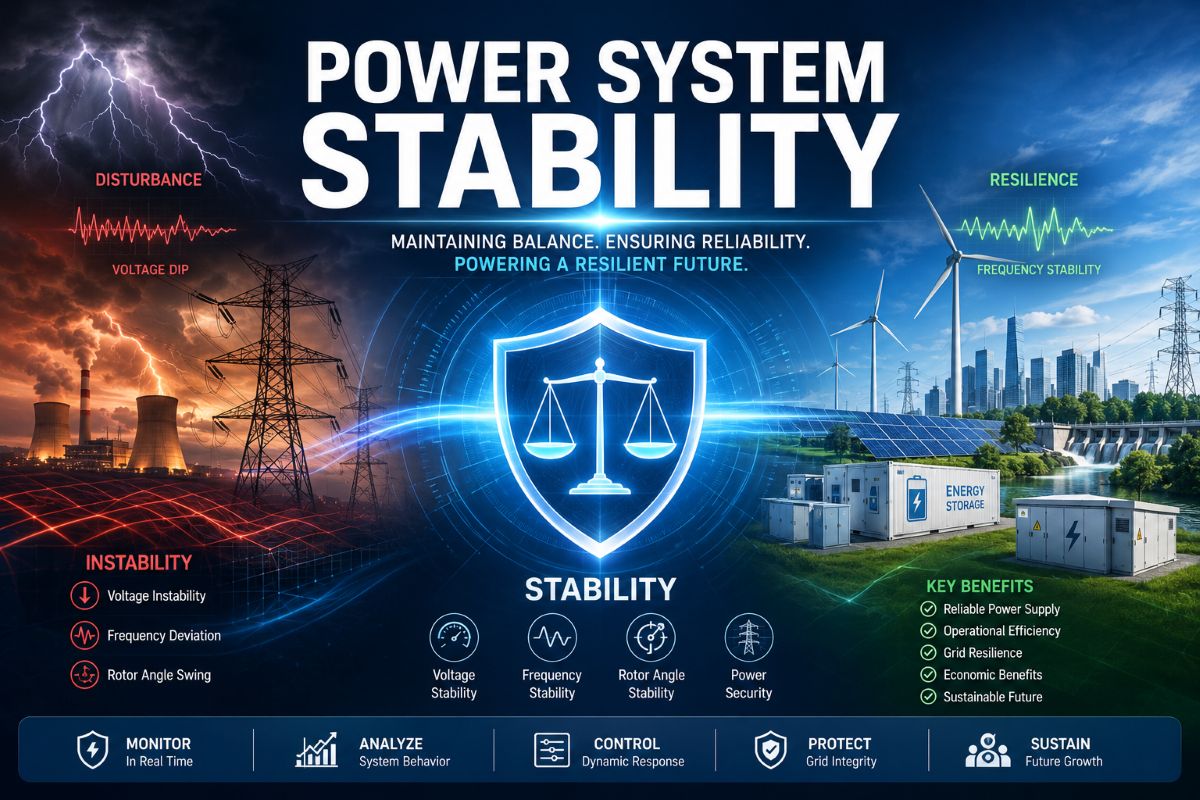
Power system stability is the ability of an electric power system to maintain synchronism and continue normal operation following a disturbance. It is a fundamental requirement for reliable and secure power system operation. In modern power systems, maintaining stability has become increasingly challenging due to growing demand, increased interconnections, and the integration of renewable energy sources.
Stability encompasses the system’s capacity to withstand sudden disturbances such as faults, loss of generation, sudden load changes, and transmission line switching without losing synchronism. A stable system returns to normal operation or reaches a new equilibrium state, while an unstable system experiences progressive deviation leading to blackouts or equipment damage.
⚡ Basic Concept of Power System Stability
The fundamental principle of power system stability relies on the balance between the electromagnetic torque produced by generators and the mechanical torque from the prime mover. When external disturbances occur—such as a sudden short circuit or load rejection—this balance is temporarily disrupted.
For a synchronous generator, the rotor speed must remain approximately constant (synchronous speed) relative to the grid frequency. The generator’s ability to restore this balance depends on:
- Inertia: The physical resistance to changes in rotor speed
- Damping: The system’s ability to dissipate energy oscillations through damping windings and load characteristics
- Restoring Forces: The automatic voltage regulators (AVR) and governor controls that help restore normal operation
🔄 Rotor Angle Stability
Definition: Rotor angle stability refers to the ability of synchronous machines in an interconnected power system to maintain synchronism following a disturbance. It is determined by the ability of each generator to restore equilibrium between the electromagnetic torque and the mechanical torque after experiencing a transient disturbance.
When a disturbance occurs, the rotor angle δ changes. The system is stable if the rotor angle remains bounded and eventually returns to a steady-state value. The stability is determined by:
- Synchronizing Torque: Proportional to sin(δ), provides the restoring force
- Damping Torque: Proportional to angular velocity deviation, dissipates energy
- Generator Inertia Constant (H): A larger H means slower rotor acceleration and better stability
⚙️ Voltage Stability and Voltage Collapse
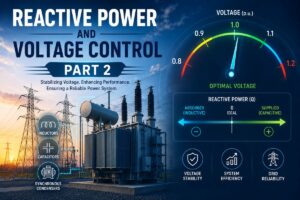
Definition: Voltage stability is the ability of a power system to maintain acceptable voltage magnitudes at all buses under normal operating conditions and after experiencing a disturbance, until equilibrium is restored.
Voltage Collapse:
Voltage collapse is an uncontrolled and steep decline in voltage magnitudes at some buses, following disturbances such as loss of generation, line outages, or a sudden increase in load demand. Unlike rotor angle instability (which occurs rapidly), voltage collapse typically develops over seconds to minutes, making it a slower process.
Mechanism of Voltage Collapse:
- Generator reactive power limits are reached
- Voltage regulators cannot increase the generator output further
- Reactive power deficit develops in the transmission network
- Reactive power from capacitors and resources depletes
- Voltage decreases uncontrollably, leading to system collapse
Voltage stability is influenced by several factors, including reactive power support, network impedance, load characteristics, and control system performance. Modern systems use reactive power resources and flexible AC transmission systems (FACTS) to maintain voltage stability.
📊 Classification of Power System Stability
1. Based on Time Scale:
Transient Stability (Immediate)
Occurs within 1-2 seconds after a disturbance. Generator rotors may swing significantly but must return to synchronous speed without losing synchronism. Examples include sudden loss of generation, major transmission line faults, or sudden load rejection.
Mid-Term Stability (5-20 seconds)
Concerns the system behavior in the 5-20 second timeframe, dominated by automatic control devices such as voltage regulators, governor controls, and power system stabilizers. It involves the interaction between generator controls and fast-acting load characteristics. Mid-term instability can occur when controls conflict or respond inadequately to prolonged disturbances.
Long-Term Stability (>20 seconds)
Occurs over longer periods (several minutes) and is primarily concerned with generator actions, including prime mover governors, load tap changer transformers, and load recovery. Long-term instability can result from generator failure to accelerate adequately or inadequate reactive power support, leading to progressive voltage decline and eventual collapse.
2. Based on Stability Type:
| Stability Type | Description |
| Rotor Angle | Ability to maintain synchronism; concerns generator rotor dynamics |
| Voltage | Ability to maintain voltage magnitudes; concerns reactive power balance |
| Frequency | Ability to maintain system frequency; related to active power balance |
🔧 Key Factors Affecting Power System Stability
- Network Configuration: Weak networks with high impedance are more prone to instability
- Generator Characteristics: Inertia constant, synchronous reactance, and excitation system strength
- Control Systems: Performance of voltage regulators, governors, and power system stabilizers
- Load Characteristics: Constant power, constant current, or constant impedance loads have different effects
- Reactive Power Resources: Availability of capacitors, synchronous condensers, and FACTS devices
- Distance Between Generators: Closer generators are generally more stable; distant generators face stability challenges
Conclusion
Power system stability is a multifaceted challenge requiring a comprehensive understanding of rotor angle dynamics, voltage control, and system-wide interactions. Engineers must consider transient, mid-term, and long-term phenomena to ensure reliable operation. With modern grids integrating renewable energy and experiencing increased stress, stability studies and advanced control strategies are more critical than ever for maintaining system security and reliability.