Flexible AC Transmission Systems
SVC, STATCOM, TCSC, and SSSC
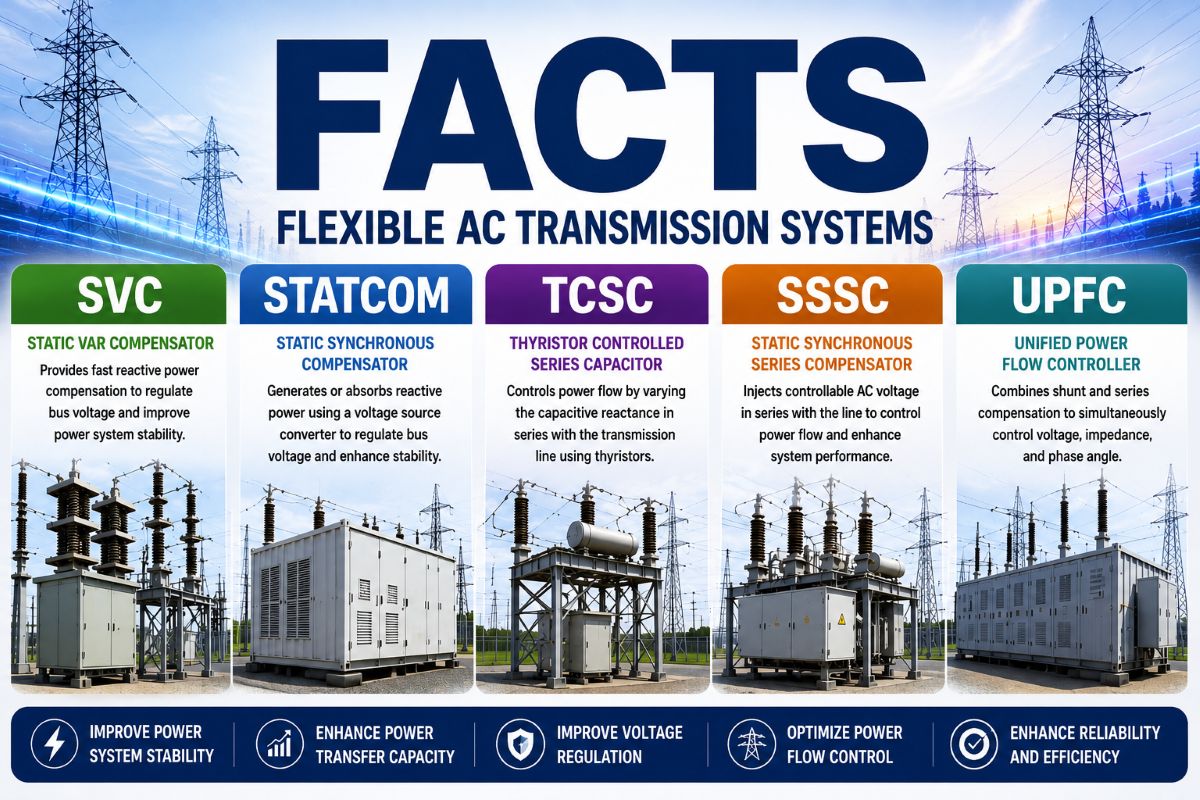
Flexible AC Transmission Systems, or FACTS, are power-electronic controllers used in AC networks to improve voltage regulation, power-flow control, stability, and transmission capacity. Among the most important FACTS devices are SVC, STATCOM, TCSC, and SSSC, which are widely used in shunt and series compensation applications.
SVC
A Static Var Compensator is a shunt-connected FACTS device used to regulate bus voltage by controlling reactive power exchange with the power system. It typically uses thyristor-controlled reactors and capacitor banks, so it behaves like a variable susceptance connected to the bus through a transformer.
SVCs are mainly applied for voltage control, flicker reduction, and reactive power compensation in weak grids and large industrial loads. When bus voltage falls, the SVC supplies reactive power; when voltage rises, it absorbs reactive power. This makes it effective, simple, and mature, although its performance degrades when the system voltage is very low.
STATCOM
A Static Synchronous Compensator is also a shunt-connected FACTS device, but unlike SVC, it uses a voltage source converter. It is connected to the AC bus through a coupling transformer, and its DC side contains a capacitor that supports converter operation.
STATCOM provides fast reactive power support, voltage regulation, oscillation damping, and improved transient and voltage stability. If the converter output voltage is higher than the system voltage, it supplies reactive power; if it is lower, it absorbs reactive power. Compared with SVC, STATCOM performs better at low voltage and in weak systems, but its cost and semiconductor complexity are higher.
TCSC
A Thyristor Controlled Series Compensator is a series FACTS device used to control the effective reactance of a transmission line. It consists of a capacitor in series with the line, while a thyristor-controlled reactor is connected in parallel with that capacitor.
By changing the thyristor firing angle, the reactor current changes, and the effective series reactance of the device is modified. TCSC is used for power-flow control, power-transfer enhancement, loss reduction, and damping of oscillations in transmission corridors. It is valuable for congestion management, but it must be designed carefully to avoid resonance and overvoltage problems.
SSSC
A Static Synchronous Series Compensator is a series-connected FACTS device based on a voltage source converter. It injects a controllable AC voltage in series with the line through a series transformer and uses a DC capacitor on the converter side.
SSSC is used for power-flow control, transient stability improvement, and oscillation damping. Its key advantage is that it can emulate inductive or capacitive reactance by injecting a series voltage in quadrature with line current, giving more flexible control than passive series compensation. Because it is converter-based, it offers fast response and precise control, though the control system is more complex than for TCSC.
Comparison
SVC and STATCOM are shunt devices, while TCSC and SSSC are series devices. In practical power systems, shunt devices are preferred for bus voltage support, and series devices are preferred for controlling line loading and transmission performance.
Conclusion
Together, these four FACTS controllers provide the core toolkit for modern transmission-system enhancement. SVC and STATCOM support voltage and reactive power, while TCSC and SSSC shape line impedance and power flow. Their use improves loadability, stability margin, damping, and reliability in stressed power networks.