Modern power plant
Modern power plant
A modern power plant is an integrated energy-conversion system built around fuel or energy input, prime movers, generators, control equipment, auxiliaries, and grid interconnection, while modern power system control keeps frequency, voltage, power flow, and reliability within permissible limits under changing load and disturbance conditions. Stability-oriented design and operation focus on adequate active/reactive reserve, strong voltage support, fast control action, and the ability to remain secure after credible disturbances.
Plant structure
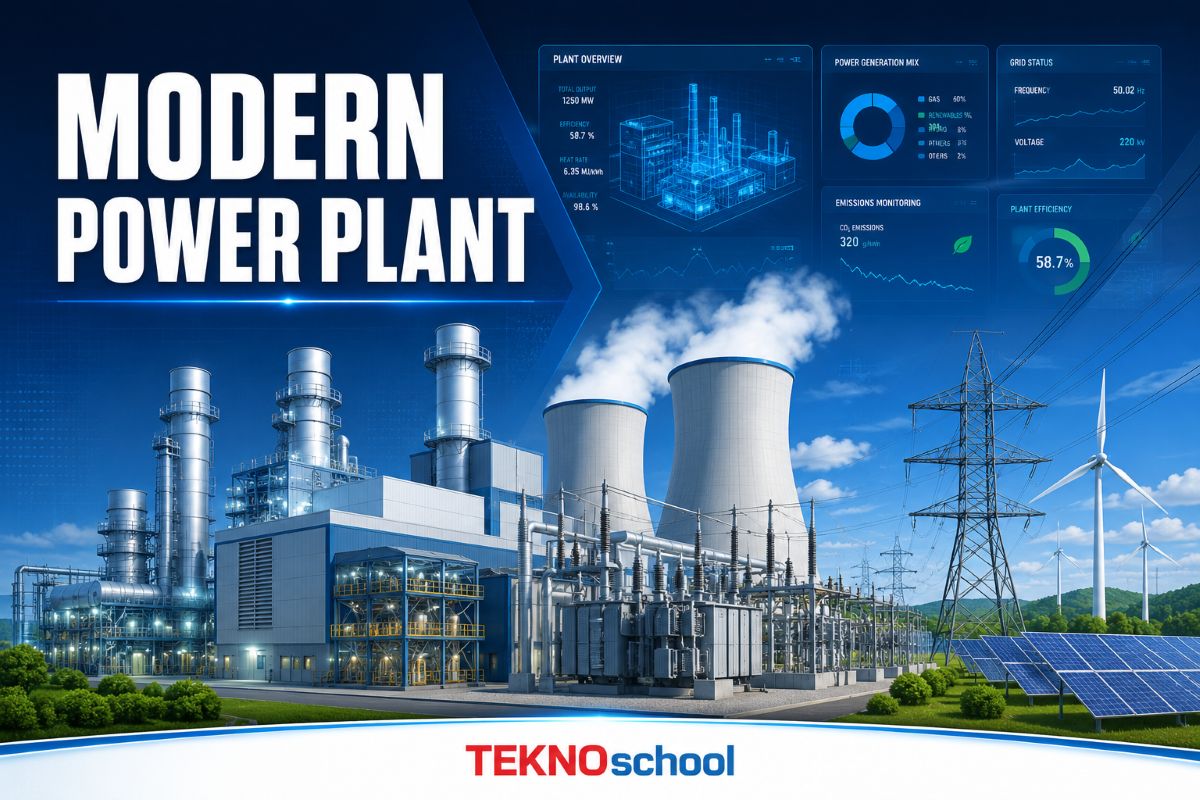
In a modern steam power plant, the main hardware typically includes the boiler with superheater, reheater, economiser, and air-heater, along with the steam turbine, generator, condenser, cooling towers, pumps, water treatment plant, control room, and switchyard. The plant layout is commonly understood through four major circuits: coal and ash circuit, air and gas circuit, feedwater and steam circuit, and cooling water circuit.
At the system level, the modern electric power structure is usually divided into generation, transmission, and distribution, with the power station feeding the grid through the switchyard and transmission network. In present practice, the plant is no longer only a thermal process block; it is also a control-rich electrical node connected to protection systems, excitation systems, communication layers, and reactive power support equipment.
Power system control
The objective of power system control is to generate and deliver power as reliably and economically as possible while maintaining voltage and frequency within permissible limits. A properly designed power system must meet continuously varying load demand, deliver acceptable power quality, maintain reliability, and satisfy safety requirements.
Control action operates at several layers. The most important functions are active power-frequency control, reactive power-voltage control, tie-line power control in interconnected systems, generator excitation control, and supervisory monitoring through coordinated devices and communications. In practical terms, governors respond to real-power imbalance and frequency deviation, while excitation and reactive compensation devices regulate voltage profile and support stability.
Design criteria
Design criteria for stability begin with the ability to meet changing active and reactive power demand through adequate reserve margins. This means the system should retain sufficient spinning reserve and reactive power capability so that generation and transmission can absorb normal load variations and withstand likely contingencies.
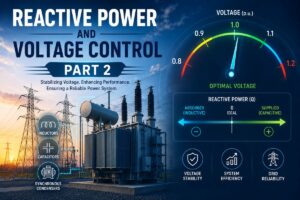
Voltage and angle stability are identified as two major modern power-system challenges. Because the network is largely reactive, weak reactive support can lead to poor voltage profile and even voltage collapse, so designers use shunt and series compensation to improve voltage profile, power-angle characteristics, damping to power oscillations, and stability margin. Devices such as SVC, STATCOM, TCSC, and SSSC are therefore important in modern grids, especially where long transmission corridors, heavy loading, or fluctuating demand exist.
Quality limits also matter in design. One source states that network frequency should be maintained within about ±3 percent of nominal value and bus voltages within about ±10 percent of nominal value, while reliability and scheduled tie-line exchange must also be maintained. These values are often taught as planning-level criteria and should be interpreted together with utility or grid-code requirements in actual projects.
Operating criteria
Operating criteria for stability are disturbance-oriented. A secure system should survive likely contingencies without unacceptable loss of synchronism, dangerous frequency deviation, severe voltage dip or rise, or protection misoperation. In operation, this requires maintaining proper loading of lines and generators, keeping adequate reactive reserve online, avoiding weak voltage conditions, and ensuring fast-acting controls remain available.
Excitation control with power system stabilizers is specifically used to damp small-signal oscillations in interconnected systems. Reactive compensation placed on transmission networks further supports operation by improving voltage profile, damping oscillations, and increasing stability margin under stressed conditions. Thus, stable operation is not achieved by one controller alone but by coordination among generation control, voltage control, protection, network compensation, and operating margins.