Linear Switched Mode and Resonant Converters
Linear, Switched-Mode, and Resonant Converters
Linear Switched Mode and Resonant Converters
Key differences, working principles, and typical applications are explained in detail.
Linear Converter (Linear Regulator)
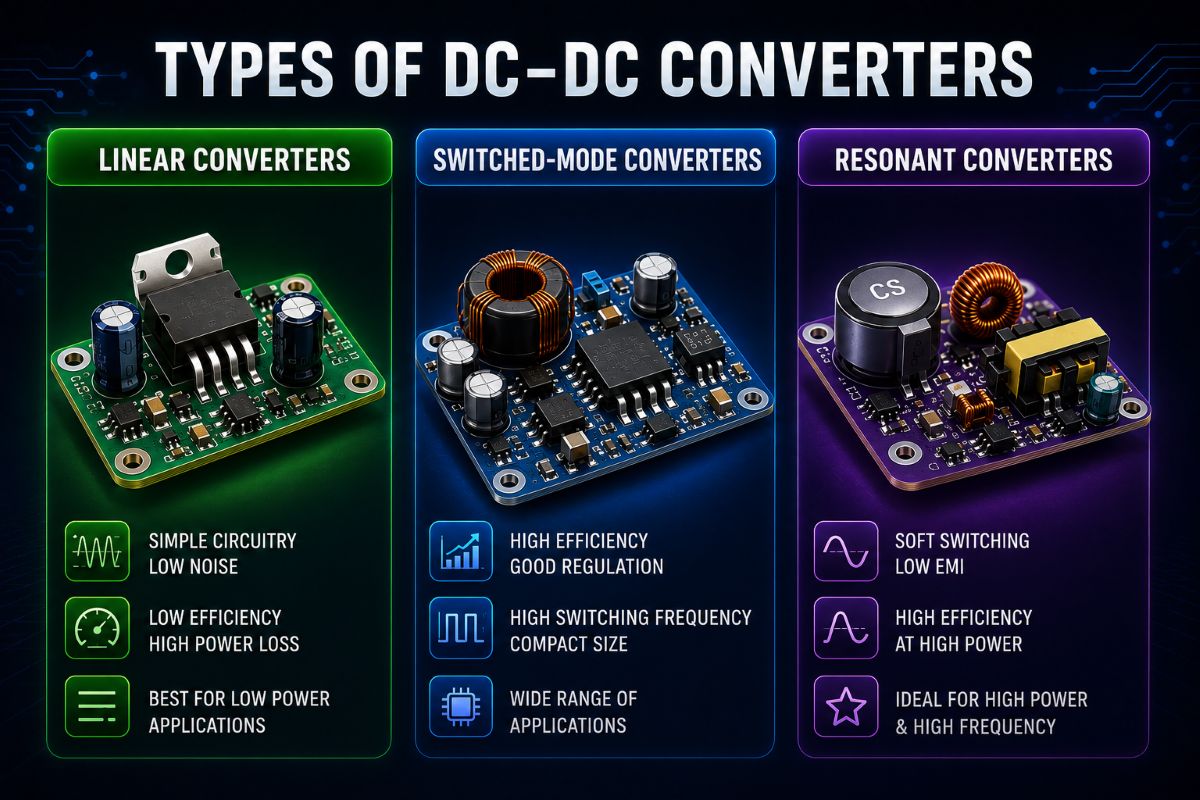
A linear power supply uses a large transformer to step down AC voltage, followed by rectification and filtering to produce a smooth DC voltage. The regulation is done by a linear control element, such as a transistor operating in its active region. The output voltage is always less than the input voltage, and the regulation is very smooth with low ripple and excellent transient response. However, the efficiency is low because the control element dissipates the excess voltage as heat. Linear supplies are heavy, bulky, and less efficient, but they provide very low noise and minimal electromagnetic interference, which makes them suitable for sensitive analog circuits and measurement systems.
Switched-Mode Converter
A switched-mode power supply (SMPS) uses high-frequency switching of power devices like MOSFETs or IGBTs to transfer energy. Instead of operating in the active region, the switch is either fully ON or fully OFF, which greatly reduces power loss. The output voltage is regulated by pulse-width modulation (PWM), where the duty cycle of the switching signal controls the average output. This allows much smaller transformers and filters, making the supply compact and efficient. Switched-mode converters are widely used in computers, mobile chargers, and industrial power supplies due to their high efficiency, high power, and light weight.
Key Differences
>Efficiency: Linear is low; SMPS is high.
>Size and weight: Linear is large and heavy; SMPS is compact and light.
>Noise: Linear has very low noise; SMPS has more switching noise and EMI.
>Regulation method: Linear uses active region control; SMPS uses PWM switching.
Resonant Converter
A resonant converter is an advanced form of switched-mode power supply that uses an LC resonant tank to achieve soft switching. Resonant converters allow the switch to turn ON or OFF when the current is zero (zero-current switching) or the voltage is zero (zero-voltage switching). This reduces switching loss and electromagnetic interference significantly and enables very high-frequency operation. The higher frequency further reduces the size of the magnetic and filter components. Resonant converters are used in high-efficiency, moderate/high power-density applications like server power supplies, LED drivers, and wireless charging systems.
Resonant Converter Types
>Series Resonant Converter (SRC): Good for fixed-load, high-frequency operation.
>Parallel Resonant Converter (PRC): Better for a wide load range, but has circulating energy.
>LLC Resonant Converter: Highly efficient, combines ZVS and ZCS, widely used in high-power DC-DC converters.
Why Resonant?
>Very low switching loss.
>Very high efficiency, often above 96%.
>Enables high-frequency operation.
>Reduces EMI and heats.
>Ideal for moderate/high power-density designs.
Summary in One Table
| Type | Efficiency | Size | Noise |
|---|---|---|---|
| Linear | Low | Large, heavy | Very low |
| Switched-Mode | High | Compact | Moderate |
| Resonant | Very high | Very compact | Very low (soft switching) |
Final Takeaway
Linear converters are simple and low-noise but inefficient and bulky. Switched-mode converters are efficient and compact but introduce more noise. Resonant converters are the most advanced form, offering very high efficiency, low noise, and moderate/high power density, making them the preferred choice for modern high-performance power electronics.