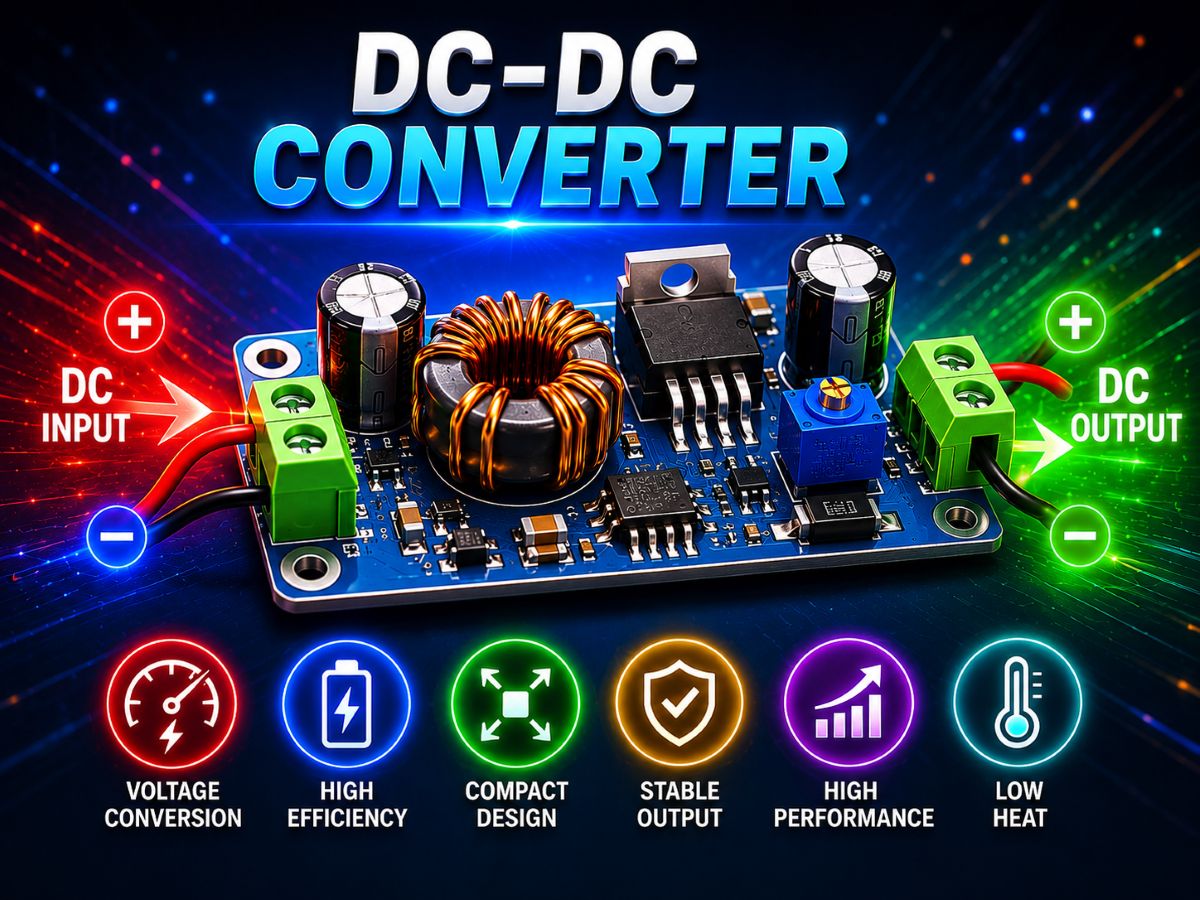
DC DC Converter
DC-DC Converter Family
DC DC Converter = Buck, Boost, Buck-Boost, Flyback, Forward, Half-Bridge, and Full-Bridge topologies explained.
Buck Regulator (Step-Down)
A buck regulator reduces the input DC voltage to a lower output DC voltage of the same polarity. When the switch is ON, the input voltage is applied to the inductor, and current increases while energy is stored. When the switch is OFF, the inductor current continues through the freewheeling diode to the load. The output voltage equals the input voltage multiplied by the duty cycle. It is widely used in on-board power supplies, microprocessors, and battery chargers.
Boost Regulator (Step-Up)
A boost regulator increases the input DC voltage to a higher output DC voltage. When the switch is ON, the inductor stores energy, and the diode is reverse-biased. When the switch turns OFF, the inductor voltage reverses and adds to the source voltage, charging the capacitor and supplying the load. The output voltage is greater than the input voltage and depends on the duty cycle.
Buck-Boost Regulator
A buck-boost regulator can produce an output voltage either higher or lower than the input voltage. It is derived from the buck-boost principle with reversed polarity at the output. When the switch is ON, energy is stored in the inductor. When OFF, the inductor releases energy with reversed polarity to the load. It is ideal for applications where input voltage varies widely, such as battery-powered systems and energy harvesting.
Flyback Converter
The flyback converter is a DC-DC topology derived from the buck-boost converter, with the inductor split to form a transformer for galvanic isolation. Energy is stored in the transformer’s magnetic field during the ON time of the switch and released to the secondary winding during the OFF time. It is simple, cost-effective, and widely used in low-power isolated supplies, such as chargers and small power adapters.
Forward Converter
A forward converter is an isolated DC-DC converter that transfers energy directly from the input to the output during the switch-on time through a transformer. Unlike the flyback, it uses an output inductor and a freewheeling diode to maintain a continuous output current. It is more efficient than flyback at higher power levels and is commonly used in medium-power isolated supplies and industrial power systems.
Half-Bridge Converter
A half-bridge converter uses two switching devices in a series configuration with a center-point connected to the transformer. It applies voltage to the transformer during both ON states of the switches. It is simpler than a full-bridge and is used in medium-power applications. The half-bridge provides good balance between complexity and performance in isolated power supplies.
Full-Bridge Converter
A full-bridge converter uses four switching devices arranged in a bridge configuration to drive the transformer. It can apply higher voltage to the transformer and handle more power than the half-bridge. The full-bridge topology is widely used in high-power isolated converters, industrial supplies, and motor drives. It provides excellent power handling with good efficiency and control flexibility.
Quick Topology Summary
>Buck: Step-down, non-isolated.
>Boost: Step-up, non-isolated.
>Buck-Boost: Step-up or step-down, non-isolated, reversed polarity.
>Flyback: Isolated, low-power, simple transformer-based.
>Forward: Isolated, medium-power, direct energy transfer.
>Half-Bridge: Isolated, medium-power, two switches.
>Full-Bridge: Isolated, high-power, four switches.