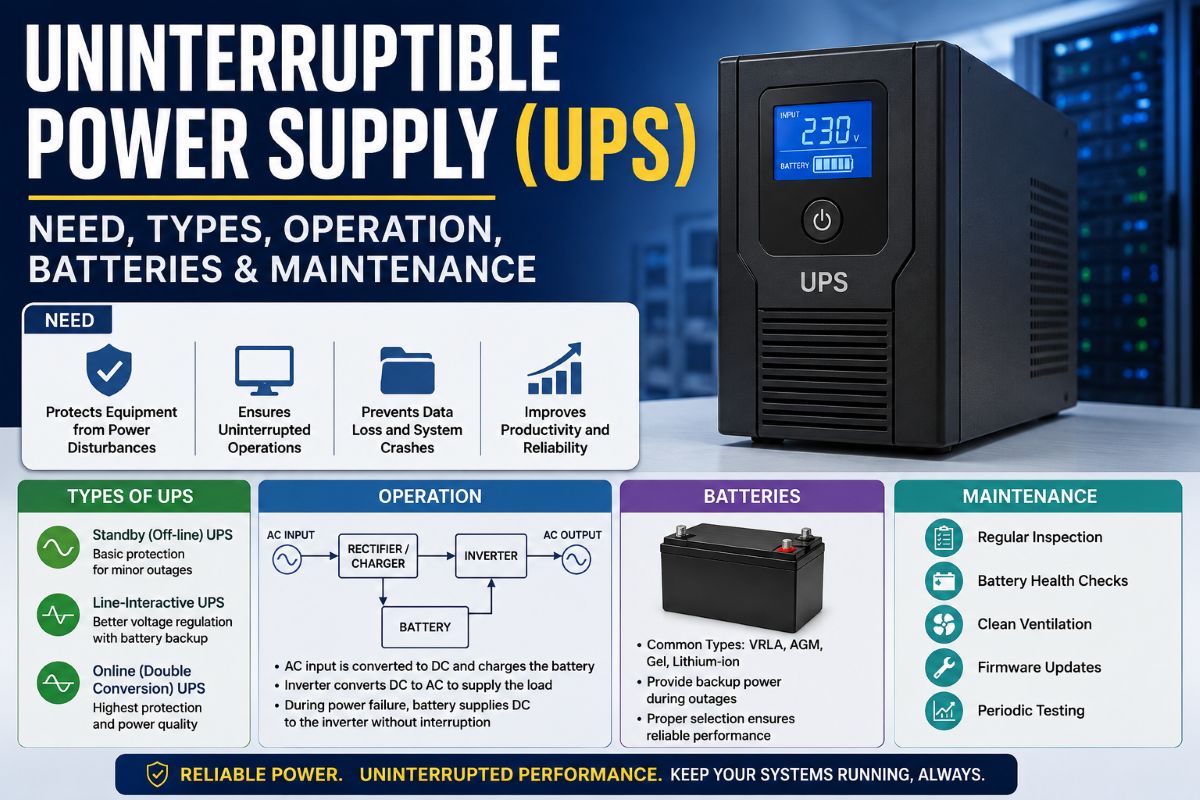
Uninterruptible Power Supply (UPS): Need, Types, Operation, Batteries & Maintenance
Uninterruptible Power Supply (UPS): Need, Types, Operation, Batteries & Maintenance
1. Need for UPS
A UPS Uninterruptible Power Supply is an essential power-conditioning and backup system designed to provide instantaneous, uninterrupted power to critical loads during mains failure, voltage fluctuations, or electrical disturbances.
Industries, IT infrastructure, hospitals, and process plants rely on UPS systems to ensure zero downtime, equipment protection, and data integrity.
Why UPS is Needed
- Power continuity — prevents shutdown of PLCs, DCS, servers, medical equipment, and communication systems.
- Voltage regulation — protects sensitive electronics from sags, surges, spikes, harmonics, and transients.
- Ride-through capability — bridges the gap until the DG set starts (typically 10–15 seconds).
- Data protection — avoids data corruption in IT and automation systems.
- Safety — ensures safe shutdown of critical equipment.
2. Types of UPS
UPS systems are broadly classified into three major categories based on topology and power flow.
1. Offline / Standby UPS
- Normal operation: Load runs directly on mains.
- In case of failure, UPS switches to the inverter within 4–10 ms.
- Suitable for: PCs, small offices, home electronics.
- Advantages: Low cost, high efficiency.
- Limitations: No isolation, switching delay, and limited protection.
2. Line-Interactive UPS
- Includes Automatic Voltage Regulator (AVR).
- Handles brownouts and overvoltage without switching to battery.
- Transfer time: 2–4 ms.
- Suitable for: SMEs, network equipment, and small servers.
3. Online Double-Conversion UPS
- Continuous conversion: AC → DC → AC.
- Zero transfer time.
- Provides complete isolation from mains disturbances.
- Suitable for: Data centers, hospitals, industrial automation, and critical loads.
- Advantages: Highest protection, stable output.
- Limitations: Higher cost, lower efficiency compared to offline.
3. Operation of UPS
The operation varies by topology, but the online double-conversion UPS is the most widely used in industrial and IT environments.
Key Components
- Rectifier — converts AC to DC and charges the battery.
- Battery bank — stores DC energy.
- Inverter — converts DC to regulated AC.
- Static switch — transfers load to bypass during overload or UPS failure.
- Bypass line — ensures continuity during UPS maintenance or a fault.
Normal Operation
- Mains AC → Rectifier → DC bus.
- DC bus → Inverter → Clean AC to load.
- The battery remains charged through the rectifier.
During Mains Failure
- The rectifier stops receiving AC.
- The battery instantly supplies DC to the inverter.
- The inverter continues supplying AC without interruption.
During Overload or UPS Fault
- Static switch transfers load to bypass within microseconds.
4. Static Switch
A static switch is a high-speed, solid-state device (SCR/IGBT-based) that ensures instantaneous transfer of load between the inverter and bypass.
Functions
- Transfers load to bypass during overload, inverter failure, or maintenance.
- Ensures no-break transfer for critical loads.
- Protects the inverter from damage due to sudden load surges.
Features
- Transfer time: < 4 ms
- Fully automatic
- No mechanical contacts → high reliability
- Synchronization with bypass supply
5. Reliability of UPS
UPS reliability depends on design, redundancy, battery health, and environmental conditions.
Factors Affecting Reliability
- Redundancy (N+1, 2N, 2(N+1))
- Quality of batteries
- Cooling and ventilation
- Load level (50–70% ideal)
- Preventive maintenance
- Environmental conditions (temperature, humidity)
Improving Reliability
- Use a modular UPS for hot-swappable power modules.
- Maintain battery room temperature at 20–25°C.
- Use SNMP monitoring for alarms and predictive maintenance.
- Perform quarterly load testing.
🔹 Hot Standby UPS
A Hot Standby UPS consists of two UPS units: one actively supplying the load and the other running in energized standby mode. The standby UPS remains synchronized with the primary UPS, enabling instant, seamless transfer through a static switch during failure. This architecture improves availability, reduces downtime, and is widely used in industrial control systems, data centers, and telecom, where uninterrupted power is critical.
🔹 Parallel UPS
A Parallel UPS configuration connects multiple UPS modules to share load and provide N+1 redundancy. If one module fails, others continue supporting the load without interruption. Parallel UPS improves scalability, reliability, and fault tolerance, making it ideal for large data centers, hospitals, and mission‑critical industrial applications.
6. Batteries Used in UPS
UPS systems use different battery chemistries depending on application, cost, and lifecycle.
1. Lead-Acid Batteries
- Types: VRLA (SMF), Flooded Tubular.
- Voltage: 12 V blocks are commonly used.
- Life: 3–5 years (VRLA), 8–12 years (Tubular).
- Advantages: Low cost, widely available.
- Limitations: Heavy, sensitive to temperature.
2. Nickel-Cadmium (Ni-Cd)
- Excellent deep-discharge capability.
- Long life: 15–20 years.
- High temperature tolerance.
- Used in: Power plants, substations, and industrial UPS.
- Limitations: High cost, cadmium toxicity.
3. Lithium-Ion Batteries
- High energy density.
- Long life: 10–15 years.
- Fast charging, lightweight.
- Used in: Data centers, telecom, and modern UPS.
- Limitations: Higher initial cost.
7. Maintenance of UPS
Proper maintenance ensures long life, reliability, and safety.
UPS Maintenance Activities
- Visual inspection — dust, loose connections, fan condition.
- Thermal scanning — detect hotspots.
- Capacitor health check — replace every 5–7 years.
- Inverter/rectifier testing.
- Firmware updates.
- Load bank testing annually.
8. Maintenance of Batteries
A. Lead-Acid Battery Maintenance
- Check float voltage and equalizing charge.
- Maintain temperature at 20–25°C.
- Inspect terminals for corrosion.
- Measure specific gravity (for flooded type).
- Perform discharge test annually.
- Replace weak cells immediately.
B. Ni-Cd Battery Maintenance
- Check electrolyte level and top-up with distilled water.
- Perform periodic deep discharge to avoid memory effect.
- Inspect for vent clogging.
- Maintain proper ventilation.
C. Lithium-Ion Battery Maintenance
- Monitor BMS (Battery Management System) alarms.
- Avoid high-temperature environments.
- Ensure proper charging profile.
- No topping-up or gravity checks needed.
9. Applications of UPS
UPS systems are used wherever uninterrupted, clean power is essential.
Major Applications
- Data centers — servers, storage, networking.
- Industrial automation — PLC, DCS, SCADA.
- Hospitals — ICU, OT, imaging equipment.
- Telecom — BTS, switching centers.
- Commercial buildings — elevators, fire systems.
- Power plants — turbine control, protection relays.
- Banks & ATMs — transaction security.
- Home & office — computers, routers, CCTV.
Conclusion
A UPS is a critical component in modern electrical and automation systems, ensuring power quality, continuity, and equipment protection. Understanding its types, operation, battery technologies, and maintenance practices helps industries achieve high reliability and zero downtime.