Electronic Ballast
⚡ ELECTRONIC BALLAST
💡 What is an Electronic Ballast?
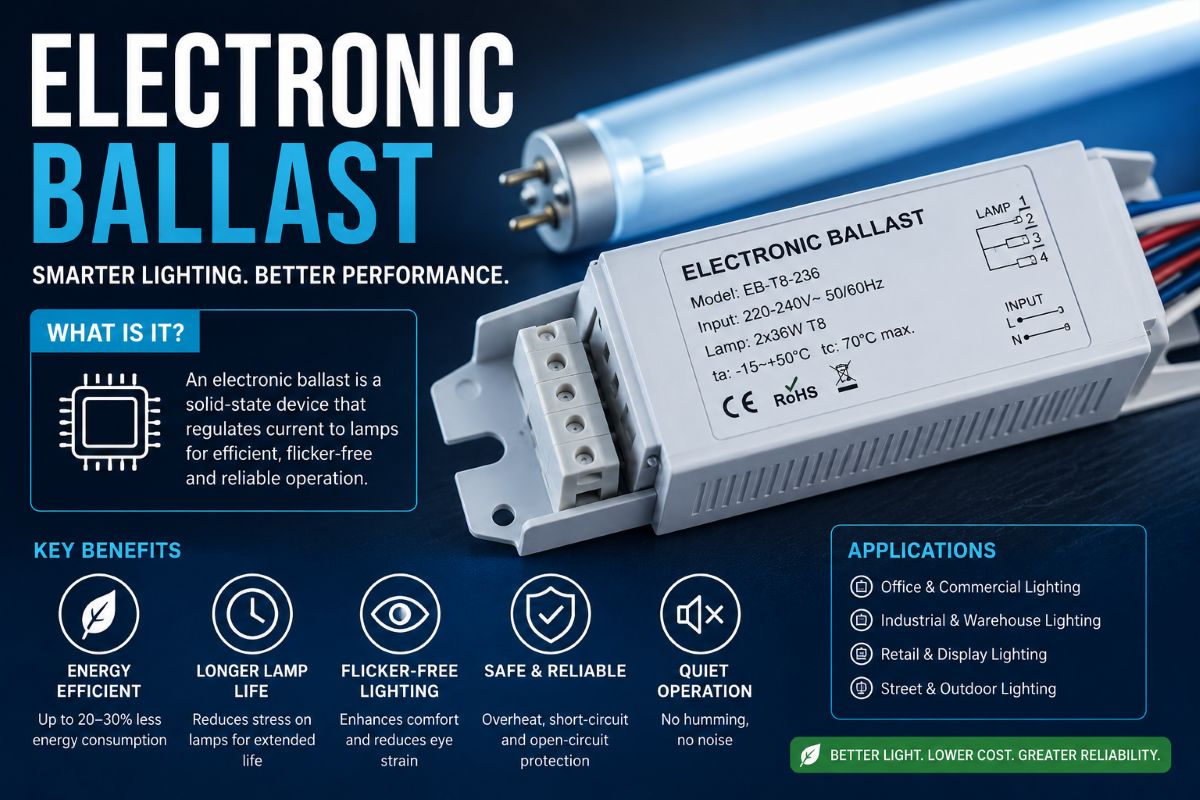
An electronic ballast is a solid-state device that regulates electrical current in fluorescent lamps. It provides the proper starting voltage and controls lamp operation during normal use.
🔧 Working Principle (6 Key Steps)
1️⃣ AC Input (230V, 50Hz)
- ⚡ Mains power enters the ballast
- 🛡️ First passes through the EMI filter for noise reduction
2️⃣ Rectification (AC → DC)
- 🔃 Bridge rectifier (4 diodes) converts AC to DC
- Creates pulsating DC voltage
3️⃣ DC Filtering
- 🟦 Capacitor smooths impure DC
- Creates a stable DC supply voltage
4️⃣ Inversion (DC → High-Frequency AC)
- 🔄 Transistors create high-frequency AC
- ⚡ Frequency: 20 kHz to 80 kHz (much higher than 50Hz mains!)
5️⃣ Voltage Step-Up
- 🔼 Step-up transformer increases voltage to 1000V
- This high voltage starts the tube lamp
6️⃣ Current Regulation
- ✅ Once the lamp glows, the voltage drops to 230V
- 🔒 Inductor limits current to a safe level
📊 Block Diagram
⚡ 230V AC → 🛡️ EMI Filter → 🔃 Rectifier → 🟦 DC Filter → 🔄 Inverter → 🔼 Transformer → 💡 Lamp
↑
└────── 📟 Control Circuit ────────────┘
↑
└────── 📟 Control Circuit ────────────┘
5 Main Blocks:
- 🛡️ EMI Filter – Reduces electromagnetic interference
- 🔃 Rectifier – AC to DC conversion
- 🟦 DC Filter – Capacitor smooths DC
- 🔄 Inverter – DC to high-frequency AC
- 📟 Control Circuit – Feedback & regulation
🆚 Electronic vs Magnetic Ballast
| Feature | Electronic ⭐ | Magnetic |
|---|---|---|
| ⚡ Efficiency | 20-33% energy saving | Lower efficiency |
| 📡 Frequency | 20-80 kHz | 50 Hz (mains) |
| 💪 Weight | Lightweight | Heavy (copper coils) |
| 📦 Size | Compact | Large |
| ❄️ Heat | Less heat | More heat |
| ✨ Flicker | No flicker | May flicker |
| ⏱️ Life | Longer service life | Shorter life |
| 🔇 Noise | Quiet operation | Humming noise |
| 🎚️ Dimming | Dimmable | Limited dimming |
✅ Advantages of Electronic Ballast
- 🌟 Energy Saving: 20-33% reduction in power consumption
- ✨ No Flicker: High-frequency operation eliminates flickering
- 🔄 Lightweight: No copper windings, smaller & lighter
- ❄️ Less Heat: Lower power losses, reduces cooling load
- 💡 Better Efficiency: 10% rise at 10 kHz frequency
- 📏 Flexible: Multiple lamps on a single ballast
- 🔇 Quiet Operation: No humming noise
- ⏱️ Instant Start: Quick lamp ignition
- 🎚️ Dimmable: Can adjust light intensity
⚠️ Disadvantages
- 💰 Higher Cost: More expensive than magnetic ballast
- 🔧 Complex Circuit: 30+ electronic components
- 🛠️ Repair Difficulty: Harder to fix if damaged
- 📡 EMI Issues: May generate electromagnetic interference
🏭 Applications
💡 Lighting Systems:
- Fluorescent tube lights (T8, T5)
- Compact Fluorescent Lamps (CFL)
- LED lighting systems
- High-intensity discharge (HID) lamps
🏢 Commercial Buildings:
- Office lighting
- Retail stores
- Shopping malls
- Hospitals
🏭 Industrial:
- Factories
- Warehouses
- Manufacturing plants
🏫 Educational:
- Schools
- Universities
- Libraries
🔬 Key Technical Details
| Parameter | Value |
|---|---|
| ⚡ Input Voltage | 230V AC |
| 📡 Input Frequency | 50-60 Hz |
| 🔄 Output Frequency | 20-80 kHz |
| 🔼 Starting Voltage | 1000V |
| ✅ Operating Voltage | 230V (after start) |
| 📏 Resonant Frequency | 60 kHz typical |
| ⚡ Energy Saving | 20-33% |
📝 Summary
An electronic ballast is a modern, energy-efficient alternative to a magnetic ballast. It operates fluorescent lamps at high frequency (20-80 kHz), providing:
- ✅ 20-33% energy savings
- ✅ No flickering effects
- ✅ Lightweight & compact design
- ✅ Longer lamp life
- ✅ Dimmable capability
Perfect for modern lighting systems in offices, homes, and industrial applications! 💡✨