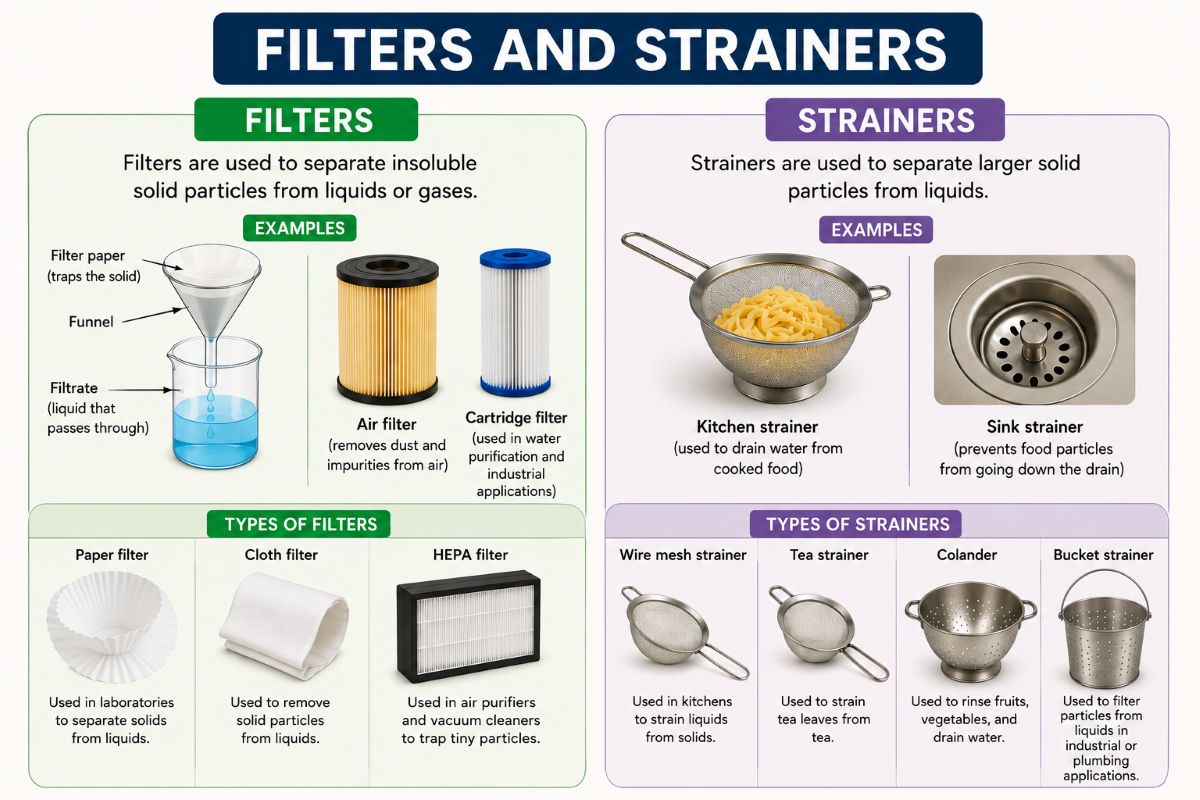
Filters & Strainers
Industrial Filters & Strainers – Cartridge, Precoated, Deep‑Bed, Bucket & Duplex Strainers (1000‑word blog)
Industrial processes depend heavily on clean, particulate‑free fluids. Whether the medium is water, fuel, oil, chemicals, or process liquids, suspended solids can cause erosion, fouling, scaling, poor heat transfer, pump damage, and product contamination. To prevent these issues, industries use a wide range of filters and strainers, each designed for specific particle sizes, flow rates, and operating conditions. Among the most widely used are cartridge filters, precoated filters, deep‑bed filters, bucket strainers, and duplex strainers. Understanding how each works helps engineers select the right equipment for reliability, efficiency, and long service life.
Cartridge Filters
Cartridge filters are compact, modular filtration units used across water treatment, chemical processing, pharmaceuticals, food & beverage, and electronics manufacturing. They consist of a cylindrical housing containing one or more replaceable filter cartridges made of polypropylene, cellulose, fiberglass, PTFE, or stainless steel mesh. These cartridges may be pleated, wound, melt‑blown, or membrane‑type, depending on the required micron rating.
Cartridge filters operate on the principle of surface or depth filtration, depending on the design. Pleated cartridges offer high surface area and low pressure drop, while depth‑type cartridges capture particles throughout the media thickness. They are ideal for fine filtration in the range of 0.2 to 100 microns.
Industries prefer cartridge filters because they are easy to replace, require no backwashing, and provide consistent filtration quality. However, they are not suitable for very high suspended solids loads, as clogging increases operating cost.
For deeper study:
- Cartridge filter working
- Pleated vs depth cartridges
Precoated Filters
Precoated filters use a layer of filter aid—typically diatomaceous earth (DE), perlite, or activated carbon—deposited on a support screen or septum. The filter aid forms a porous cake that traps fine particles as the fluid passes through. This method is widely used in sugar refining, pharmaceuticals, gelatin production, breweries, and cooling water systems.
The precoating process begins by circulating a slurry of filter aid through the filter until a uniform cake forms. During operation, additional filter aid may be continuously added (body feed) to maintain permeability and extend run time. Once the cake becomes loaded with impurities, it is discharged, and the filter is recoated.
Precoated filters excel in removing very fine particles (1–5 microns) and handling fluids with high turbidity. They also protect downstream equipment from colloidal matter that would otherwise pass through conventional filters.
Explore more:
- Diatomaceous earth filtration
- Precoating procedure
Deep‑Bed Filters
Deep‑bed filters use a thick layer of granular media—typically sand, anthracite, garnet, or multimedia combinations—to remove suspended solids through a combination of straining, sedimentation, adsorption, and flocculation. These filters are common in water treatment plants, cooling towers, desalination pre‑treatment, and industrial wastewater treatment.
As water flows downward through the media, particles are trapped at various depths, not just on the surface. This allows deep‑bed filters to handle high solids loading and achieve long filtration cycles. When the pressure drop increases, the filter is cleaned by backwashing, which expands the bed and releases trapped solids.
Multimedia filters (anthracite + sand + garnet) offer superior performance because the coarse‑to‑fine layering promotes deeper penetration of solids and longer run times.
Deep‑bed filters are ideal for removing particles in the 10–50 micron range and are often used as pre‑filters before cartridge or membrane systems.
Learn more:
- Deep bed filtration
- Multimedia filter design
Bucket Strainers (Simplex Strainers)
Bucket strainers, also known as simplex basket strainers, are mechanical devices used to remove coarse particles from pipelines. They consist of a perforated or mesh basket housed inside a pressure vessel. As fluid flows through the basket, debris is trapped, protecting pumps, valves, heat exchangers, and instrumentation.
Bucket strainers are widely used in cooling water, fuel oil, lubrication oil, chemical transfer lines, and general industrial services. They are easy to maintain—operators simply open the cover, remove the basket, clean it, and reinstall it. However, they require shutdown during cleaning, which limits their use in continuous‑operation systems.
Typical filtration levels range from 50 to 5000 microns, making them suitable for coarse protection rather than fine filtration.
Explore:
- Bucket strainer working
- Basket mesh selection
Duplex Strainers
Duplex strainers are an advanced version of bucket strainers designed for continuous operation. They consist of two strainer chambers connected by a changeover valve. When one basket becomes clogged, the operator switches flow to the standby chamber without stopping the process. The clogged basket can then be cleaned while the system remains online.
This makes duplex strainers essential in critical services such as boiler feed lines, cooling water for turbines, fuel oil systems, fire‑fighting lines, and chemical dosing systems. They are available in cast iron, carbon steel, stainless steel, and exotic alloys, depending on fluid compatibility.
Duplex strainers handle the same particle size range as simplex strainers but offer higher reliability and reduced downtime. Many modern duplex units include differential pressure gauges, quick‑opening covers, and magnetic inserts for capturing ferrous particles.
Comparing Filters & Strainers
To understand where each device fits, consider the following comparison:
| Type | Cartridge | Precoated | Deep Bed | Bucket | Duplex |
|---|---|---|---|---|---|
| Filtration Level | Fine (0.2–100 µm) | Very fine (1–5 µm) | Medium (10–50 µm) | Coarse (50–5000 µm) | Coarse (50–5000 µm) |
| Solids Handling | Low | Medium | High | High | High |
| Cleaning | Replace cartridge | Discharge cake | Backwash | Manual cleaning | Online cleaning |
| Operation | Batch | Semi‑continuous | Continuous | Intermittent | Continuous |
| Ideal Use | Polishing | High‑purity liquids | Water treatment | Equipment protection | Critical continuous service |
Conclusion
Filters and strainers play a vital role in protecting equipment, improving product quality, and ensuring smooth plant operation. Cartridge filters deliver fine filtration for sensitive processes, while precoated filters handle colloidal and ultra‑fine impurities. Deep‑bed filters manage high solids loads in water treatment, and bucket strainers provide simple, robust protection for pipelines. For uninterrupted operation, duplex strainers offer the best reliability.
Selecting the right filtration system depends on particle size, solids loading, flow rate, fluid type, and maintenance philosophy. A well‑designed filtration strategy not only reduces downtime but also extends equipment life and improves overall plant efficiency.