From Quarry to Quality Cement
🧱 Cement Manufacturing Process – From Quarry to Quality Cement
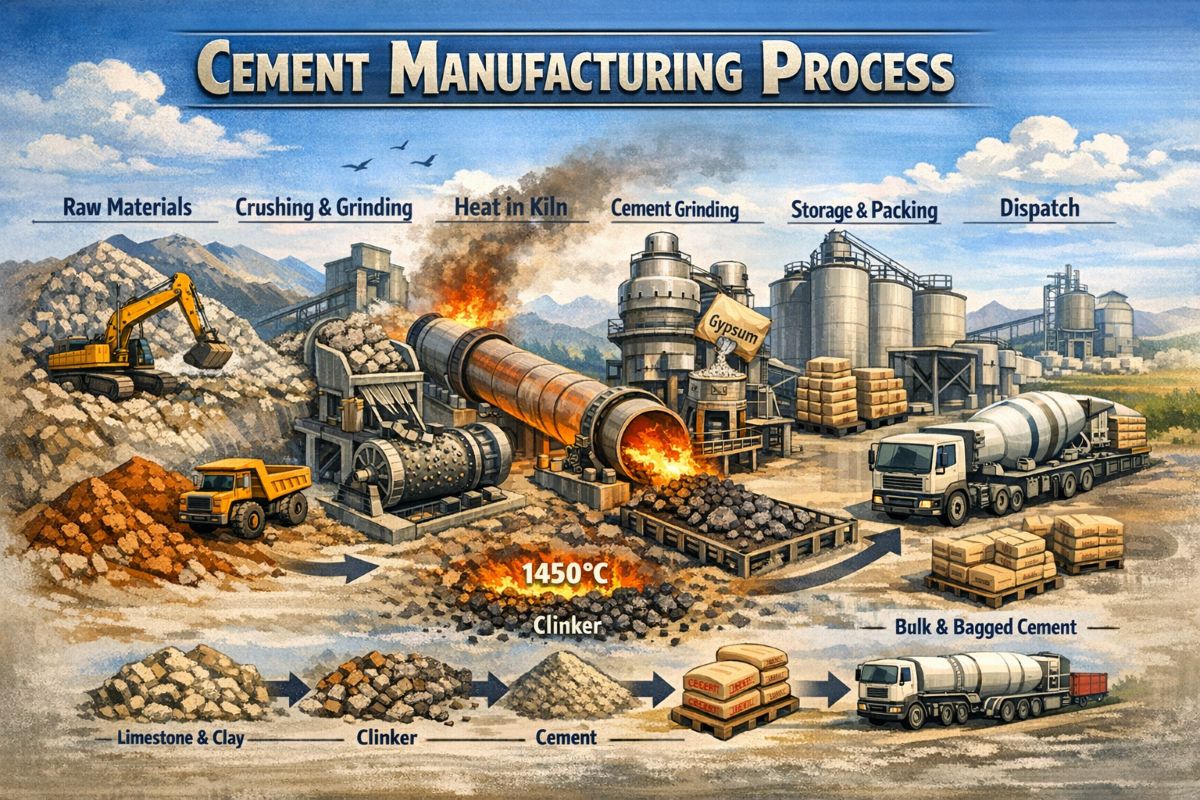
Cement is the backbone of modern infrastructure. From homes and highways to dams and skyscrapers, cement plays a crucial role in shaping the built environment. But how exactly is this essential material produced? The journey from raw rock to the fine gray powder called Portland cement is a fascinating blend of geology, chemistry, engineering, and high‑temperature industrial processing.
This blog breaks down the complete cement manufacturing process in a simple way.
⛰️ 1. Raw Material Acquisition – The Beginning of the Journey
Cement production starts with the extraction of raw materials from the earth. These materials fall into four major groups:
- Calcareous (Lime-rich): Limestone, chalk, marl
- Siliceous: Sand, clay
- Argillaceous: Shale, clay
- Ferriferous: Iron ore, mill scale
🔹 Key Activities
- Drilling & blasting
- Excavation & loading
- Crushing (primary & secondary)
- Screening & stockpiling
These materials are stored separately to allow precise proportioning later.
⚙️ 2. Raw Milling – Preparing the Perfect Raw Mix
The goal of raw milling is to achieve the correct chemical composition and fine particle size for efficient kiln operation.
🔹 Three Milling Methods
- Dry Process – Most common today
- Wet Process – Older, energy‑intensive
- Semi‑Dry Process – Pelletized feed
🔹 What Happens in Raw Milling?
- Materials are proportioned based on chemistry
- Ground to fine powder (<125 microns)
- Blended to reduce variation
- Stored as raw meal (dry) or slurry (wet)
Modern plants use vertical roller mills (VRM) for efficient grinding, drying, and classification.
🔥 3. Pyroprocessing – The Heart of Cement Manufacturing
This is where the magic happens. The raw mix enters a rotary kiln, a massive inclined rotating furnace, and undergoes a series of thermal transformations.
🔥 Temperature Zones
- Drying: ~100°C
- Preheating: 500–800°C
- Calcination: 900–1000°C (CaCO₃ → CaO + CO₂)
- Clinkering: 1400–1500°C (formation of C₃S, C₂S, C₃A, C₄AF)
- Cooling: Rapid quenching to stabilize minerals
🔥 Kiln Types
- Wet Kiln – Long, high fuel consumption
- Dry Kiln – More efficient
- Preheater/Precalciner Kiln – Modern, highly energy‑efficient
🔥 Why Such High Temperatures?
To form clinker minerals, especially tricalcium silicate (C₃S), which gives cement its strength.
🧊 4. Clinker Cooling – Recovering Heat & Stabilizing Minerals
Fresh clinker exiting the kiln is red‑hot (~1400°C). It must be cooled rapidly to:
- Preserve mineral structure
- Improve grindability
- Recover heat for reuse
🔹 Types of Coolers
🧊 Reciprocating Grate Cooler
A reciprocating grate cooler pushes clinker across a moving grate while forcing large volumes of air upward for rapid cooling. It offers excellent heat recovery and is the most widely used cooler in modern cement plants.
🪐 Planetary Cooler
A planetary cooler uses multiple tubes attached to the kiln shell, cooling clinker as it rotates with the kiln. It is compact and energy‑efficient but less suitable for high‑capacity kilns.
🔄 Rotary Cooler
A rotary cooler is a rotating drum that tumbles clinker through ambient or forced air. It is simple and robust, though less efficient in heat recovery compared to grate coolers.
🏗️ 5. Clinker Storage – Buffering for Continuous Production
Cooled clinker is transported via conveyors and bucket elevators to storage silos or covered halls.
🔹 Why Store Clinker?
- To ensure uninterrupted cement production
- To balance kiln and mill operation rates
- To maintain product quality
Plants typically store 5–25% of annual clinker output.
⚙️ 6. Finish Milling – Turning Clinker into Cement
This is the final step where clinker is ground with additives to produce cement.
🔹 Ingredients
- Clinker – 90–95%
- Gypsum – 3–5% (controls setting time)
- Additives – Fly ash, limestone, slag (optional)
🔹 Grinding Equipment
⚙️ Ball Mill
A ball mill uses rotating steel balls inside a horizontal cylinder to crush clinker into fine powder. It is reliable and versatile, but consumes more energy than modern grinding systems.
⚙️ Tube Mill
A tube mill is a longer, multi‑chamber version of a ball mill, allowing staged grinding for better particle size control. It is commonly used in older plants and paired with separators for closed‑circuit operation.
⚙️ Vertical Roller Mill (VRM)
A VRM grinds clinker using pressure‑loaded rollers over a rotating table while simultaneously drying and classifying the material. It offers superior energy efficiency and consistent product quality.
📦 7. Packing & Loading – Ready for the Market
Finished cement is conveyed to large silos and then dispatched via:
- Bulk trucks
- Rail wagons
- Barges
- 50 kg bags (for retail markets)
Modern plants use dust‑free loading spouts and fabric filters to minimize emissions.
🌫️ Pollution Sources & Controls – Keeping the Environment Safe
Cement plants generate mainly particulate emissions and combustion gases.
🔹 Major Pollutants
- Dust (PM)
- SO₂
- NOₓ
- CO₂
🔹 Control Technologies
🧽 Fabric Filters (Baghouses)
Fabric filters trap fine dust by passing gas through filter bags, achieving up to 99.9% particulate removal. They are the preferred choice in modern plants due to their high efficiency and reliability.
⚡ Electrostatic Precipitators (ESP)
ESPs use high‑voltage electrical fields to charge and collect dust particles on metal plates. They handle large gas volumes effectively but are sensitive to moisture and temperature variations.
🌀 Cyclones
Cyclones use centrifugal force to separate coarse dust from gas streams. They are typically used as pre‑collectors to reduce the load on downstream filters.
💧 Water Sprays / Wet Scrubbers
Water sprays suppress dust at transfer points, while wet scrubbers absorb particulates and gases using liquid droplets. They are effective but generate wastewater that requires treatment.
🏗️ Enclosures & Dust Suppression Systems
Enclosures, windbreaks, and chemical suppressants prevent dust from escaping during handling and storage. These methods are essential for controlling fugitive emissions in quarries and material yards.
♻️ Waste Co‑Processing – Turning Waste into Energy
Cement kilns are excellent for the safe destruction and reuse of waste materials.
🔹 Benefits
- Energy recovery
- Material recovery
- Reduced landfill burden
- Lower fossil fuel use
🔹 Waste Types Used
- Liquid industrial waste
- Used oils
- Tyre‑derived fuel (TDF)
- Biomass
- Sludges with metals or organics
🔚 Final Thoughts
The cement manufacturing process is a remarkable combination of natural materials, high‑temperature chemistry, and precision engineering. From quarrying limestone to producing the final bag of cement, every step is optimized for quality, efficiency, and sustainability.