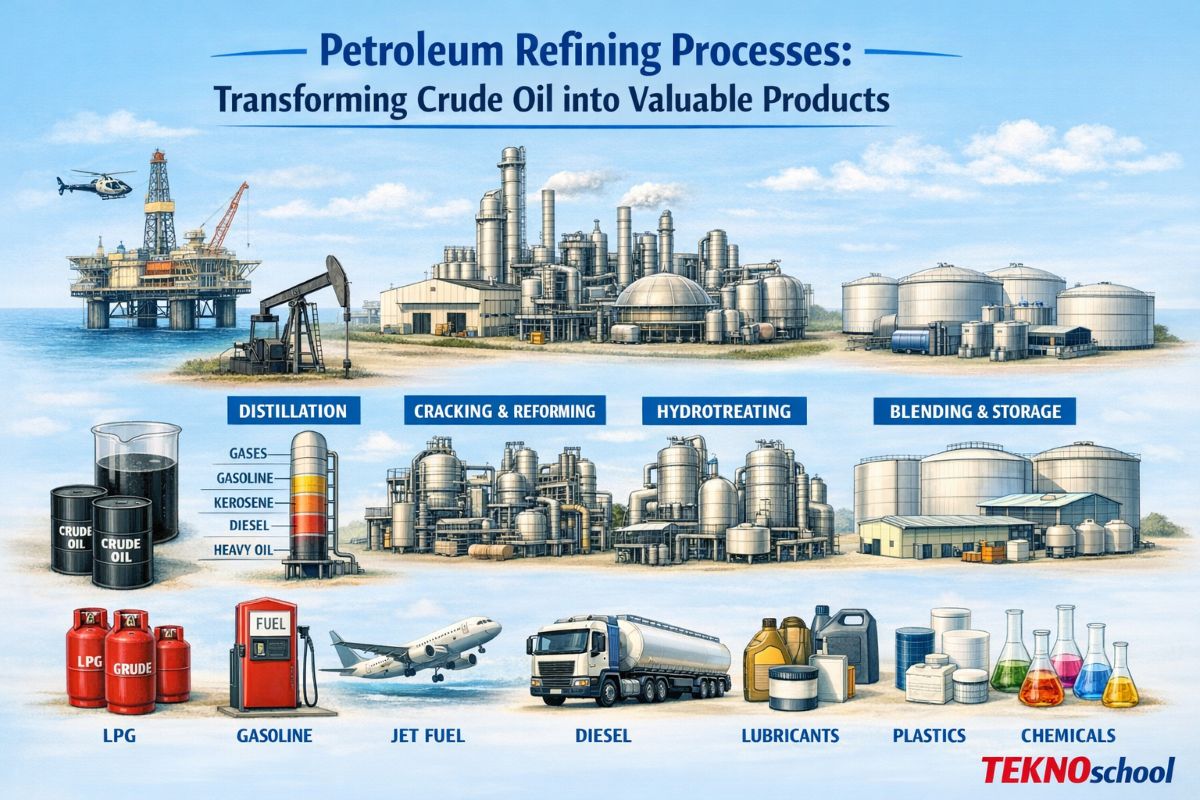
Petroleum Refining Processes: Transforming Crude Oil into Valuable Products
Petroleum Refining Processes: Transforming Crude Oil into Valuable Products
Petroleum refining is one of the most critical industrial operations in the modern energy ecosystem. Crude oil, as extracted from underground reservoirs, is a complex mixture of hydrocarbons with varying molecular weights, boiling points, and chemical properties. On its own, crude oil has limited direct utility. Its true value emerges only after undergoing a series of carefully engineered refining processes that convert it into usable fuels and petrochemical feedstocks.
Understanding petroleum refining requires examining both physical separation processes and chemical conversion processes, each playing a distinct role in transforming raw crude into high-demand products such as gasoline, diesel, jet fuel, lubricants, and petrochemicals.
1. Nature of Crude Oil and Refining Objectives
Crude oil is not a single substance but a mixture of hundreds of hydrocarbon compounds ranging from light gases to heavy residues. These components differ primarily in:
- Molecular size
- Boiling temperature
- Density
- Chemical structure
The primary objective of refining is to:
- Separate crude oil into useful fractions
- Upgrade low-value components into high-value products
- Remove impurities such as sulfur, nitrogen, and metals
- Optimize yield based on market demand
Refining is therefore both a separation science and a chemical engineering discipline.
2. Physical Separation Processes
The first stage in refining focuses on separating crude oil into fractions without altering their chemical structure. This is achieved mainly through distillation techniques.
2.1 Fractional Distillation: The Backbone of Refining
Fractional distillation is the most fundamental process in petroleum refining. It relies on differences in boiling points of hydrocarbon components.
Crude oil is:
- Preheated using heat exchangers
- Further heated in a furnace to high temperatures (typically 300–370°C)
- Fed into a tall distillation column
Inside the column:
- Vapors rise upward
- Temperature decreases from bottom to top
- Components condense at different levels based on boiling ranges
This results in separation into fractions such as:
- LPG (top)
- Naphtha (gasoline range)
- Kerosene
- Diesel (gas oil)
- Residual fuel oil (bottom)
Each fraction is not pure but a mixture within a boiling range defined by:
- Initial Boiling Point (IBP)
- Final Boiling Point (FBP)
2.2 Role of Reflux and Column Efficiency
To improve separation efficiency, part of the condensed liquid at the top is returned into the column. This is called reflux.
Reflux:
- Enhances contact between rising vapors and descending liquid
- Improves separation sharpness
- Allows better control of product quality
Modern columns use trays or packing to maximize vapor-liquid interaction.
2.3 Vacuum Distillation
Some heavy fractions require very high temperatures to vaporize. At such temperatures, thermal cracking may occur unintentionally.
To avoid this:
- Distillation is carried out under reduced pressure (vacuum)
- Boiling points decrease
- Heavy components can be separated safely
Vacuum distillation produces:
- Vacuum gas oil (VGO)
- Lubricating oil fractions
- Residue for further processing
2.4 Side Stripping and Product Refinement
Side streams withdrawn from the column may still contain lighter components. To refine these:
- Side strippers are used
- Steam is injected to remove lighter fractions
- Product purity improves
This ensures narrow boiling ranges for products like kerosene and diesel.
2.5 Other Physical Separation Techniques
When boiling point differences are insufficient, additional methods are used:
Absorption
- Uses liquid solvents to capture specific hydrocarbons
- Common in gas processing
Adsorption
- Uses solid materials like activated carbon or molecular sieves
- Removes impurities or separates close-boiling components
Extraction
- Uses selective solvents to separate aromatics or undesirable compounds
Filtration and Crystallization
- Used in wax removal and lubricant production
These processes enhance product quality without altering molecular structure.
3. Chemical Conversion Processes
While physical processes separate crude oil, they cannot meet modern demand patterns. For example, crude oil contains more heavy fractions than required by the market.
This imbalance is corrected through conversion processes, which chemically transform hydrocarbons.
3.1 Cracking: Breaking Large Molecules
Cracking is the most important conversion process. It breaks large hydrocarbon molecules into smaller, more valuable ones.
Types of Cracking:
1. Thermal Cracking
- Uses high temperature and pressure
- Produces gasoline, diesel, and gases
- Older technology, but still used in specific applications
2. Catalytic Cracking
- Uses catalysts (e.g., zeolites)
- More efficient and selective
- Produces high-octane gasoline
3. Fluid Catalytic Cracking (FCC)
- Most widely used process
- Catalyst behaves like a fluid
- Continuous regeneration of the catalyst
Cracking increases:
- Gasoline yield
- Petrochemical feedstock availability
3.2 Hydrocracking
Hydrocracking combines:
- Cracking
- Hydrogenation
It operates under:
- High pressure
- Presence of hydrogen
- Catalysts
Advantages:
- Produces cleaner fuels
- Removes sulfur, nitrogen, and metals
- Generates high-quality diesel and jet fuel
Hydrocracking is highly flexible and can process a wide range of feedstocks.
3.3 Reforming
Reforming upgrades low-quality naphtha into high-octane gasoline.
Key reactions:
- Dehydrogenation
- Isomerization
- Aromatization
It also produces hydrogen, which is used in other refining processes.
3.4 Alkylation and Polymerization
These processes combine small molecules into larger, high-value products.
- Alkylation produces high-octane blending components
- Polymerization converts light olefins into gasoline-range hydrocarbons
These processes are crucial for gasoline quality improvement.
3.5 Isomerization
Isomerization rearranges molecular structure without changing composition.
Example:
- Straight-chain hydrocarbons → Branched hydrocarbons
Benefits:
- Improved octane number
- Better fuel performance
4. Treatment and Purification Processes
Refined products often contain impurities that must be removed.
Key Treatments:
- Hydrotreating: Removes sulfur and nitrogen
- Desalting: Removes salts and water from crude
- Sweetening: Reduces odor and improves fuel stability
These steps ensure compliance with environmental regulations and product standards.
5. Refinery Configuration and Complexity
Modern refineries vary in complexity depending on:
- Crude oil type
- Product demand
- Investment level
Types of Refineries:
- Simple Refineries
- Only distillation
- Limited product range
- Conversion Refineries
- Include cracking and reforming
- Higher gasoline production
- Deep Conversion Refineries
- Advanced processes like hydrocracking
- Maximum value extraction
Refinery configuration is optimized for economic efficiency and market needs.
6. Importance of Heat Integration and Energy Efficiency
Refining is energy-intensive. To reduce costs:
- Heat exchangers recover energy from hot streams
- Furnace efficiency is improved
- Process integration minimizes energy loss
Energy management is a critical aspect of modern refining operations.
7. Environmental Considerations
Refineries must comply with strict environmental norms.
Key challenges:
- Sulfur emissions
- Greenhouse gases
- Wastewater treatment
Solutions include:
- Cleaner fuel production
- Carbon capture technologies
- Advanced emission control systems
8. Future Trends in Petroleum Refining
The refining industry is evolving due to:
- Increasing demand for cleaner fuels
- Growth of petrochemicals
- Transition to renewable energy
Emerging trends:
- Integration with petrochemical production
- Digital process optimization
- Hydrogen economy development
Refineries are gradually transforming into energy and chemical hubs.
Conclusion
Petroleum refining is a sophisticated combination of physical separation and chemical transformation processes. From fractional distillation to advanced hydrocracking, each stage plays a crucial role in converting crude oil into valuable, market-ready products.
As global energy demands evolve, refineries must adapt by improving efficiency, reducing environmental impact, and integrating new technologies. Despite the rise of renewable energy, petroleum refining will continue to be a cornerstone of industrial and economic activity for decades to come.