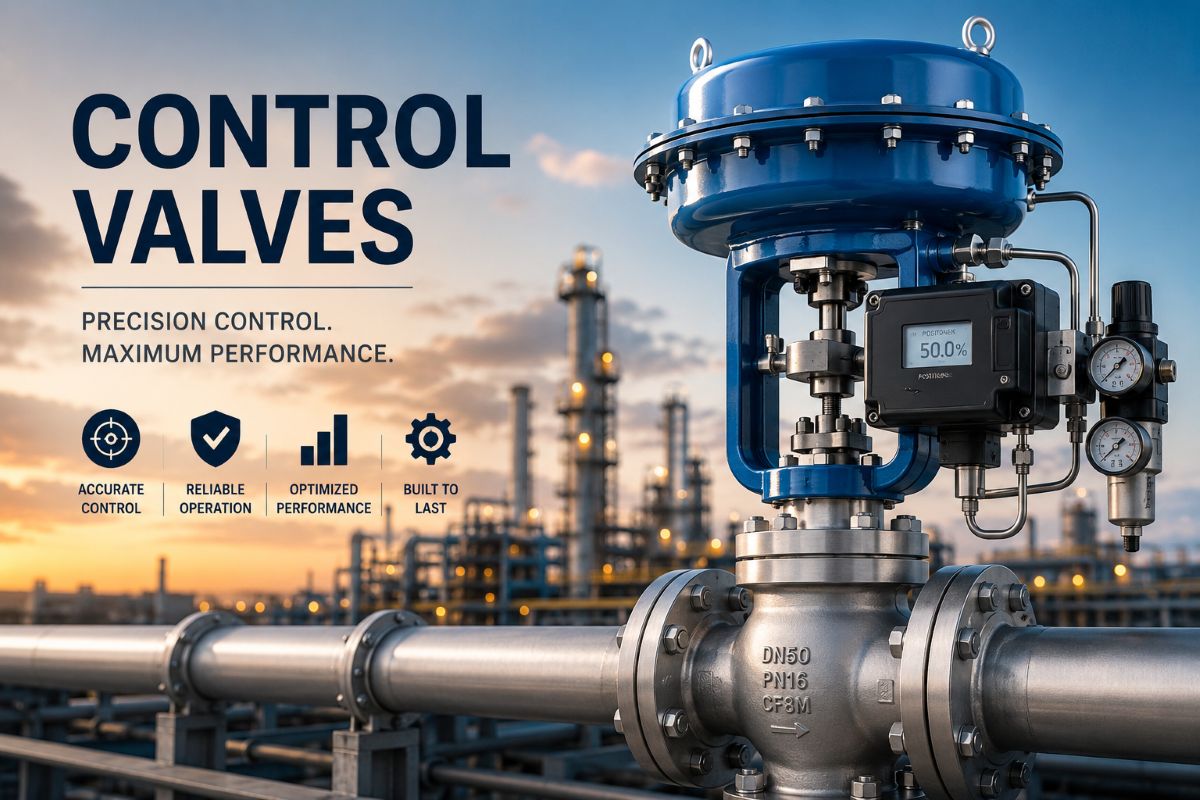
control valves
Valve Function and Basic Parts
Industrial processes—whether in oil & gas, chemical, fertilizer, power, or water treatment—depend heavily on control valves to regulate, isolate, throttle, or safeguard fluid flow. A valve may look simple from the outside, but internally it is a precisely engineered assembly designed to withstand pressure, temperature, corrosion, and continuous operation.
This blog explains what a valve does, its major components, and the materials of construction (MOC) used for each part.
1. What Is a Valve and What Does It Do?
A valve is a mechanical device used to start, stop, regulate, or direct the flow of a fluid (liquid, gas, steam, slurry). It works by changing the size of the flow passage using a movable element called the disk or closure member.
Primary functions of a valve
- Isolation — completely stop flow (Gate, Ball, Plug valves)
- Regulation — control flow rate or pressure (Globe, Control valves)
- Non‑return — prevent reverse flow (Check valves)
- Pressure protection — relieve excess pressure (Safety/Relief valves)
Valves are selected based on pressure class, temperature, fluid type, corrosion, erosion, and process control requirements.
2. Major Parts of a Valve and Their Construction
Below are the essential components found in most industrial valves.
2.1 Valve Body
The valve body is the main pressure‑retaining shell. It contains the flow passage and houses the internal trim.
Functions
- Withstands internal pressure
- Provides inlet and outlet connections
- Supports the trim and bonnet
Common MOC
- Cast Iron (CI) — low‑pressure water services
- Carbon Steel (A216 WCB) — oil, gas, steam, general industrial
- Stainless Steel (CF8/CF8M) — corrosive chemicals, food, pharma
- Alloy Steel (WC6/WC9) — high‑temperature steam
- Duplex / Super Duplex — seawater, chlorides
- Hastelloy / Monel / Inconel — highly corrosive or acidic services
2.2 Valve Bonnet
The bonnet is the cover that closes the body opening and supports the stem and packing.
Functions
- Provides a leak‑tight enclosure
- Guides the stem
- Holds packing and gland arrangement
Common MOC
Same as body to avoid galvanic corrosion:
WCB, CF8M, Alloy Steel, Duplex, etc.
Types of bonnets
- Bolted bonnet — high pressure
- Screwed bonnet — small valves
- Welded bonnet — high‑temperature, leak‑free
- Pressure‑seal bonnet — very high pressure (boilers, power plants)
2.3 Valve Trim
The trim includes all internal parts that come in contact with the fluid and control flow.
Trim typically includes:
- Disk
- Seat
- Stem
- Backseat
- Guide bushings
Common MOC
- SS 304 / SS 316 — standard trim
- Stellite hard‑facing — erosion resistance
- Monel / Hastelloy — corrosive fluids
- Tungsten carbide — severe service, erosive slurries
2.4 Disk (Closure Element)
The disk is the moving part that blocks or allows flow.
Functions
- Provides shutoff
- Controls throttling (in globe/control valves)
Types
- Gate
- Ball
- Plug
- Globe disk
- Poppet (safety valves)
MOC
- SS316, SS304
- Stellite‑faced for high wear
- Alloy steel for high temperature
- PTFE/EPDM for soft‑seated valves
2.5 Seat
The seat provides the sealing surface against which the disk closes.
Types
- Integral seat — machined into the body
- Renewable seat — screwed/welded in
- Soft seat — PTFE, Nylon, Viton
MOC
- SS316, SS304
- Stellite hard‑facing
- PTFE for soft‑seated ball valves
2.6 Stem
The stem connects the actuator/handwheel to the disk.
Functions
- Transmits torque or thrust
- Provides linear or rotary motion
Types
- Rising stem
- Non‑rising stem
- Rotating stem (ball/plug valves)
MOC
- SS410 (standard)
- SS316 (corrosive service)
- Monel (chlorides)
2.7 Packing
The packing prevents leakage along the stem.
Materials
- Graphite (high temperature)
- PTFE (chemical service)
- Aramid fibers
- Braided carbon
Functions
- Maintain stem sealing
- Allow smooth movement
2.8 Actuator
The actuator provides the force to operate the valve.
Types
- Manual — handwheel, lever
- Pneumatic — diaphragm or piston
- Electric — motorized actuators
- Hydraulic — high‑force applications
- Electro‑pneumatic — control valves
Selection depends on
- Required torque/thrust
- Speed of operation
- Fail‑safe position (fail open/close)
- Control signal (4–20 mA, digital, pneumatic)
3. Materials of Construction (MOC) – Summary Table
| Component | Common MOC | Service Suitability |
|---|---|---|
| Body | CI, WCB, CF8M, Alloy Steel, Duplex | Water, steam, chemicals, high temp |
| Bonnet | Same as body | Pressure containment |
| Trim | SS316, Stellite, Monel | Corrosion, erosion, severe service |
| Disk | SS316, Stellite, PTFE | Shutoff, throttling |
| Seat | SS316, Stellite, PTFE | Sealing, soft/hard seat |
| Stem | SS410, SS316, Monel | Strength, corrosion resistance |
| Packing | Graphite, PTFE | Stem sealing |
| Actuator | Steel, Aluminum, SS | Manual/automatic operation |
4. Conclusion
Valves are essential components in every industrial process. Understanding their function, construction, and materials helps engineers select the right valve for safety, reliability, and long service life. Each part—from the body to the actuator—plays a critical role in ensuring leak‑tight, efficient, and controlled fluid movement.