Lead Lag Control in Compressors
Lead Lag Control in Compressors: A Practical Guideline
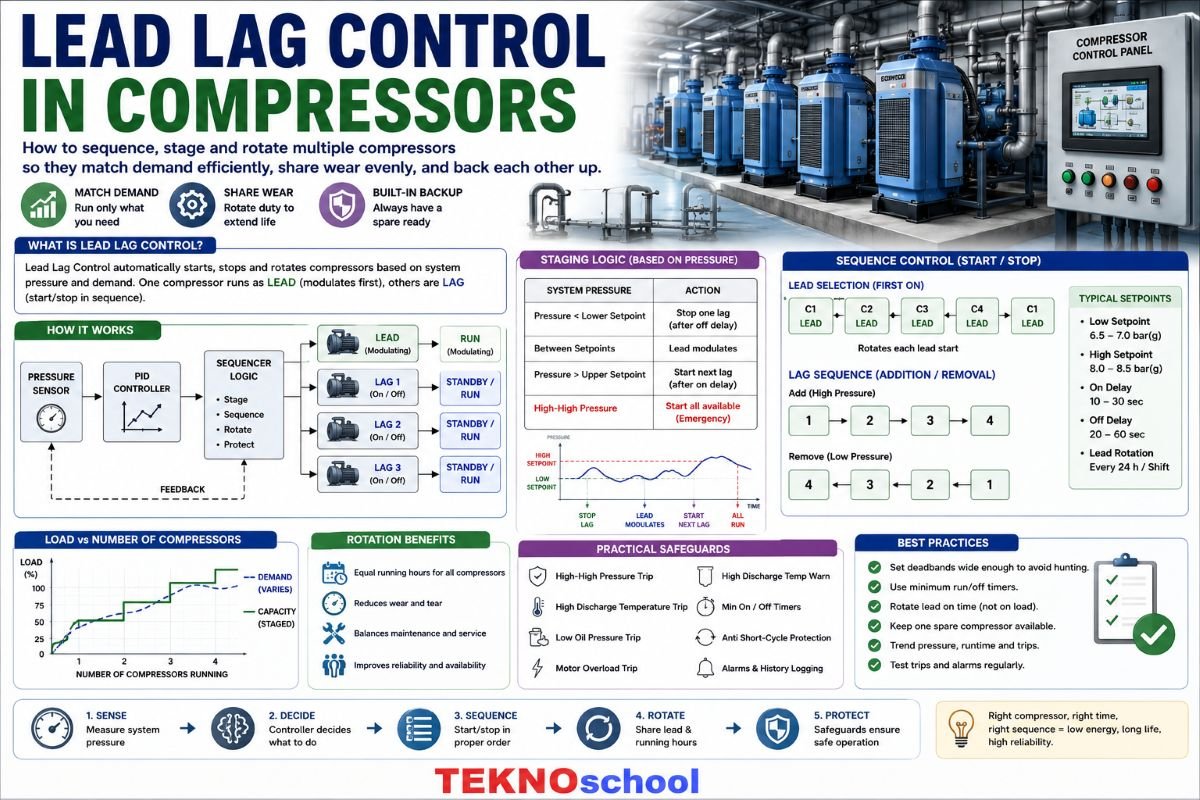
Lead Lag Control in Compressors-How to sequence, stage and rotate multiple compressors so they match demand efficiently, share wear evenly, and back each other up.
When a plant runs two or more compressors on a common header, they must be coordinated — otherwise they fight each other, cycle needlessly and waste energy. Lead/lag control is the sequencing strategy that solves this. One machine is designated the lead: it carries the base load and modulates to hold system pressure. The others are lag units that stage on and off as demand rises and falls. Done well, lead/lag control matches a swinging demand efficiently, spreads run-hours evenly across the fleet, and provides automatic standby capacity. This guideline covers the roles, the sequencing methods, rotation, the key parameters, and the pitfalls to avoid.
A note on the term: “Lead/lag” here means compressor sequencing, not the lead-lag compensator from control theory. They share a name but are unrelated — this article is about staging multiple machines.
Where Lead/Lag Is Used
The strategy appears anywhere multiple machines feed a common header. In compressed-air plants it sequences several air compressors against a receiver and plant pressure. In refrigeration and chiller systems it stages compressors or whole chillers to hold suction pressure or chilled-water temperature. In process gas service it coordinates booster or export compressors on a shared discharge. The equipment differs, but the logic is identical: one machine trims the controlled variable while the rest follow in sequence.
The Problem Lead/Lag Solves
Air, gas and refrigeration demand is rarely constant. A single large compressor sized for peak demand spends most of its life at part load, where it either runs unloaded — burning energy for no output — or short-cycles. It also offers no redundancy: if it trips, the whole plant stops.
Splitting capacity across several smaller machines fixes both problems, but only if they are sequenced. Left to their own local controllers, multiple units chasing the same pressure setpoint will hunt, load and unload together, and wear unevenly. Lead/lag control imposes order: exactly one unit trims pressure at any time, and the rest are brought in or dropped out in a disciplined sequence.
Lead and Lag Roles
The lead compressor
First to start, last to stop. It runs continuously and modulates — through inlet throttling, load/unload, or variable speed — to trim system pressure to setpoint. The lead does the fine control; it is the machine actively holding the header.
The lag compressor(s)
Staged in when the lead can no longer meet demand — pressure falls to a stage-in threshold, or the lead reaches full load — and staged out when demand eases and pressure recovers. Lag units typically run fully loaded or off; the lead absorbs the remaining swing.
The core rule: only the lead modulates. This single discipline is what stops multiple machines from fighting over the same setpoint.
Staging vs. Equal Load Sharing
There are two philosophies for how the running machines divide the load, and it is worth choosing deliberately.
Sequential staging (classic lead/lag)
The lead trims while lag units run fully loaded or off. This keeps each running machine near its most efficient point, which suits fixed-speed compressors where part-load operation is wasteful. It is the default for most compressed-air plants.
Equal load sharing
All running machines are held at the same percentage load, sharing the demand proportionally. This balances wear across identical, well-matched units and can smooth control, but it forces machines to run at part load — efficient with variable-speed drives, less so with fixed-speed units that waste energy when throttled.
Sequencing Methods
There are three common ways to decide when lag units come and go.
Rotation and Redundancy
If the same machine is always the lead, it accumulates far more run-hours than the rest and reaches overhaul first. To avoid this, the lead role is rotated — on a fixed schedule, on equalised run-hours, or manually. The controller simply reassigns which unit modulates and which follow.
Automatic changeover: Rotation also delivers redundancy. If the lead trips or is taken out for service, a lag unit is promoted to lead automatically, so the header stays supported without operator action. This fault changeover is one of the biggest reasons to run lead/lag in the first place.
Key Control Parameters
Good sequencing lives or dies on a handful of settings.
- Stage-in / stage-out setpoints and deadband. Set a clear gap between the pressure that brings a lag unit on and the pressure that drops it off; too small a gap causes rapid cycling.
- Time delays. Apply a stage-on delay, a minimum run time and a minimum off time so short demand blips do not start and stop motors repeatedly.
- Target pressure. Hold the lowest header pressure the plant can tolerate — roughly every 2 psi of unnecessary pressure adds about 1 % to compressor energy.
- Storage volume. Adequate receiver capacity buffers demand swings so staging is smooth rather than frantic.
Common Pitfalls
Short cycling. Too-tight a deadband or missing time delays make lag units start and stop constantly, overheating motors and wearing valves. Widen the band, add delays, and add storage.
Machines fighting. If more than one unit modulates to the same setpoint, they hunt against each other. Enforce the rule that only the lead trims; lag units run loaded or off.
Overlapping bands. With cascade sequencing, badly set pressure bands run more units than the load needs. Check the staggering and keep the total band as narrow as the process allows.
No rotation. A fixed lead wears out first and leaves the fleet unbalanced. Rotate on run-hours and confirm the automatic changeover actually works during testing.
Key Takeaways
- Lead/lag coordinates multiple compressors so exactly one — the lead — modulates while lag units stage on and off.
- Choose the sequencing method to suit the plant: cascade for simplicity, a sequencer for tight pressure, base-load-plus-VSD-trim for best part-load efficiency.
- Rotate the lead on run-hours for even wear, and prove the automatic changeover for redundancy.
- Tune stage-in/out deadbands, time delays and storage to stop short cycling.
- Hold the lowest acceptable header pressure — it is the easiest energy saving in the whole system.