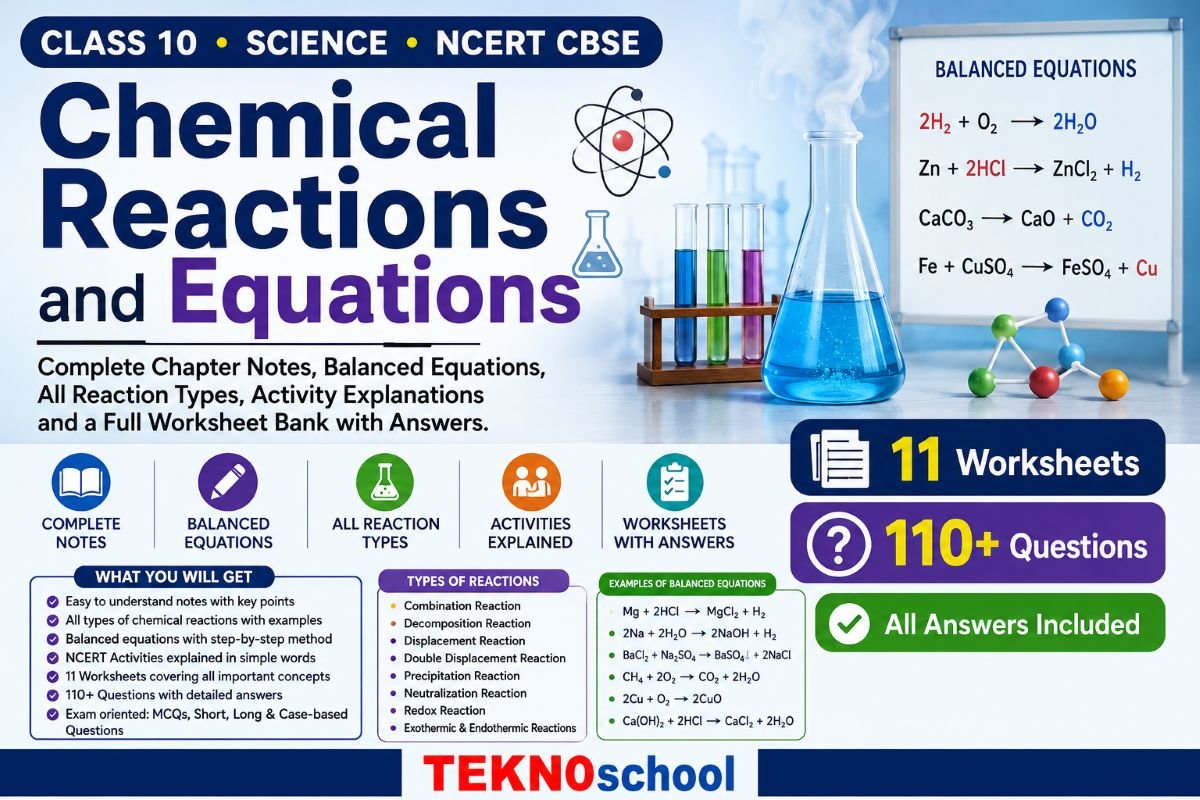
Chemical Reactions and Equations
Chemical Reactions and Equations
Chemical Reactions and Equations-Complete chapter notes, balanced equations, all reaction types, activity explanations and a full worksheet bank with answers.
110+ Questions
All Answers Included
Every time a piece of iron rusts in the monsoon, a slice of apple turns brown on the plate, or milk left outside turns sour, matter is quietly rearranging itself. The substances you started with are gone, and completely new substances with new properties have taken their place. That is a chemical reaction — and this chapter teaches you how to describe it, balance it, classify it and predict it.
This is the foundation chapter for the whole of Class 10 Chemistry. Acids and bases, metals and non-metals, and carbon compounds all lean on the equation-writing skill you build here. Take your time with balancing — it is the single most examined skill in the chapter.
What You Will Learn
- How to recognise that a chemical reaction has taken place
- How to write word equations, skeletal equations and balanced chemical equations
- The law of conservation of mass and why balancing is compulsory
- Five reaction types: combination, decomposition, displacement, double displacement, redox
- Exothermic and endothermic changes with everyday examples
- Corrosion and rancidity — oxidation at work in daily life
1. What Is a Chemical Reaction?
A chemical reaction is a change in which one or more substances (the reactants) are converted into one or more entirely new substances (the products) with different chemical properties. Old bonds break, new bonds form, and the identity of the matter changes permanently.
Signs That a Chemical Reaction Has Occurred
| Observable Change | Everyday / Lab Example | What Is Happening |
|---|---|---|
| Change in state | Burning of a candle (wax → gases) | Solid converts to gaseous products |
| Change in colour | Iron nail in copper sulphate solution | Blue solution turns pale green |
| Evolution of a gas | Zinc + dilute sulphuric acid | Hydrogen gas bubbles off |
| Change in temperature | Quicklime + water | Vessel becomes very hot (heat released) |
| Formation of a precipitate | Barium chloride + sodium sulphate | White insoluble solid settles down |
Exam Tip: Not every change with heat or colour is chemical. Melting of ice, dissolving sugar in water and glowing of an electric bulb filament are physical changes — no new substance is formed and the change is reversible.
2. Writing a Chemical Equation
A chemical equation is the shorthand of chemistry. It builds up in three stages:
Stage 1 — Word Equation
Names of reactants on the left, names of products on the right, arrow pointing towards the products.
Magnesium + Oxygen → Magnesium oxide
Stage 2 — Skeletal (Unbalanced) Equation
Replace names with symbols and formulae. Atoms are not yet equal on both sides.
Mg + O2 → MgO
Stage 3 — Balanced Chemical Equation
Coefficients are added so that the number of atoms of every element is the same on both sides.
2Mg + O2 → 2MgO
Law of Conservation of Mass: Mass can neither be created nor destroyed in a chemical reaction. The total mass of reactants always equals the total mass of products. This is exactly why every chemical equation must be balanced.
Balancing Step by Step (Hit-and-Trial Method)
Balance: Fe + H2O → Fe3O4 + H2
| Step | Action | Equation After the Step |
|---|---|---|
| 1 | Count atoms of each element on both sides | Fe: 1 → 3 | H: 2 → 2 | O: 1 → 4 |
| 2 | Start with the element having the most atoms — oxygen. Put 4 before H2O | Fe + 4H2O → Fe3O4 + H2 |
| 3 | Balance hydrogen: 8 H on the left, so put 4 before H2 | Fe + 4H2O → Fe3O4 + 4H2 |
| 4 | Balance iron: 3 Fe on the right, so put 3 before Fe | 3Fe + 4H2O → Fe3O4 + 4H2 |
| 5 | Re-check every element — all equal. Add physical states | 3Fe(s) + 4H2O(g) → Fe3O4(s) + 4H2(g) |
Making an Equation More Informative
| Symbol | Meaning | Used As |
|---|---|---|
| (s) | Solid | Fe(s), CaCO3(s) |
| (l) | Liquid | H2O(l) |
| (g) | Gas | H2(g), CO2(g) |
| (aq) | Aqueous (dissolved in water) | CuSO4(aq) |
| ↑ | Gas evolved | H2↑ |
| ↓ | Precipitate formed | BaSO4↓ |
| Above arrow | Heat, catalyst, pressure, light | Heat, Ni catalyst, sunlight |
3. Types of Chemical Reactions
A. Combination Reaction
Two or more substances combine to form a single product. General form: A + B → AB
CaO(s) + H2O(l) → Ca(OH)2(aq) (quicklime → slaked lime, used in whitewashing)
2H2(g) + O2(g) → 2H2O(l)
C(s) + O2(g) → CO2(g)
2Mg(s) + O2(g) → 2MgO(s)
Note: Slaked lime on a wall reacts slowly with CO2 from air to form calcium carbonate, giving a shiny white finish after 2–3 days.
B. Decomposition Reaction
A single compound breaks down into two or more simpler substances. General form: AB → A + B. It is the exact opposite of combination and always needs energy.
| Type | Energy Source | Example |
|---|---|---|
| Thermal | Heat | CaCO3(s) → CaO(s) + CO2(g) 2FeSO4(s) → Fe2O3(s) + SO2(g) + SO3(g) 2Pb(NO3)2(s) → 2PbO(s) + 4NO2(g) + O2(g) |
| Electrolytic | Electricity | 2H2O(l) → 2H2(g) + O2(g) Hydrogen collected is exactly double the oxygen |
| Photolytic | Sunlight | 2AgCl(s) → 2Ag(s) + Cl2(g) (white → grey) 2AgBr(s) → 2Ag(s) + Br2(g) (used in photography) |
Observation to remember: Ferrous sulphate crystals are green because of water of crystallisation. On heating they first lose water, turn white, then decompose to reddish-brown Fe2O3 with a smell of burning sulphur.
C. Displacement Reaction
A more reactive element displaces a less reactive element from its compound. General form: A + BC → AC + B
Fe(s) + CuSO4(aq) → FeSO4(aq) + Cu(s) (blue → pale green, brown coating on nail)
Zn(s) + CuSO4(aq) → ZnSO4(aq) + Cu(s)
Pb(s) + CuCl2(aq) → PbCl2(aq) + Cu(s)
Key idea: Zn, Fe and Pb are more reactive than Cu, so they can push copper out of its salt. Copper cannot displace zinc — the reaction simply does not happen.
D. Double Displacement Reaction
Two compounds exchange their ions. General form: AB + CD → AD + CB. When one product is insoluble, it is also called a precipitation reaction.
Na2SO4(aq) + BaCl2(aq) → BaSO4↓(s) + 2NaCl(aq)
White precipitate of barium sulphate
Pb(NO3)2(aq) + 2KI(aq) → PbI2↓(s) + 2KNO3(aq)
Yellow precipitate of lead iodide
NaOH(aq) + HCl(aq) → NaCl(aq) + H2O(l) (neutralisation)
E. Oxidation, Reduction and Redox Reactions
| Oxidation | Reduction |
|---|---|
| Gain of oxygen | Loss of oxygen |
| Loss of hydrogen | Gain of hydrogen |
| Substance oxidised acts as the reducing agent | Substance reduced acts as the oxidising agent |
CuO(s) + H2(g) → Cu(s) + H2O(l)
• CuO loses oxygen → reduced → it is the oxidising agent
• H2 gains oxygen → oxidised → it is the reducing agent
ZnO(s) + C(s) → Zn(s) + CO(g)
MnO2(s) + 4HCl(aq) → MnCl2(aq) + 2H2O(l) + Cl2(g)
Copper turning black: When copper is heated in air, a black coating of copper(II) oxide forms — 2Cu + O2 → 2CuO. Passing hydrogen over the hot black surface turns it brown again as copper is regained.
4. Exothermic and Endothermic Reactions
| Basis | Exothermic | Endothermic |
|---|---|---|
| Heat | Released to surroundings | Absorbed from surroundings |
| Temperature | Vessel becomes warm | Vessel becomes cool |
| Examples | Respiration, burning of fuels, quicklime + water, decomposition of vegetable matter into compost | Photosynthesis, thermal decomposition of CaCO3, electrolysis of water |
5. Effects of Oxidation in Everyday Life
Corrosion
Slow eating away of a metal surface by air, moisture or chemicals around it. In iron it is called rusting, and the rust formed is hydrated iron(III) oxide, Fe2O3·xH2O — reddish-brown and flaky.
Conditions needed: both oxygen (air) and moisture (water). Remove either one and rusting stops.
Other metals: silver turns black (silver sulphide), copper develops a green coat (basic copper carbonate).
Prevention: painting, oiling and greasing, galvanisation (zinc coating), electroplating, anodising, and alloying — iron alloyed with chromium and nickel gives stainless steel, which does not rust.
Rancidity
When fats and oils in food are oxidised on standing, their taste and smell change unpleasantly. This is rancidity — think of old fried snacks or stale ghee.
How it is prevented: adding antioxidants such as BHA and BHT; flushing packets with nitrogen gas (chips packets); refrigeration; storing in airtight containers; and using coloured or opaque bottles to keep light out.
Worksheet Bank
Eleven worksheets • Ten questions in each • Answer given right below every question
Worksheet 1 — Multiple Choice Questions
1. Which of the following is a decomposition reaction?
(a) NaOH + HCl → NaCl + H2O (b) H2 + Cl2 → 2HCl (c) 2KClO3 → 2KCl + 3O2 (d) Fe + CuSO4 → FeSO4 + Cu
Answer: (c) — a single compound splits into two simpler products.
2. An iron nail dipped in copper sulphate solution turns brownish and the blue colour fades. This is a
(a) combination reaction (b) displacement reaction (c) double displacement reaction (d) decomposition reaction
Answer: (b) — more reactive iron displaces copper from its salt.
3. White silver chloride turns grey when kept in sunlight because of
(a) thermal decomposition (b) electrolytic decomposition (c) photolytic decomposition (d) neutralisation
Answer: (c) — sunlight breaks AgCl into grey silver and chlorine gas.
4. The correctly balanced equation for the burning of magnesium is
(a) Mg + O2 → MgO (b) 2Mg + O2 → 2MgO (c) Mg + 2O2 → MgO2 (d) 2Mg + 2O2 → 2MgO
Answer: (b) — 2 Mg and 2 O atoms on each side.
5. Respiration is considered a/an
(a) endothermic reaction (b) exothermic reaction (c) precipitation reaction (d) neutralisation reaction
Answer: (b) — oxidation of glucose releases energy.
6. The chemical formula of rust is
(a) FeO (b) Fe3O4 (c) Fe2O3·xH2O (d) Fe(OH)3
Answer: (c) — rust is hydrated ferric oxide.
7. Chips packets are flushed with which gas to prevent rancidity?
(a) Oxygen (b) Carbon dioxide (c) Nitrogen (d) Chlorine
Answer: (c) — nitrogen is unreactive and keeps oxygen away from the fat.
8. In the reaction CuO + H2 → Cu + H2O, the substance acting as the oxidising agent is
(a) CuO (b) H2 (c) Cu (d) H2O
Answer: (a) — CuO gives up its oxygen, so it is reduced and acts as the oxidising agent.
9. On adding lead nitrate solution to potassium iodide solution, the precipitate obtained is
(a) white (b) yellow (c) green (d) black
Answer: (b) — yellow lead iodide, PbI2.
10. Which pair of substances, when mixed, causes the temperature of the container to rise sharply?
(a) Calcium carbonate and heat (b) Quicklime and water (c) Barium chloride and sodium sulphate (d) Water and electricity
Answer: (b) — an exothermic combination reaction forming slaked lime.
Worksheet 2 — Fill in the Blanks
1. A chemical equation must be balanced to satisfy the law of ____________.
Answer: conservation of mass
2. The substances that take part in a chemical reaction are called ____________.
Answer: reactants
3. Reactions in which heat is absorbed from the surroundings are called ____________ reactions.
Answer: endothermic
4. The reaction CaO + H2O → Ca(OH)2 is an example of a ____________ reaction.
Answer: combination
5. Decomposition of a compound using electricity is called ____________ decomposition.
Answer: electrolytic
6. The insoluble solid formed in a double displacement reaction is called a ____________.
Answer: precipitate
7. Oxidation is the ____________ of oxygen or the loss of hydrogen by a substance.
Answer: gain
8. Coating iron with a layer of zinc to protect it from rusting is called ____________.
Answer: galvanisation
9. The unpleasant smell and taste developed in oily food on standing is called ____________.
Answer: rancidity
10. Green ferrous sulphate crystals on strong heating give a reddish-brown residue of ____________.
Answer: ferric oxide, Fe2O3
Worksheet 3 — True or False
1. In a balanced chemical equation the number of atoms of each element is equal on both sides.
Answer: True
2. Melting of ice is a chemical change.
Answer: False — it is a physical change; no new substance is formed.
3. Decomposition reactions always release energy.
Answer: False — they generally absorb energy in the form of heat, light or electricity.
4. Copper can displace zinc from zinc sulphate solution.
Answer: False — zinc is more reactive than copper, so no reaction occurs.
5. Photosynthesis is an endothermic reaction.
Answer: True — plants absorb solar energy.
6. In the electrolysis of water, the volume of hydrogen collected is twice that of oxygen.
Answer: True
7. A substance that gets oxidised in a reaction acts as an oxidising agent.
Answer: False — it acts as the reducing agent.
8. Rusting of iron needs both air and moisture.
Answer: True
9. Adding an antioxidant to packaged food slows down rancidity.
Answer: True
10. Silver bromide is used in black-and-white photography because it decomposes in sunlight.
Answer: True
Worksheet 4 — Match the Columns
| No. | Column A | No. | Column B | Answer |
|---|---|---|---|---|
| 1 | 2Mg + O2 → 2MgO | i | Yellow precipitate | 1 → iii |
| 2 | CaCO3 → CaO + CO2 | ii | Photolytic decomposition | 2 → iv |
| 3 | Fe + CuSO4 → FeSO4 + Cu | iii | Combination reaction | 3 → v |
| 4 | Pb(NO3)2 + 2KI | iv | Thermal decomposition | 4 → i |
| 5 | 2AgCl → 2Ag + Cl2 | v | Displacement reaction | 5 → ii |
| 6 | Rust | vi | Nitrogen flushing | 6 → vii |
| 7 | Rancidity prevention | vii | Fe2O3·xH2O | 7 → vi |
| 8 | Photosynthesis | viii | Galvanisation | 8 → x |
| 9 | Zinc coating on iron | ix | Exothermic reaction | 9 → viii |
| 10 | Burning of natural gas | x | Endothermic reaction | 10 → ix |
Cover the last column while attempting, then check.
Worksheet 5 — Assertion and Reason
Choose the correct option in each case:
(a) Both A and R are true, and R is the correct explanation of A
(b) Both A and R are true, but R is not the correct explanation of A
(c) A is true but R is false
(d) A is false but R is true
1. A: Chemical equations must be balanced. R: Matter can be created during a chemical reaction.
Answer: (c) — balancing follows the law of conservation of mass; matter is never created.
2. A: Photosynthesis is an endothermic process. R: Plants absorb solar energy to convert carbon dioxide and water into glucose.
Answer: (a)
3. A: Silver chloride is stored in dark-coloured bottles. R: Silver chloride decomposes in the presence of sunlight.
Answer: (a)
4. A: Copper displaces iron from ferrous sulphate solution. R: Copper is more reactive than iron.
Answer: Both statements are false — copper is less reactive than iron, so the displacement does not occur.
5. A: Quicklime added to water makes the vessel hot. R: Formation of slaked lime is an exothermic combination reaction.
Answer: (a)
6. A: Painting an iron gate protects it from rusting. R: Paint cuts off contact between iron and air or moisture.
Answer: (a)
7. A: In ZnO + C → Zn + CO, carbon acts as the oxidising agent. R: Carbon gains oxygen in the reaction.
Answer: (d) — carbon gains oxygen, so it is oxidised and acts as the reducing agent.
8. A: Barium chloride and sodium sulphate give a white precipitate. R: The barium sulphate formed is insoluble in water.
Answer: (a)
9. A: Respiration is called an exothermic reaction. R: Energy is released when glucose is oxidised inside our cells.
Answer: (a)
10. A: Stainless steel does not rust easily. R: Stainless steel is an alloy of iron with chromium and nickel.
Answer: (a)
Worksheet 6 — Very Short Answer Questions (1 Mark)
1. Define a chemical reaction.
Answer: A change in which reactants are converted into one or more entirely new substances with different properties.
2. What is a skeletal chemical equation?
Answer: An equation written with symbols and formulae in which the atoms are not yet balanced on both sides.
3. Name the gas released when zinc reacts with dilute sulphuric acid.
Answer: Hydrogen gas, H2.
4. What is the colour of the flame when magnesium ribbon burns in air?
Answer: A dazzling white flame.
5. Write the chemical name of quicklime.
Answer: Calcium oxide, CaO.
6. Why is magnesium ribbon cleaned with sandpaper before burning?
Answer: To remove the protective layer of magnesium oxide so that the metal burns readily.
7. Give one example of a photolytic decomposition reaction.
Answer: 2AgCl(s) → 2Ag(s) + Cl2(g) in sunlight.
8. What is a precipitation reaction?
Answer: A reaction in which two solutions react to give an insoluble solid called a precipitate.
9. Name the process of coating iron with molten zinc.
Answer: Galvanisation.
10. Which two conditions are essential for rusting of iron?
Answer: Presence of oxygen (air) and moisture (water).
Worksheet 7 — Short Answer Questions (2–3 Marks)
1. Why must a chemical equation be balanced? State the law involved.
Answer: Because mass is conserved. The law of conservation of mass states that mass is neither created nor destroyed in a chemical reaction, so the number of atoms of every element must be the same on both sides of the equation.
2. Distinguish between a combination reaction and a decomposition reaction with one example each.
Answer: In a combination reaction two or more substances join to form a single product, for example CaO + H2O → Ca(OH)2. In a decomposition reaction one compound splits into two or more simpler products, for example CaCO3 → CaO + CO2.
3. Explain, with an equation, why the blue colour of copper sulphate solution fades when an iron nail is dipped in it.
Answer: Iron is more reactive than copper, so it displaces copper from copper sulphate. The blue Cu2+ ions are replaced by pale green Fe2+ ions and a brown deposit of copper appears on the nail.
Fe(s) + CuSO4(aq) → FeSO4(aq) + Cu(s)
4. What happens when ferrous sulphate crystals are heated strongly? Write the equation.
Answer: The green crystals first lose their water of crystallisation and turn white, then decompose to leave a reddish-brown residue of ferric oxide, releasing gases with a burning-sulphur smell.
2FeSO4(s) → Fe2O3(s) + SO2(g) + SO3(g)
5. Differentiate between an exothermic and an endothermic reaction with one example each.
Answer: An exothermic reaction gives out heat and the container warms up, for example respiration or the burning of coal. An endothermic reaction takes in heat and needs continuous heating, for example photosynthesis or the heating of limestone.
6. Identify the substance oxidised and the substance reduced in: MnO2 + 4HCl → MnCl2 + 2H2O + Cl2
Answer: HCl is oxidised, since it loses hydrogen and forms chlorine. MnO2 is reduced, since it loses oxygen. So MnO2 is the oxidising agent and HCl is the reducing agent.
7. Why does the wall look shiny white two to three days after whitewashing?
Answer: Slaked lime applied on the wall reacts slowly with carbon dioxide in the air to form a hard, shiny layer of calcium carbonate.
Ca(OH)2 + CO2 → CaCO3 + H2O
8. State two methods of preventing corrosion of iron and explain how each works.
Answer: Painting or oiling forms a physical barrier so air and moisture cannot touch the iron surface. Galvanisation coats the iron with zinc, which seals the surface and corrodes in preference to the iron beneath.
9. What is rancidity? Write two ways of slowing it down.
Answer: Rancidity is the oxidation of fats and oils in food, which gives an unpleasant smell and taste. It is slowed by adding antioxidants and by packing the food in nitrogen gas, or by refrigeration and airtight storage.
10. During electrolysis of water, why is the volume of gas collected at one electrode double that at the other?
Answer: Water contains hydrogen and oxygen in a 2 : 1 ratio, so 2H2O → 2H2 + O2 produces twice as many hydrogen molecules as oxygen molecules. Hydrogen is collected at the cathode and oxygen at the anode.
Worksheet 8 — Long Answer Questions (5 Marks)
1. Explain the steps involved in balancing a chemical equation, using Fe + H2O → Fe3O4 + H2 as your example.
Answer: Write the skeletal equation, then count the atoms of each element on both sides. Balance the element with the largest number of atoms first — oxygen, by placing 4 before H2O. Next balance hydrogen by placing 4 before H2, then balance iron by placing 3 before Fe. Recheck every element and finally add the physical states.
3Fe(s) + 4H2O(g) → Fe3O4(s) + 4H2(g)
2. Describe the five main types of chemical reactions with one balanced equation for each.
Answer: Combination — two or more substances form one product: 2Mg + O2 → 2MgO. Decomposition — one compound splits into simpler ones: CaCO3 → CaO + CO2. Displacement — a more reactive element replaces a less reactive one: Fe + CuSO4 → FeSO4 + Cu. Double displacement — two compounds exchange ions: Na2SO4 + BaCl2 → BaSO4↓ + 2NaCl. Redox — oxidation and reduction occur together: CuO + H2 → Cu + H2O.
3. What are decomposition reactions? Explain the three types with equations and the energy source used in each.
Answer: A single compound breaks into two or more simpler substances, always absorbing energy. Thermal decomposition uses heat: CaCO3 → CaO + CO2. Electrolytic decomposition uses electricity: 2H2O → 2H2 + O2. Photolytic decomposition uses sunlight: 2AgBr → 2Ag + Br2.
4. Define oxidation and reduction. Show, using CuO + H2 → Cu + H2O, which species is oxidised, which is reduced, and identify both agents.
Answer: Oxidation is the gain of oxygen or loss of hydrogen; reduction is the loss of oxygen or gain of hydrogen. Here hydrogen gains oxygen, so it is oxidised and acts as the reducing agent. Copper oxide loses oxygen, so it is reduced and acts as the oxidising agent. Since both processes occur together, this is called a redox reaction.
5. What is corrosion? Describe the corrosion of iron, silver and copper, and list four methods of prevention.
Answer: Corrosion is the slow eating away of a metal surface by air, moisture or chemicals. Iron forms a reddish-brown flaky layer of hydrated ferric oxide called rust, Fe2O3·xH2O. Silver develops a black coating of silver sulphide and copper develops a green coating of basic copper carbonate. Prevention: painting or greasing, galvanisation, electroplating, and alloying such as stainless steel.
6. Describe the activity to show that quicklime reacts with water. State the type of reaction and two uses of the product.
Answer: Take a small amount of calcium oxide in a beaker and add water slowly. The mixture hisses, the beaker becomes hot to touch, and a white suspension of slaked lime is formed.
CaO(s) + H2O(l) → Ca(OH)2(aq) + heat
It is an exothermic combination reaction. Slaked lime is used for whitewashing walls and for neutralising acidic soil.
7. Explain a double displacement reaction. Describe the reaction between sodium sulphate and barium chloride with observations and a balanced equation.
Answer: In a double displacement reaction two compounds exchange their ions, following the form AB + CD → AD + CB. On mixing the two colourless solutions, a white insoluble precipitate of barium sulphate appears at once while sodium chloride stays dissolved.
Na2SO4(aq) + BaCl2(aq) → BaSO4↓(s) + 2NaCl(aq)
8. How can a chemical equation be made more informative? Explain with symbols and one fully written example.
Answer: Add physical states as (s), (l), (g) and (aq); use an upward arrow for a gas evolved and a downward arrow for a precipitate; write the conditions such as heat, catalyst, temperature or pressure above the arrow; and indicate whether heat is released or absorbed. Example: 2H2O(l) → 2H2(g) + O2(g), carried out using electricity.
9. Explain rancidity in detail — its cause, the changes observed in food, and four preventive measures used by the food industry.
Answer: Rancidity is caused by the oxidation of fats and oils in food when they are exposed to air over time. The food develops an unpleasant smell, its taste changes, and sometimes its colour also changes. It is prevented by adding antioxidants such as BHA and BHT, by flushing packets with nitrogen gas, by refrigeration, and by using airtight or opaque containers that keep out both air and light.
10. Compare displacement and double displacement reactions on the basis of definition, general form, number of elements exchanged, and one example each.
Answer: In a displacement reaction a more reactive element replaces a less reactive element from its compound, of the form A + BC → AC + B, with only one element exchanged, for example Zn + CuSO4 → ZnSO4 + Cu. In a double displacement reaction two compounds exchange their ions, of the form AB + CD → AD + CB, with two exchanges taking place, for example Pb(NO3)2 + 2KI → PbI2↓ + 2KNO3.
Worksheet 9 — Balance These Equations
1. H2 + O2 → H2O
Answer: 2H2 + O2 → 2H2O
2. Fe + H2O → Fe3O4 + H2
Answer: 3Fe + 4H2O → Fe3O4 + 4H2
3. NaOH + H2SO4 → Na2SO4 + H2O
Answer: 2NaOH + H2SO4 → Na2SO4 + 2H2O
4. Mg + N2 → Mg3N2
Answer: 3Mg + N2 → Mg3N2
5. C3H8 + O2 → CO2 + H2O
Answer: C3H8 + 5O2 → 3CO2 + 4H2O
6. Pb(NO3)2 → PbO + NO2 + O2
Answer: 2Pb(NO3)2 → 2PbO + 4NO2 + O2
7. Al + CuCl2 → AlCl3 + Cu
Answer: 2Al + 3CuCl2 → 2AlCl3 + 3Cu
8. BaCl2 + Al2(SO4)3 → BaSO4 + AlCl3
Answer: 3BaCl2 + Al2(SO4)3 → 3BaSO4 + 2AlCl3
9. KClO3 → KCl + O2
Answer: 2KClO3 → 2KCl + 3O2
10. Zn + AgNO3 → Zn(NO3)2 + Ag
Answer: Zn + 2AgNO3 → Zn(NO3)2 + 2Ag
Worksheet 10 — Case Based Questions
Case I: A student took about 2 g of lead nitrate powder in a boiling tube and heated it over a flame. A brown gas with a sharp smell escaped and a yellow residue was left behind. In a second experiment, the same student added potassium iodide solution to lead nitrate solution in a test tube and immediately saw a bright yellow solid settle down.
1. Write the balanced equation for the heating of lead nitrate and name the brown gas.
Answer: 2Pb(NO3)2(s) → 2PbO(s) + 4NO2(g) + O2(g). The brown gas is nitrogen dioxide.
2. What type of reaction takes place on heating lead nitrate?
Answer: Thermal decomposition.
3. Name the yellow residue left in the boiling tube.
Answer: Lead oxide, PbO.
4. Write the balanced equation for the second experiment and name the yellow solid.
Answer: Pb(NO3)2(aq) + 2KI(aq) → PbI2↓(s) + 2KNO3(aq). The yellow solid is lead iodide.
5. Classify the second reaction and state why it is also called a precipitation reaction.
Answer: It is a double displacement reaction. It is also called precipitation because one product, lead iodide, is insoluble in water and separates out as a solid.
Case II: A shopkeeper stores fried snacks in transparent plastic jars kept near a sunny window. After a few weeks customers complain that the snacks smell bad and taste strange. In the same shop, an iron shutter facing the street has developed a flaky reddish-brown layer during the rainy season, while a stainless steel counter beside it looks untouched.
6. Name the process responsible for the bad smell and taste in the snacks.
Answer: Rancidity — the oxidation of fats and oils present in the fried snacks.
7. Suggest two changes the shopkeeper should make in the way the snacks are stored.
Answer: Store them in airtight opaque or dark containers away from sunlight, and use packets flushed with nitrogen gas or containing an antioxidant.
8. Name the reddish-brown layer on the shutter and give its chemical formula.
Answer: Rust, which is hydrated ferric oxide, Fe2O3·xH2O.
9. Why does the stainless steel counter not develop the same layer?
Answer: Stainless steel is an alloy of iron with chromium and nickel, which resists corrosion, so it does not rust.
10. Suggest one low-cost method the shopkeeper can use to protect the iron shutter.
Answer: Painting the shutter, or applying a coat of grease or oil, to keep air and moisture away from the iron surface.
Worksheet 11 — Higher Order Thinking Skills
1. A silver spoon kept in a drawer for years turns black. Explain the chemistry and suggest how to restore it.
Answer: Silver reacts with hydrogen sulphide present in air to form a black coating of silver sulphide, which is a form of corrosion. The shine can be restored by cleaning with a mild abrasive or a silver polish that removes the sulphide layer.
2. Why is respiration called an exothermic reaction even though it takes place slowly inside the body?
Answer: In respiration glucose is oxidised and energy is released for the body to use. The classification depends on whether energy is released, not on how fast the reaction happens, so respiration is exothermic even though it is slow and controlled.
3. A copper vessel loses its shine when exposed to moist air but regains it after being rubbed with lemon. Explain.
Answer: Moist air containing carbon dioxide reacts with copper to form a dull green layer of basic copper carbonate. The citric acid in lemon dissolves this layer and exposes the shiny metal underneath.
4. Can a decomposition reaction ever be exothermic? Justify your answer with reasoning.
Answer: Yes. Most decomposition reactions need a continuous supply of energy, but a few release it — for example the decomposition of hydrogen peroxide, or the decay of vegetable matter into compost, which is why a compost heap becomes warm.
5. Why can we not balance an equation by changing the subscripts in a formula, for example writing H2O2 in place of H2O?
Answer: Changing a subscript changes the substance itself — H2O2 is hydrogen peroxide, not water. Balancing must keep the substances unchanged, so only the coefficients written in front of a formula may be adjusted.
6. A student mixes silver nitrate solution with sodium chloride solution and gets a white precipitate that darkens on the window sill. Explain both observations with equations.
Answer: A double displacement reaction gives white silver chloride: AgNO3(aq) + NaCl(aq) → AgCl↓(s) + NaNO3(aq). In sunlight this undergoes photolytic decomposition and grey silver appears: 2AgCl(s) → 2Ag(s) + Cl2(g).
7. Why are food cans coated with tin and not with zinc, even though zinc is cheaper?
Answer: Tin is less reactive than zinc and does not react with the acidic food inside, so the contents stay safe. A zinc coating would slowly react with food acids and contaminate the food.
8. Two test tubes contain iron nails, one in dry air sealed with anhydrous calcium chloride and the other in boiled water covered with oil. Predict what happens in each and give your reason.
Answer: Neither nail rusts. In the first tube the calcium chloride absorbs all the moisture, and in the second the boiled water contains no dissolved air while the oil layer keeps fresh air out. Rusting needs both air and moisture together.
9. When barium hydroxide is mixed with ammonium chloride the beaker becomes so cold that it can freeze water beneath it. Name the type of reaction and explain.
Answer: It is a strongly endothermic reaction. The mixture absorbs a large amount of heat from its surroundings, so the temperature of the beaker and anything touching it drops sharply.
10. A gas evolved during a reaction turns lime water milky. Identify the gas, write the equation with lime water, and name one decomposition reaction that produces it.
Answer: The gas is carbon dioxide. Ca(OH)2(aq) + CO2(g) → CaCO3↓(s) + H2O(l), and the white calcium carbonate makes the lime water milky. It is produced by the thermal decomposition of limestone: CaCO3(s) → CaO(s) + CO2(g).
Quick Revision
Everything worth carrying into the exam hall, in one place.
Definitions in One Line
| Term | Meaning |
|---|---|
| Chemical reaction | Change in which reactants become entirely new substances |
| Skeletal equation | Equation with formulae but atoms not yet equal on both sides |
| Balanced equation | Equal number of atoms of every element on both sides |
| Conservation of mass | Mass is neither created nor destroyed in a chemical reaction |
| Oxidation | Gain of oxygen or loss of hydrogen |
| Reduction | Loss of oxygen or gain of hydrogen |
| Redox reaction | Oxidation and reduction happening together in one reaction |
| Precipitate | Insoluble solid formed when two solutions are mixed |
| Corrosion | Slow eating away of a metal by air, moisture or chemicals |
| Rancidity | Oxidation of fats and oils giving food a bad smell and taste |
The Five Reaction Types at a Glance
| Type | General Form | Marker Example |
|---|---|---|
| Combination | A + B → AB | CaO + H2O → Ca(OH)2 |
| Decomposition | AB → A + B | CaCO3 → CaO + CO2 |
| Displacement | A + BC → AC + B | Fe + CuSO4 → FeSO4 + Cu |
| Double displacement | AB + CD → AD + CB | Na2SO4 + BaCl2 → BaSO4↓ + 2NaCl |
| Redox | Oxidation + reduction | CuO + H2 → Cu + H2O |
Must-Know Balanced Equations
2Mg + O2 → 2MgO combination, dazzling white flame
CaO + H2O → Ca(OH)2 combination, exothermic
Ca(OH)2 + CO2 → CaCO3 + H2O shine on a whitewashed wall
CaCO3 → CaO + CO2 thermal decomposition, lime kiln
2FeSO4 → Fe2O3 + SO2 + SO3 green → reddish brown
2Pb(NO3)2 → 2PbO + 4NO2 + O2 brown fumes
2H2O → 2H2 + O2 electrolytic decomposition
2AgCl → 2Ag + Cl2 photolytic, white → grey
Fe + CuSO4 → FeSO4 + Cu displacement, blue → pale green
Zn + H2SO4 → ZnSO4 + H2 hydrogen evolved
Pb(NO3)2 + 2KI → PbI2↓ + 2KNO3 yellow precipitate
Na2SO4 + BaCl2 → BaSO4↓ + 2NaCl white precipitate
CuO + H2 → Cu + H2O redox, black → brown
3Fe + 4H2O → Fe3O4 + 4H2 steam on hot iron
Colours and Observations Asked in Exams
| Substance / Change | Colour or Observation |
|---|---|
| Copper sulphate solution | Blue, turning pale green with an iron nail |
| Ferrous sulphate crystals | Green, white on losing water, then reddish brown |
| Lead iodide | Bright yellow precipitate |
| Barium sulphate, silver chloride | White precipitate |
| Lead oxide | Yellow residue |
| Nitrogen dioxide | Brown gas with a sharp smell |
| Copper heated in air | Black coating of copper oxide |
| Rust on iron | Reddish-brown flaky layer |
| Tarnished silver | Black coating of silver sulphide |
| Corroded copper | Green coating of basic copper carbonate |
Ten Points Students Lose Marks On
- Balance using coefficients only — never change a subscript inside a formula.
- Write physical states when the question asks for a complete equation.
- Decomposition absorbs energy; combination usually releases it.
- The substance oxidised is the reducing agent, and vice versa — do not swap them.
- Displacement needs a more reactive element; copper cannot displace zinc or iron.
- Rusting needs air and moisture; removing either one stops it.
- Rust is Fe2O3·xH2O, not Fe2O3 and not Fe3O4.
- Rancidity is oxidation of fats and oils, not the action of bacteria.
- In electrolysis of water, hydrogen is double the volume of oxygen and comes at the cathode.
- Melting, dissolving and boiling are physical changes — do not call them reactions.