HVDC Technology
When engineers in the early 1950s began transmitting bulk electric power over hundreds of kilometres using direct current, most in the industry viewed it as a curiosity — a niche workaround for situations where alternating current could not do the job. Today, High-Voltage Direct Current transmission is anything but a niche. It is the backbone of long-distance power corridors in China, Scandinavia, Brazil, and India, and it is poised to become the connective tissue of tomorrow’s global renewable energy grid.
What Is HVDC and How Does It Work?
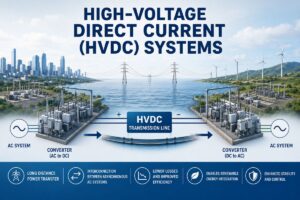
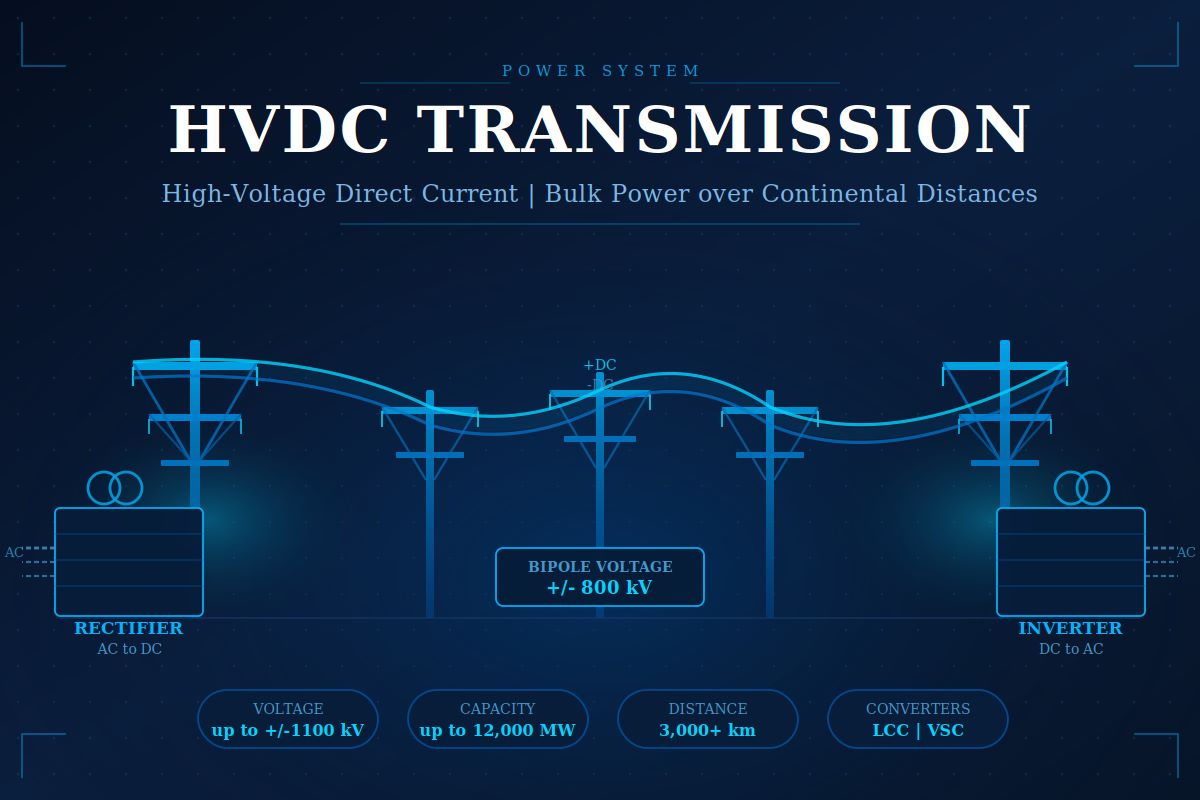
HVDC transmission converts three-phase AC power at the sending end into high-voltage DC, transmits it over a line or cable, and then inverts it back to AC at the receiving end. The conversion equipment at each terminal — historically a thyristor-based Line-Commutated Converter (LCC) and, in modern installations, a Voltage-Source Converter (VSC) — is the defining technological component of the entire system.
The fundamental electrical advantage is straightforward: direct current carries no reactive power losses associated with inductance and capacitance in long cables. In AC systems, the charging current of a long underground or submarine cable can consume so much reactive power that no useful active power reaches the far end beyond a critical distance — roughly 50–80 km for a submarine cable. HVDC has no such limit. The cable is essentially a pure resistive conductor, and power delivery efficiency improves dramatically over distances exceeding 600–800 km overland or any significant submarine route.
The Break-Even Distance: HVDC terminals are expensive relative to AC substations, but HVDC lines are cheaper per kilometre (fewer conductors, smaller towers). The crossover point — where total HVDC project cost equals AC — is approximately 600–800 km of overhead and 50–80 km of submarine cables. Beyond these distances, HVDC is unambiguously more economical.
Converter Technologies: LCC vs. VSC
Two converter families define the HVDC landscape, each with distinct operational characteristics.
A line-commutated converter uses thyristors and relies on the AC network for commutation. It dominates ultra-high-voltage, ultra-long-distance projects where bulk power transfer — often 3,000–12,000 MW — is the primary objective. The UHVDC links in China (Changji–Guquan at ±1,100 kV) represent the current apex of LCC technology. However, LCC systems consume reactive power, require synchronous AC networks at both ends, and cannot feed into weak or passive grids.
Voltage-Source Converter uses fully controllable IGBT (Insulated Gate Bipolar Transistor) valves, enabling independent, rapid control of both active and reactive power. VSC can energise passive networks and connect offshore wind farms with no local generation. It reverses power flow without reversing voltage polarity, making it the preferred technology for HVDC grids and multi-terminal systems. Modern Modular Multilevel Converter (MMC) topology has reduced losses and harmonic content to levels competitive with LCC.
Key Applications of HVDC Transmission
HVDC earns its place in the grid wherever AC transmission reaches its physical, economic, or operational boundaries.
Hydro-rich regions in Brazil (Belo Monte, ±800 kV), China (multiple ±800 kV and ±1,100 kV corridors), and India (Rihand–Delhi at ±500 kV) deliver thousands of megawatts from remote generation sources to population centres thousands of kilometres away — distances impossible to serve economically with AC.
The NorNed cable between Norway and the Netherlands (580 km, 700 MW), the BritNed link, and the planned NeuConnect interconnector between Germany and the UK all exploit HVDC’s unique ability to make long submarine cables practical. HVDC cables are now the standard technology for cross-sea interconnectors worldwide.
As offshore wind turbines move further from shore — 100 km, 150 km, and beyond — VSC-HVDC becomes the only technically viable export option. The DolWin, BorWin, and SylWin converter platforms off Germany’s North Sea coast exemplify this, each connecting up to 900 MW of offshore wind to the mainland grid.
HVDC back-to-back stations connect AC grids that operate at different frequencies or that must remain electrically decoupled for stability reasons. In India, back-to-back stations at Vindhyachal and Sasaram interconnect the Northern, Western, and Eastern regional grids. This allows power exchange while preventing fault propagation between regions.
HVDC links act as controllable firebreaks in the power system. Because power flow is set electronically rather than governed by Kirchhoff’s network equations, an HVDC link does not participate in AC fault propagation or inter-area oscillations. This makes strategic HVDC interconnections a powerful tool for improving overall AC system stability — not just for transferring power, but for actively damping oscillations through supplementary modulation controls.
Planning and Engineering an HVDC Project
An HVDC project spans a complex planning horizon that integrates power system studies, environmental permitting, civil engineering, equipment procurement, and multi-stakeholder coordination. The key engineering decisions made early in the process largely determine the technical and economic outcome of the entire scheme.
Load flow, short-circuit, and electromagnetic transient (EMT) studies define the power rating, voltage level, and whether LCC or VSC is more appropriate. AC network strength at both terminals is a critical determinant: weak AC grids almost always mandate VSC. Power rating is sized to grid development forecasts 15–25 years ahead, given the long asset life of HVDC infrastructure.
Overhead line routes must balance right-of-way costs, terrain, environmental sensitivity, and proximity to population centres. Submarine cable routes require detailed seabed surveys, collision risk assessments, and coordination with fisheries and shipping. Environmental impact assessment is increasingly a critical path item — permitting can take 5–10 years in Europe for major interconnectors.
The station encompasses valve halls (containing the converter valves), converter transformers, AC filters (for LCC), DC switchgear, cooling systems, and the control and protection platform. Valve hall design, particularly the insulation coordination and cooling architecture for high-power IGBT valves, is a specialist engineering domain. Control system design must address both steady-state power scheduling and dynamic responses to AC faults at either terminal.
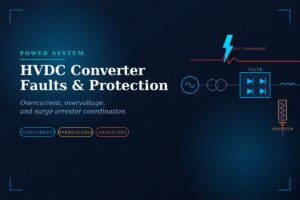
Factory acceptance testing of converter valves, system-level testing on hardware-in-the-loop (HIL) simulators, and staged energisation during commissioning are mandatory milestones. Protection relay coordination between the HVDC system and adjacent AC networks requires careful study, as DC fault currents rise extremely rapidly — within microseconds — demanding ultra-fast DC circuit breakers or fault-blocking converter designs for multi-terminal systems.
DC fault interruption remains the central unsolved engineering challenge for multi-terminal HVDC grids. Unlike AC, which passes through zero naturally 100 times per second, DC fault current must be forced to zero by mechanical or semiconductor means. DC circuit breakers capable of interrupting tens of kiloamperes in under 5 milliseconds have only recently become commercially available, at costs that significantly affect project economics.
Modern Trends Shaping HVDC Technology
The HVDC industry is undergoing a genuine technology inflection point, driven by the global energy transition, advances in power electronics, and the growing recognition that point-to-point links must evolve into meshed DC grids.
China’s Changji–Guquan link transmits 12,000 MW over 3,293 km at ±1,100 kV — the highest DC voltage ever used commercially. This represents a 50% increase in power density over previous ±800 kV UHVDC systems and sets the benchmark for the next generation of continent-scale power corridors.
Europe’s North Sea Wind Power Hub concept envisions a multi-terminal HVDC grid that connects the UK, Germany, Denmark, and the Netherlands via shared offshore converter hubs. The European HVDC Overlay — a planned meshed DC transmission backbone — would fundamentally change how continental power flows are managed, requiring new DC grid codes and protection standards.
Embedding VSC-HVDC links within dense AC networks — rather than using them only as long-distance bulk corridors — allows precise power flow control and congestion management impossible with AC alone. This Flexible AC Transmission System (FACTS) equivalent at the DC level is driving a new category of embedded HVDC applications in mature AC grids.
Silicon Carbide (SiC) MOSFET technology, already dominant in EV powertrains and industrial drives, is now entering HVDC converter development. SiC switches at higher frequencies and lower on-state losses than silicon IGBTs, potentially reducing converter losses from approximately 1% per terminal to below 0.5% — a meaningful efficiency gain for continental-scale power transmission. Several OEMs have announced SiC-based valve prototypes for grid-scale applications.
High-temperature superconducting (HTS) DC cables, operating at liquid nitrogen temperatures (77 K), can carry 3–5 GW through a cable smaller in diameter than conventional XLPE cables, with near-zero resistive losses. While commercial deployment remains limited by cooling infrastructure costs, pilot projects in Germany (EnergyNecklace) and the US are building the engineering evidence base for urban HVDC using superconducting technology.
The global renewable energy transition is the single largest driver of HVDC demand. Solar and wind resources are geographically concentrated — the Sahara, Patagonia, Rajasthan, the North Sea — while consumption centres are elsewhere. Delivering this energy at a continental scale requires HVDC. The IEA estimates that achieving net-zero emissions by 2050 requires approximately 80,000 km of new HVDC transmission lines globally by mid-century, compared to roughly 7,000 km installed today.
HVDC in India: A Growing Portfolio
India operates several landmark HVDC installations that have played a defining role in national grid integration. The Rihand–Delhi bipole (±500 kV, 3,000 MW, 910 km), commissioned in stages since the early 1990s, was a pioneering project that demonstrated bulk HVDC viability on the Indian subcontinent. Back-to-back stations at Vindhyachal, Chandrapur, and Sasaram enabled the phased electrical integration of the regional AC grids into the unified national grid — a process completed in 2013.
Looking ahead, India’s transmission masterplan includes new HVDC corridors to evacuate large-scale solar power from Rajasthan and wind energy from the southern peninsula to load centres in the north and west. POWERGRID has announced studies for ±800 kV HVDC projects, and the 500 MW submarine HVDC cable connecting mainland India to the Andaman and Nicobar Islands represents a new application domain for the technology.
Conclusion: DC Becomes the Grid’s Backbone
HVDC began as a solution to problems AC could not solve. It is becoming the architecture through which the clean energy future will be built. As renewable generation scales to terawatts and is deployed across continents, the question is no longer whether HVDC will be part of the grid — it is whether the engineering and regulatory frameworks can be developed quickly enough to build the HVDC infrastructure the world needs. From UHVDC bulk corridors in Asia to North Sea offshore grids to submarine interconnectors stitching together regional markets, high-voltage direct current is no longer the grid’s exception. It is rapidly becoming the rule.