Area flow meter
Area flow meter
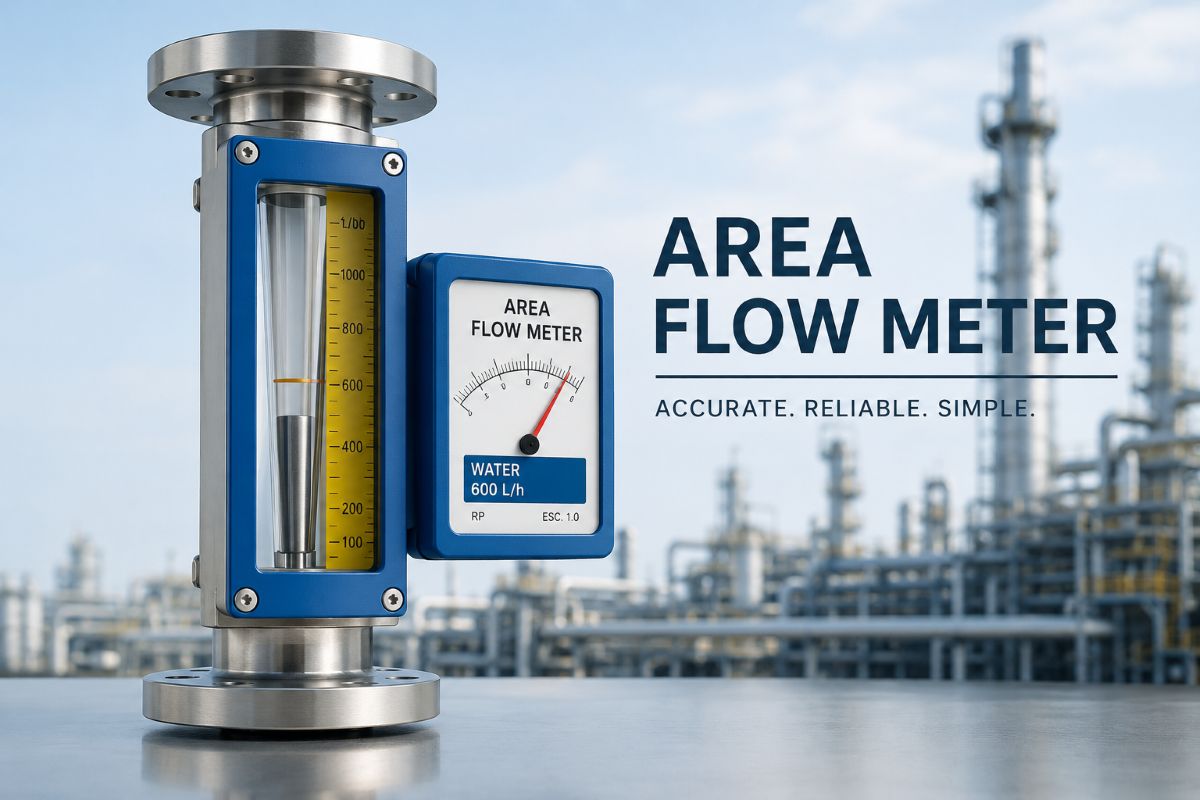
An area flow meter, also known as a variable area flow meter or rotameter, is one of the simplest and most widely used instruments for measuring liquid and gas flow in industry. It consists of a tapered tube and a float. The process fluid enters from the bottom and moves upward. As the flow increases, the float rises inside the tapered tube. Because the tube widens toward the top, the available flow area around the float becomes larger as the float rises. The float stops at the point where the upward force from the flowing fluid balances the downward force due to gravity. The float position is then calibrated in units of flow. This simple operating principle makes the rotameter easy to install, easy to read, and useful for many local indication applications.
Glass tube rotameters are the traditional form of area flow meter. In this design, the measuring tube is made of transparent glass, usually borosilicate glass, so the float can be seen directly. The operator reads the float position against a printed scale on the tube. Glass tube rotameters are economical and convenient for clean, non-hazardous services where direct visual indication is enough. According to the fetched selection guidance, they are especially suitable for clean air, inert gases, and water in low-flow applications. However, their use is limited by the mechanical strength of the glass tube. The same guidance states that glass tube rotameters are generally not recommended for flammable, toxic, dirty, or corrosive media in standard service, and it gives typical limits of about 415 kPa gauge pressure and 90°C temperature.
Metal tube rotameters are built for much tougher operating conditions. Instead of a transparent glass tube, they use a metal measuring tube, usually stainless steel or another corrosion-resistant alloy. Since the float cannot be seen directly, the float position is transmitted magnetically to an external indicator, which may be a pointer scale or a digital display. Some models also provide 4–20 mA output, alarms, or HART communication. Metal tube rotameters are selected when the process fluid is chemically reactive, opaque, under high pressure, at high temperature, or located in a hazardous area. The fetched material describes them as suitable for flammable, toxic, or corrosive media, and also for flammable and explosive dangerous places.
In hazardous areas, the application of the rotameter must be considered very carefully. A hazardous area is a location where flammable gases, vapors, or combustible dusts may be present in sufficient concentration to create an explosion risk. In such places, instrument strength, leak tightness, and certification are all important. Metal tube rotameters are preferred because they provide stronger containment and can be supplied with explosion-proof or Ex-rated arrangements. Some manufacturers offer hazardous-area-certified variable-area meters, including certain glass-tube models, but standard engineering guidance still favors metal-tube construction for hazardous media. In practical industrial selection, if the service involves hydrocarbons, solvents, or toxic chemicals in a classified area, the safer choice is normally a metal tube rotameter.
For flammable liquids such as solvents, light hydrocarbons, or fuel additives, glass tube rotameters are usually avoided because breakage would create an immediate spill and vapor hazard. A metal tube rotameter is more suitable because the tube is mechanically strong and better able to contain the process. This makes it useful in petrochemical plants, paint and solvent units, and chemical dosing systems where combustible liquid flow must be monitored locally.
For corrosive liquids, material compatibility becomes the key selection factor. Mild corrosive liquids may sometimes be measured with anti-corrosion glass rotameters, particularly in laboratory or low-pressure services. However, for strong acids, alkalis, oxidants, and aggressive solvents, metal tube rotameters with special wetted materials are usually preferred. The guidance mentions float and body materials such as 316 stainless steel, Monel, Hastelloy C, and titanium, and it also notes that PTFE or PFA liners may be used for highly corrosive fluids. This makes metal tube rotameters suitable for acid dosing, alkali transfer, and chemical injection applications.
Viscous liquids require extra attention because viscosity changes the drag on the float and can alter the calibration. Rotameters can be used for some viscous liquids, but only when the manufacturer calibrates the meter for the actual liquid properties and operating conditions. One search result notes that rotameters can measure loaded and viscous liquids, while another notes that for very viscous liquids such as oils and syrups, positive displacement or Coriolis meters may be better choices. So, a rotameter may be acceptable for moderate viscosity, but not always ideal for very high viscosity service.
For corrosive gases, the selection again depends on pressure, hazard level, and material compatibility. Anti-corrosion glass rotameters may be used in light-duty or laboratory applications for corrosive gas service, but industrial plants generally prefer metal tube rotameters because they are safer and stronger. This is especially important for acid gases, oxidizing gases, or gas streams that must remain well contained.
For flammable gases, such as fuel gas or hydrocarbon gas, metal tube rotameters are the normal choice. The sources clearly state that metal tube designs are suitable for flammable media and for explosive dangerous places. These meters are used in refinery units, gas skids, burner fuel lines, and purge gas systems where reliable indication and safer enclosure are required.