Cabinetless Automation ROI: Cost Savings, Downtime Reduction, Sustainability & Future Trends
√ Cabinetless Automation: Cost, Downtime, Sustainability & the Future of Smart Machines
Cabinetless automation is not just a technical upgrade — it’s a strategic shift that impacts cost, uptime, sustainability, and future-readiness. By eliminating centralized control cabinets and distributing drives, I/O, and safety modules directly onto the machine, OEMs and factories are unlocking new levels of efficiency. The cabinetless automation ROI is becoming a major driver for OEMs and factories
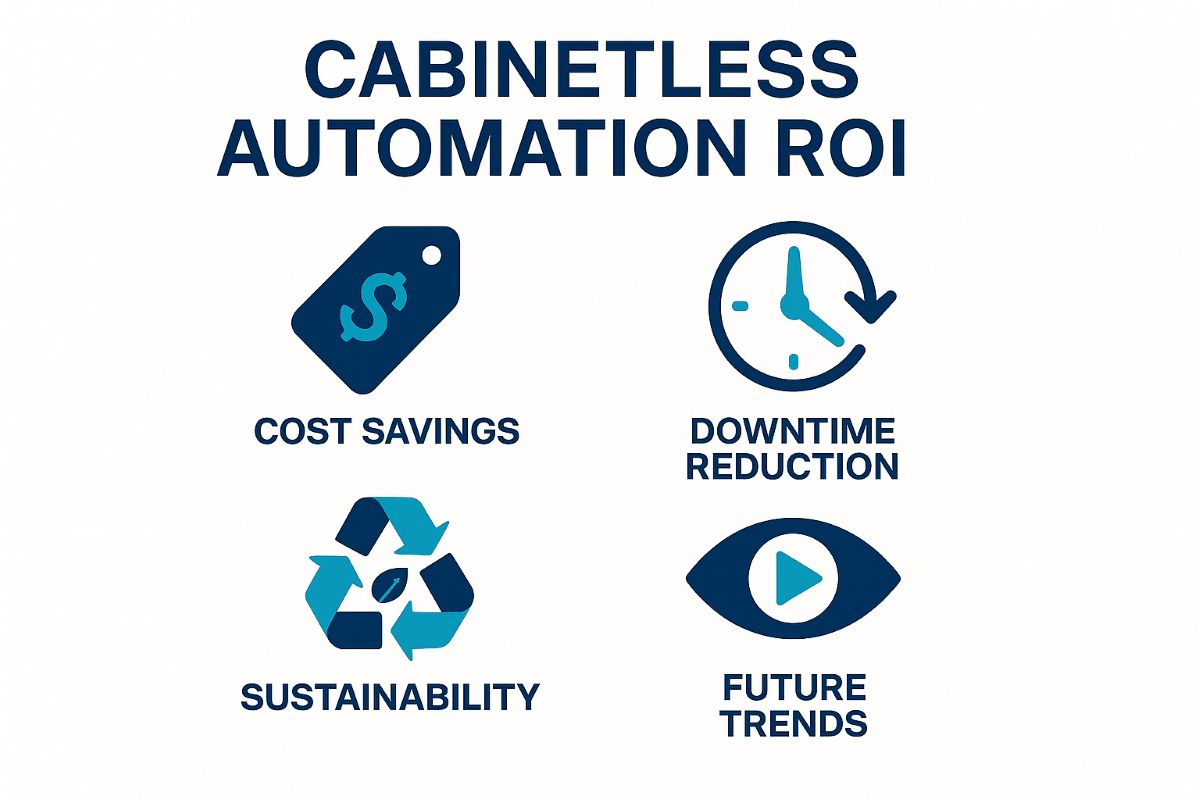
This blog explores six critical dimensions:
- 💸 Cost comparison
- 🔧 Maintainability and uptime
- 🌱 Sustainability
- 🔮 Industry 4.0 integration
- 🧱 Modular production (MTP)
- 📉 The future of control cabinets
💸 1. Cabinetless Automation ROI: Why Businesses Are Moving Beyond Traditional Cabinets. Cost Comparison: Cabinetless vs Traditional Cabinet-Based Machines
Cabinetless machines reduce costs across multiple dimensions:
🔧 Wiring & Labor
| Item | Traditional | Cabinetless |
|---|---|---|
| Cable length | Long runs to the cabinet | Short local cables |
| Cable trays | Required | Often eliminated |
| Labor hours | High | 40–60% less |
| Error rate | Higher | Lower due to plug-and-play |
🧰 Panel Building
- Traditional:
- Large enclosure
- DIN rail mounting
- Terminal blocks
- Cooling fans
- Safety relays
- Cabinetless:
- Small junction box or none
- IP67 modules on the machine
- No cooling required
- Safety over EtherCAT
⏱️ Commissioning Time
- Traditional: 2–4 weeks
- Cabinetless: 3–5 days
📉 OEMs report 15–30% lower total machine cost when switching to cabinetless architecture.
🔧 2. How Cabinetless Machines Reduce Downtime and Improve Maintainability
Downtime is expensive. Cabinetless systems improve uptime through:
🧩 Field-Replaceable Modules
- IP67 drives and I/O can be swapped without opening a cabinet
- No need to shut down the entire machine
- Modules are hot-swappable in EtherCAT networks
🔌 Plug-and-Play I/O
- Pre-configured modules
- Auto-detection via IO-Link
- No manual wiring or terminal blocks
📡 Remote Diagnostics
- EtherCAT enables real-time fault detection
- Safety and motion errors are logged and timestamped
- Maintenance teams can diagnose issues remotely
🛠️ Faster Service
- No cabinet = no door unlocking, no ladder climbing
- Technicians access modules directly on the machine
- Less training required
📈 Result: 20–40% reduction in unplanned downtime and faster MTTR (Mean Time to Repair).
🌱 3. Sustainability Benefits of Cabinetless Automation
Cabinetless systems support green manufacturing goals:
🧵 Less Copper
- Shorter cables
- Fewer cable trays
- Hybrid cables reduce material usage
🧱 Fewer Materials
- No large enclosures
- No cooling fans
- No terminal blocks or DIN rails
⚡ Lower Energy Use
- Drives mounted near motors = less energy loss
- No cabinet cooling = lower HVAC load
- EtherCAT P reduces power conversion losses
📦 Smaller Footprint
- Machines occupy less floor space
- Easier to relocate or reconfigure
- Supports lean manufacturing layouts
🌍 Many OEMs report 10–20% lower energy consumption and reduced carbon footprint with cabinetless designs.
🔮 4. Cabinetless + EtherCAT + Digital Twins: The Next Generation of Smart Machines
Cabinetless systems are ideal for digital twin integration because:
📡 Real-Time Data
- EtherCAT provides deterministic updates
- Drives, I/O, and safety modules stream live data
- Supports simulation and predictive analytics
🧠 Modular Mapping
- Each module has a unique ID and function
- Digital twins can simulate module behavior
- Easy to replicate machine sections
🧪 Simulation-Driven Design
- Engineers test machine logic before deployment
- Virtual commissioning reduces errors
- Maintenance scenarios can be rehearsed
🔗 Cloud Connectivity
- EtherCAT data can be mirrored to cloud platforms
- Supports dashboards, alerts, and remote control
🧠 Cabinetless machines become self-aware, self-diagnosing, and simulation-ready — the foundation of Industry 4.0.
🧱 5. Why Cabinetless Systems Are the Natural Fit for Modular Production (MTP)
Modular Type Package (MTP) is a standard for plug-and-produce manufacturing. Cabinetless systems align perfectly:
🔌 Independent Modules
- Each machine section has its own drives, I/O, and safety
- No dependency on a central cabinet
🔁 Plug-and-Produce
- Modules connect via EtherCAT
- Auto-configuration and diagnostics
- Easy to add/remove modules
🧱 Scalable Architecture
- Machines can grow or shrink based on demand
- Ideal for batch production and flexible lines
📦 Faster Changeovers
- No rewiring
- No cabinet redesign
- No PLC reprogramming
Cabinetless automation is MTP-native — it supports modular orchestration, reusability, and rapid deployment.
📉 6. The Rise of Machine-Mounted Drives: Will Control Cabinets Disappear by 2030?
Control cabinets are shrinking — and in many machines, disappearing.
📈 Trends Driving Cabinetless Adoption:
- IP67 drives and I/O
- EtherCAT P hybrid cables
- Safety over EtherCAT
- Predictive maintenance
- Modular production (MTP)
- Digital twins and simulation
🧠 OEM Adoption:
- Packaging: 60–80% wiring reduction
- Automotive: EtherCAT-based modular stations
- Pharma: IP69k hygienic modules
🔮 By 2030:
- Cabinets will be optional in most machines
- Drives will be mounted directly on the frame
- Safety will be networked
- Diagnostics will be cloud-based
- Machines will be plug-and-play
📊 The cabinet is no longer the brain of the machine — it’s becoming a legacy component.
🧠 Summary: Cabinetless Automation Is a Business Strategy
Cabinetless automation delivers:
- 💸 Lower machine cost
- 🔧 Faster commissioning
- 📉 Reduced downtime
- 🌱 Sustainability gains
- 🔮 Industry 4.0 readiness
- 🧱 Modular scalability
As the cabinetless automation ROI continues to rise, manufacturers will shift toward modular, distributed architectures. It’s not just about removing a cabinet — it’s about reimagining how machines are built, maintained, and evolved.