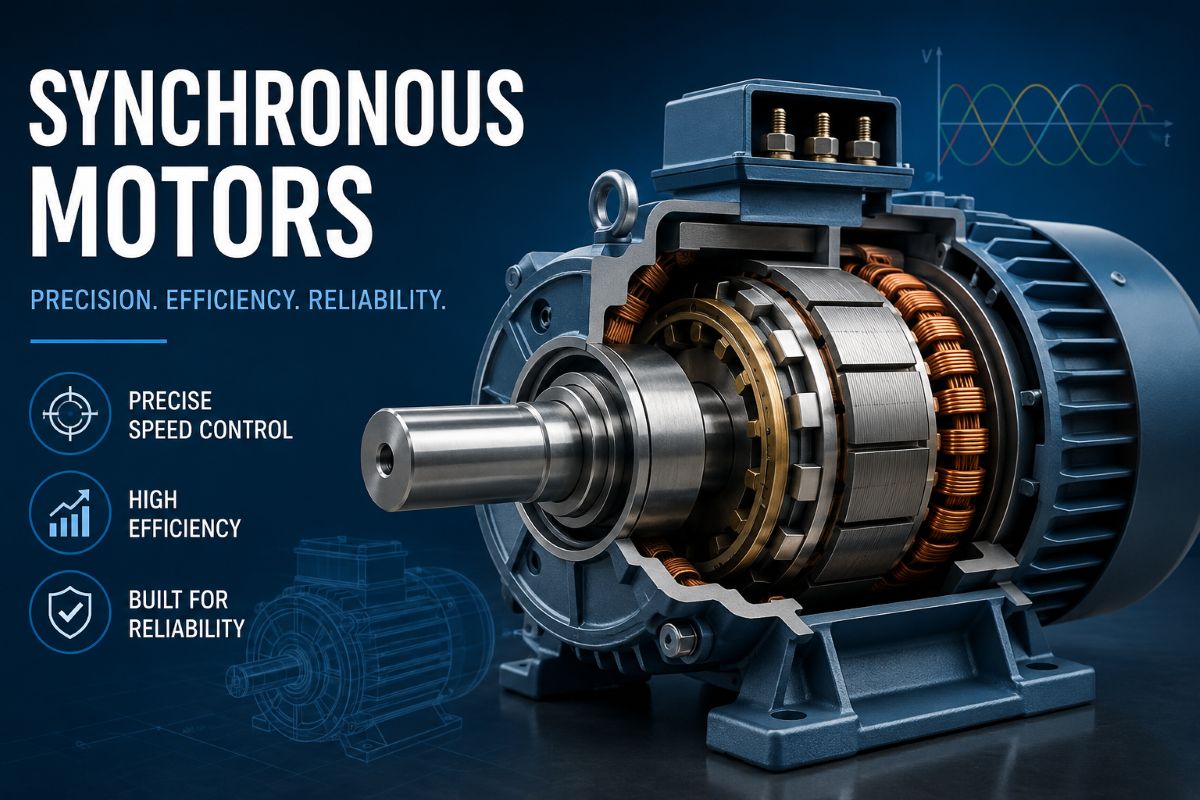
Synchronous Motors
Synchronous Motors
Understanding Constant-Speed Electromagnetic Power Conversion
What is a Synchronous Motor?
A synchronous motor is an AC induction machine that operates at a constant speed directly proportional to the frequency of the AC supply. Unlike induction motors, which rely on slip between the rotor and rotating magnetic field, synchronous motors maintain perfect speed synchronization with the supply frequency, making them ideal for applications demanding precise speed control and high power factors.
Construction and Components
A synchronous motor consists of two main components: a stator and a rotor. The stator comprises three-phase armature windings distributed around the inner surface of a cylindrical iron core. These windings are connected to a three-phase AC power supply. The rotor (also called the field structure) contains field windings that require a separate DC power supply for excitation. This DC supply is typically delivered through slip rings and brushes mounted on the shaft.
The synchronous motor’s ability to operate at constant speed depends critically on the field winding excitation and the mechanical load. Proper field adjustment maintains synchronism, preventing the motor from falling out of step with the rotating magnetic field of the stator.
Operating Principle
When three-phase AC flows through the stator windings, a rotating magnetic field is established. This field rotates at synchronous speed determined by the equation: Ns = 120f/P, where f is the frequency in Hz, and P is the number of poles.
The DC-excited rotor develops its own magnetic field. This rotor field locks onto the rotating stator field, causing the rotor to rotate at the same speed as the magnetic field—the synchronous speed. If external torque tries to slow the rotor, the angle between the rotor and stator fields increases, developing restoring torque that maintains synchronism. This unique characteristic distinguishes synchronous motors from asynchronous induction machines.
Types of Synchronous Motors
Cylindrical Rotor Synchronous Motors: Feature a uniform cylindrical rotor with distributed DC field windings, ideal for high-speed applications and large power generation systems.
Salient Pole Synchronous Motors: Have protruding poles on the rotor structure, providing higher torque at lower speeds and better load-pulling capability, preferred for industrial drive applications.
Permanent Magnet Synchronous Motors: Use permanent magnets instead of field windings, eliminating the need for separate excitation and reducing losses—increasingly popular in modern applications.
Industrial Applications
Synchronous motors excel in applications requiring constant speed operation and power factor correction. Common uses include compressors, blowers, pumps, and hydraulic drives in manufacturing facilities. They’re extensively used in rolling mills, printing presses, and process control systems where speed and precision is critical. Synchronous condensers improve power factors in electrical grids by drawing or supplying reactive power. Their ability to operate at leading power factors makes them valuable for industrial facilities seeking to reduce reactive power penalties.
Advantages and Limitations
Advantages: Constant speed operation independent of load, high efficiency, ability to improve power factor, higher pull-out torque capabilities, and precision speed control make them suitable for critical industrial processes.
Limitations: Require separate DC excitation supply and complex control circuits, cannot self-start without damper windings, have a higher initial cost than induction motors, and require skilled maintenance personnel familiar with synchronous machine operation.
Conclusion
Synchronous motors remain indispensable in industrial automation and power systems where constant speed, high efficiency, and power factor correction are paramount. Their operation at fixed synchronous speed, combined with excellent performance characteristics, makes them the choice for demanding applications despite higher complexity and cost. Modern advances in permanent magnet materials and power electronics continue expanding synchronous motor applications in renewable energy systems, electric vehicles, and industrial IoT-enabled facilities.