Quantity flow meters
Quantity flow meters
Quantity flow meters, also known as positive displacement (PD) flow meters, measure total fluid volume by repeatedly filling and emptying known compartments and counting cycles. The major types are tilting trap meters, piston meters, nutating disk meters, and rotary vane meters. Each traps a fixed volume per cycle and is therefore ideal for custody transfer, billing, batching, and services where cumulative volume matters more than instantaneous velocity.
Principle
Quantity meters operate by dividing the flow into discrete, known volumes. The meter mechanically traps a fixed amount of fluid, moves it to the outlet, and counts how many times this happens. Because the volume per cycle is constant, total flow is simply the number of cycles multiplied by the fixed volume. This approach is fundamentally different from velocity meters that infer flow from speed and area.
Tilting trap meter
A tilting trap meter is a mass-quantity meter in which a divided container or trap fills with fluid, tilts when full, and discharges the measured volume. The source material lists tilting traps under mass measurement, alongside weighing tanks, as a way to measure total quantity. In practice, the tilting motion is used to dump a fixed volume, and the number of tilts gives the total throughput.
This design is useful for batching and dosing where a direct mechanical count of volume is acceptable. It is less common in modern high-speed pipeline service but remains valid for simple industrial batching and for laboratory or process charging where repeatability matters.
Piston meter
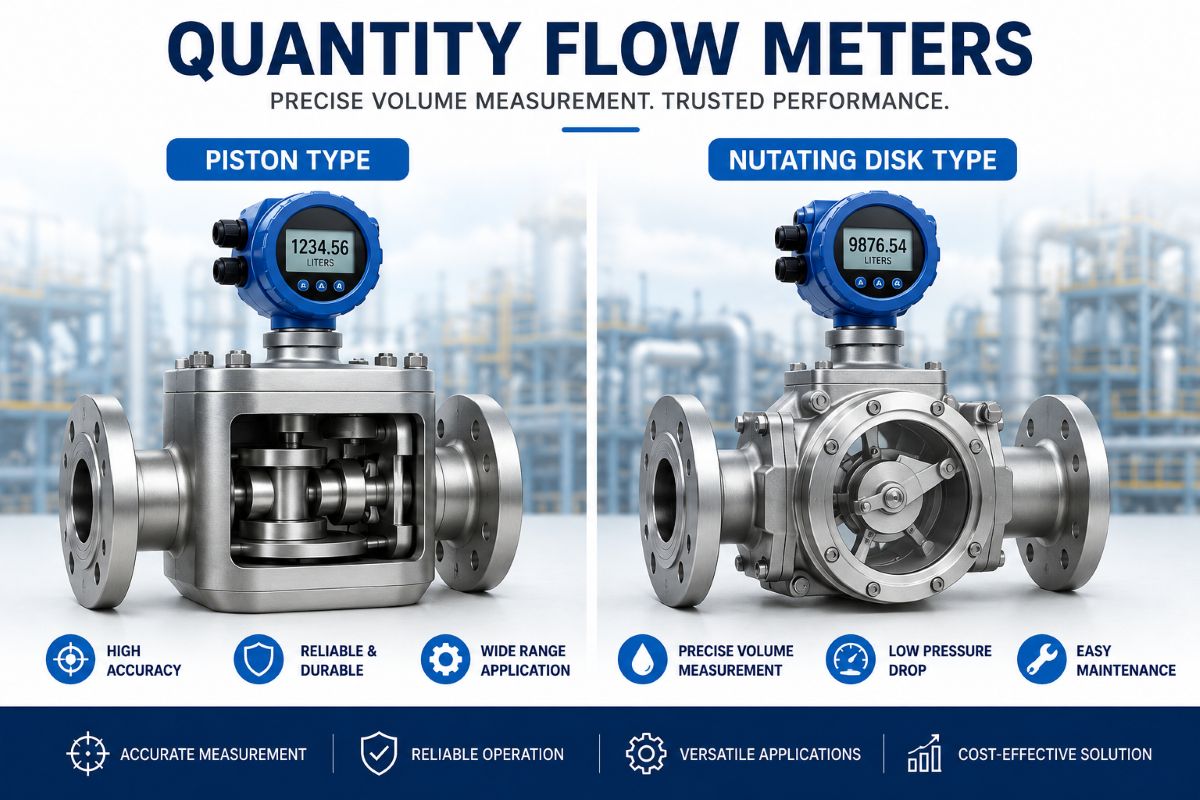
A piston meter is a positive displacement meter in which a piston reciprocates or oscillates inside a precisely machined chamber. Each stroke or oscillation displaces a fixed volume. The fetched material notes that there are two main types: the oscillating piston type and the single-piston reciprocating type. In the oscillating piston form, the piston rotates back and forth in the chamber, and each rotation corresponds to a fixed water volume. The piston motion is transmitted by magnetic coupling to an external register, so the total volume is displayed directly.
Piston meters are common in utility water metering, food and beverage, and chemical applications where high accuracy and low-flow sensitivity are needed. They are often described as positive displacement meters capable of precise flow measurement because the fluid is physically displaced rather than inferred.
Nutating disk meter
A nutating disk meter uses a disk that wobbles or nutates inside a measuring chamber. The chamber is divided into compartments by the disk and the housing geometry. As fluid flows through, the disk nutates, and each complete nutation cycle moves a fixed volume from inlet to outlet. The disk motion is sensed by a magnet and transmitted to a register or totalizer.
It is valued as a cost-effective, rugged, and reliable solution for clean water and industrial fluids like condensate, boiler feed, and additive dosing. The meter may be mechanically or magnetically coupled.
Rotary vane meter
A rotary vane meter consists of a circular rotor mounted inside a round compartment, with several sliding vanes that isolate fixed volumes of liquid between the rotor and the compartment wall. The center of the rotor is offset from the center of the compartment so that the vanes keep contact and form sealed pockets. As the rotor turns, these pockets move fluid from the inlet to the outlet, and each revolution represents a precisely measured volume. The output is then geared to totalize in gallons, barrels, or other units.
Rotary vane meters are commonly used for clean, low-viscosity liquids and for some light petroleum products.
Comparison and selection
For a user needing a simple mechanical totalizer, a tilting trap is one of the most direct methods. For clean water and utility billing, the nutating disk is a proven, low-cost positive displacement meter. For high accuracy in low flows or sanitary applications, the oscillating piston is preferred. For low-viscosity liquids in industrial service, the rotary vane meter remains a standard PD option. The shared principle across all four is that each cycle traps and counts a fixed volume, so these meters are inherently totalizing instruments and are well-suited to custody transfer, batch filling, and billing where cumulative quantity is the key measurement.