Velocity flow meters
Velocity flow meters
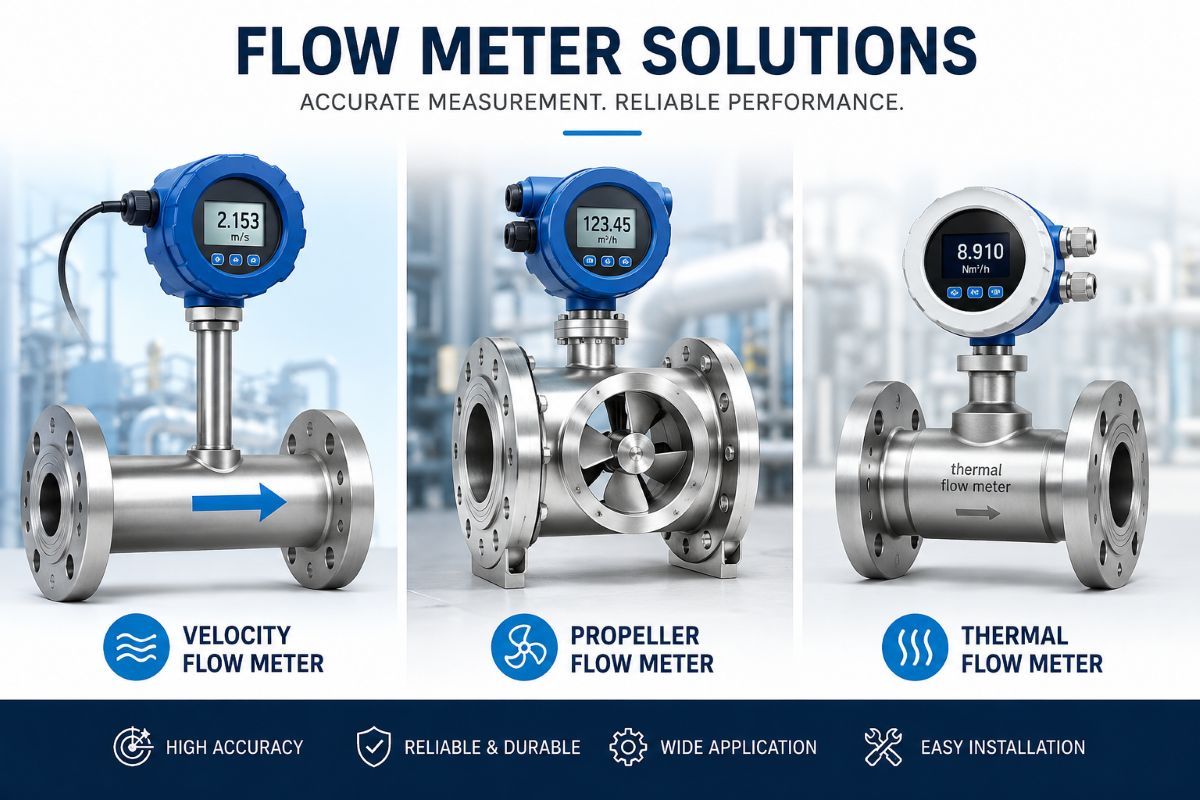
Velocity flow meters, propeller flow meters, and thermal flow meters are three important flow-measurement approaches that infer flow from velocity, but they do not measure flow in the same way. A velocity flow meter calculates flow from fluid speed and pipe area, a propeller flow meter is a mechanical velocity meter that uses a rotating element, and a thermal flow meter measures mass flow from heat transfer between a sensor and the moving fluid.
Velocity flow meter
A velocity flow meter is a broad category of instrument in which the meter first determines the fluid velocity and then converts that value into flow rate using the relationship Q=A×V, where Q is flow rate, A is cross-sectional area, and V is velocity. The basic principle behind velocity-based meters which are used to obtain the current flow rate in a pipe for monitoring and process control.
Many common industrial meters fall into this family because they sense velocity by different physical methods and then infer volumetric flow. For example, electromagnetic meters generate a voltage proportional to the velocity of a conductive fluid moving through a magnetic field, while area-velocity meters in open channels combine depth measurement with ultrasonic Doppler sensing to compute flow.
The main advantage of the velocity principle is versatility, because the same idea can be adapted to liquids in closed pipes, wastewater channels, irrigation systems, and other services. Its limitation is that accuracy depends not only on the sensor but also on a stable flow profile, correct pipe area, and proper installation, since any error in measured velocity or assumed area affects the final flow calculation.
Propeller flow meter
A propeller flow meter is a mechanical type of velocity flow meter in which the flowing liquid rotates a propeller mounted in the stream, and the rotational speed is related to the flow velocity. Rotation is converted into a signal or register output, allowing the instrument to indicate total flow or rate of flow in the pipeline.
These meters are especially common in large-diameter pipelines carrying clean, low-viscosity liquids, particularly water. Multiple sources describe them as widely used in agriculture, irrigation systems, municipal water supply, water treatment, industrial water systems, wastewater management, and some batching or valve-control duties because they are simple, repeatable, and cost-effective.
The strongest point of a propeller meter is its rugged simplicity in water service, especially where pipe sizes are large and the fluid is relatively clean. Its practical limitation is that it is better suited to clean or lightly contaminated, low-viscosity liquids than to sticky fluids, corrosive chemicals, or dirty slurries, because the propeller is a moving mechanical element exposed directly to the flow.
In hydrology, a related propeller-type current meter is also used to measure local flow velocity in rivers, canals, reservoirs, and irrigation channels. In that case, the device measures velocity at selected points in the water body, and the overall channel flow is then estimated from the measured velocities and the cross-sectional area of the stream.
Thermal flow meter
A thermal flow meter measures flow by observing how a moving fluid removes heat from a heated sensor or element. The sources explain that thermal flow meters use the thermal properties of the fluid to determine mass flow rate, and that this principle is especially common for gases flowing in closed pipes and ducts.
Two major forms appear repeatedly in the source material. One is the capillary or bypass thermal mass flow meter, which is widely used for low flows of clean gases and can also be applied to higher flows through a bypass arrangement, and the other is the full-bore or inline thermal meter, which may be supplied as an insertion probe or an inline instrument for direct measurement in the main flow path.
A major benefit of the thermal meter is that it measures mass flow directly rather than inferring mass flow from separate density or pressure compensation. This makes it highly useful in industrial gas measurement, burner management, compressed air monitoring, gas dosing, and duct applications where knowing true mass flow is more valuable than knowing only volumetric flow.
Thermal meters also have important selection limits. The sources emphasize that calibration is essential, and sensor design depends on the specific fluid, while common industrial use is mainly for gases and for relatively clean services, especially in capillary designs.
Selection and comparison
The easiest way to compare these three is by the physical quantity each one senses first. A general velocity flow meter senses flow speed and then converts it to volumetric flow, a propeller meter senses speed by mechanical rotation of a blade, and a thermal meter senses heat transfer and converts that to mass flow.
For clean water lines, irrigation networks, and municipal distribution systems, the propeller meter is often the practical and economical choice because it is built for large pipes and water service. For broad industrial applications where velocity is measured by electromagnetic, ultrasonic, or other methods, the velocity meter category offers flexibility, while for gas flow, where direct mass measurement is important, thermal flow meters are usually more attractive.
So, in simple terms, a velocity flow meter is the general concept, a propeller flow meter is one mechanical member of that family, and a thermal flow meter measures mass flow from heat loss rather than from fluid speed alone. In plant selection, the best choice depends mainly on fluid type, cleanliness, pipe size, whether the user needs volumetric or mass flow, and how much maintenance the application can tolerate.