Open channel flow meters
Open channel flow meters
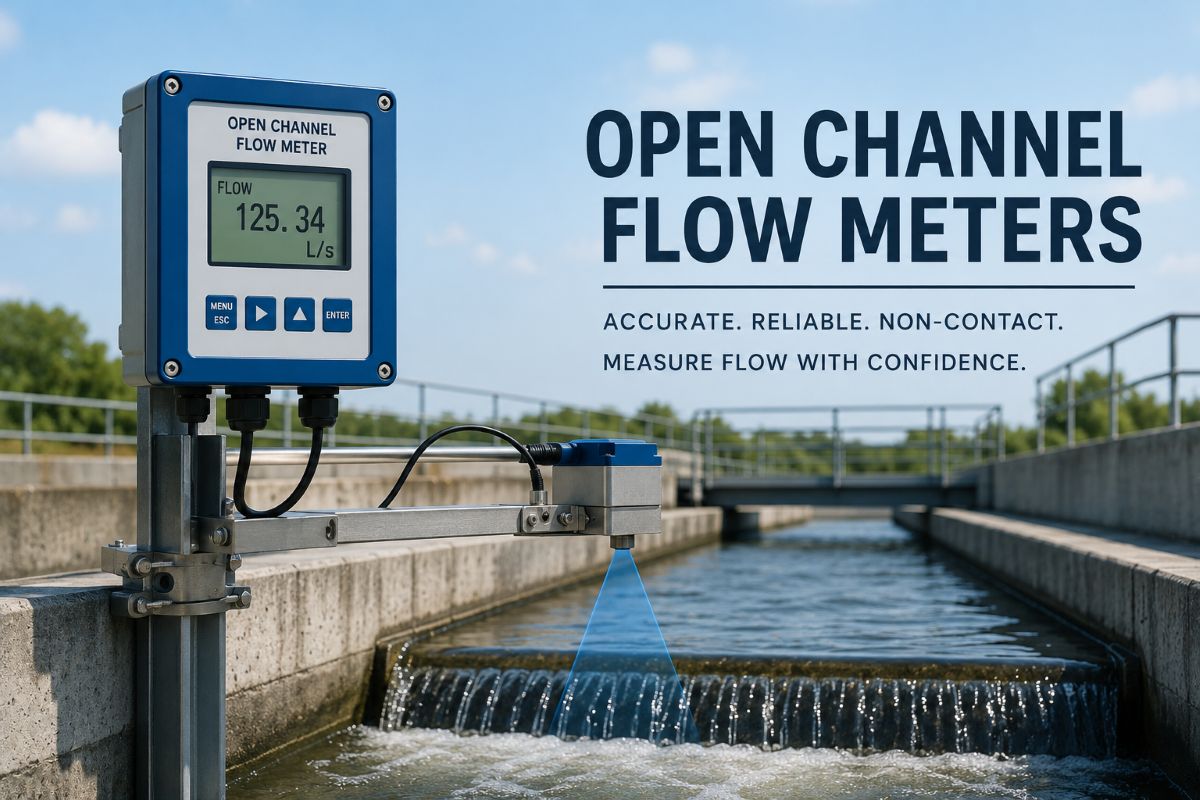
Open channel flow meters are used to measure liquid flow in channels, ditches, drains, rivers, and partially filled conduits, where the liquid has a free surface exposed to the atmosphere. The two most common primary devices are weirs and flumes, and the choice depends on channel geometry, expected flow range, head loss tolerance, debris load, and maintenance needs.
Open channel flow basics
Unlike closed-pipe flow measurement, open channel systems measure flow from the liquid level created by a restriction or shaped hydraulic structure. The meter usually determines the level upstream of the structure and converts that level into flow using a rating curve, formula, or built-in compensation algorithm.
In practice, the measuring point is installed where the flow is stable and straight enough for a clean upstream approach. Proper installation matters because turbulence, sediment, weeds, and downstream backup can all distort the level-to-flow relationship.
Weir
A weir is a vertical obstruction placed across the channel so the liquid must flow over a crest or notch. The upstream water level, called head, is measured and used to calculate discharge; common types include rectangular, V-notch, and trapezoidal weirs.
Weirs are simple, inexpensive, and popular for low to moderate flows, especially where a visible head condition is acceptable. Thin-plate weirs are among the most common devices, but they can require more maintenance because sediment and debris may collect upstream and alter the pool shape and accuracy.
A major advantage of a weir is simplicity, but the trade-off is higher head loss and greater sensitivity to upstream conditions. They are generally best where the channel can tolerate ponding and where regular cleaning is practical.
Flume
A flume is a specially shaped structure that constricts and accelerates flow through a throat section, while the upstream head is measured to determine discharge. Common flume types include Parshall, trapezoidal, and cutthroat flumes.
Flumes are usually preferred when lower head loss, better sediment handling, and more reliable long-term operation are needed. Because of their shape, they often pass debris and sediment better than weirs, which makes them suitable for irrigation channels, wastewater, and drainage applications.
Parshall flumes are especially widely used because they are economical, accurate, and available in many sizes. The source material notes that flumes can be used across a very wide range of flows and channel types, including trapezoidal channels, round pipes, and rectangular channels.
Weir vs flume
A practical rule is that weirs fit cleaner, lower-flow applications, while flumes fit harsher field conditions and larger flow variability. When maintenance access is limited or sediment is present, flumes are often the better engineering choice.
Measurement method
Open channel meters generally use a level sensor, staff gauge, or pressure-based head measurement upstream of the device. The meter then applies a rating table or equation to convert the level into the flow rate and total volume.
Modern open channel systems often use non-contact ultrasonic sensors, especially for weirs and flumes, because they avoid fouling and can also be used for tanks or partially filled channels. Some systems display level, flow, and totalized volume continuously and may provide output signals for SCADA or control systems.
Selection factors
The main selection factors are channel size, minimum and maximum flow, available head, sediment load, debris, space, and required maintenance. If the flow range is wide and the site has debris or sediment, a flume is usually more robust; if the installation is simple and the site can be kept clean, a weir may be enough.
For irrigation and drainage work, the device should also match the channel shape and slope. The source guidance emphasizes choosing the most economical device that fits the channel geometry and provides a reliable rating relationship over the expected operating range.
Industrial use
Open channel flow meters are widely used in wastewater treatment plants, stormwater channels, irrigation canals, effluent discharge lines, and environmental monitoring stations. In those applications, the meter helps with compliance, allocation, pump control, and totalization of liquid flow.
For a simple example, a rectangular weir may be used in a small drainage channel where the water level is easy to stabilize and inspect, while a Parshall flume may be selected for a wastewater channel carrying solids because it creates less blockage risk. That difference is why both devices remain important in practical flow measurement.
Open channel flow meters remain popular because they are rugged, understandable, and well-suited to gravity-flow systems. The key to good performance is matching the device to the hydraulics of the site rather than choosing only by initial cost.
An open-channel nozzle flow meter is a specialty open-channel device that uses a shaped nozzle-like restriction to create a predictable head-discharge relationship. Compared with a weir and a flume, it is usually a compact, low-loss option for free-discharge applications, but it is less common than the other two in standard canal measurement.
A nozzle meter measures flow by constricting and accelerating the liquid through a shaped passage, then relating the upstream level or pressure head to discharge. In open-channel use, the nozzle is applied where the liquid still has a free surface or discharges freely into a tank, lagoon, or manhole.
A weir works differently: it forces water to pass over a crest, so discharge depends on the head above the crest. A flume accelerates flow through a throat and often reaches critical depth, so discharge is calculated from the upstream head and the flume geometry.
Comparison
Nozzle: compact, low head loss, useful for free discharge and some custody-transfer style open-channel installations.
Weir: simplest and cheapest, but causes the highest backing-up and head loss.
Flume: better for sediment, debris, and lower head loss than a weir, with more stable field performance.
Practical choice
Choose a weir when the channel is clean, the flow is moderate, and simplicity matters most. Choose a flume when you want less head loss and better debris handling. Choose a nozzle-style open-channel meter when you need a compact arrangement and a controlled free-discharge profile, especially in specialized installations.
One-line summary
- Nozzle — Energy conversion: Pressure energy → velocity; flow inferred from pressure differential.
- Weir — Potential energy (head) drives overflow; flow inferred from the height of water above the crest.
- Flume — Critical flow transition: Channel geometry forces flow to the critical state; depth at a point gives the flow rate.