Scientists Behind Temperature, Pressure, Flow, and Level Measurement
🌡️ Scientists Behind Temperature, Pressure, Flow, and Level Measurement
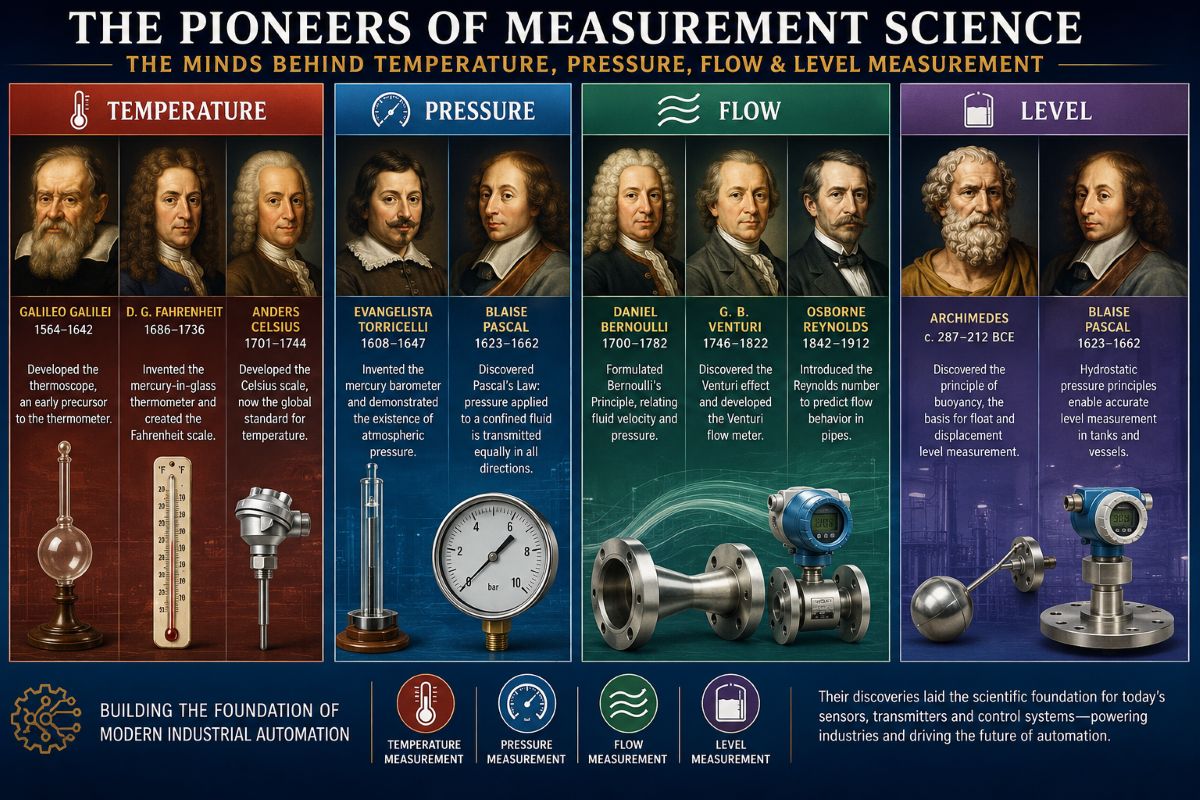
In instrumentation engineering, most measurement principles come from a few powerful scientific laws developed by famous scientists. These laws explain how heat, force, motion, and liquid height behave in real processes, and they form the base of modern transmitters, gauges, meters, and sensors.
This short note explains the main scientists involved in temperature, pressure, flow, and level measurement, along with their theories in simple professional language.
🌡️ Temperature Measurement
Temperature measurement is based on the idea that heat changes the physical or electrical properties of a material. In industry, temperature is usually measured by thermocouples, RTDs, thermistors, bimetallic elements, and filled thermal systems.
👨🔬 Main Scientists
- ▶ Thomas Johann Seebeck – discovered the Seebeck effect, which is the working principle of thermocouples.
- ▶ Anders Celsius – introduced the Celsius temperature scale used widely in engineering.
- ▶ William Siemens & Hugh Callendar – helped develop resistance temperature measurement using platinum RTDs.
📘 Theory in Simple Words
- Thermocouple principle: When two dissimilar metals are joined, and the two junctions are at different temperatures, a small voltage is produced. This is called the Seebeck effect.
- RTD principle: When the temperature increases, the electrical resistance of a metal such as platinum also increases. This is used in RTD sensors.
- Bimetal principle: Two different metals expand by different amounts when heated, causing bending. This is used in bimetallic thermometers.
📊 Mini Infographic:
🔥 Heat increase
⬇
⚡ Voltage changes in thermocouple (or 🔌 resistance changes in RTD)
⬇
📟 The indicator or transmitter shows temperature
🧭 Pressure Measurement
Pressure measurement is based on the force exerted by a fluid on a surface. In engineering terms, pressure is force per unit area. Pressure instruments convert this force into pointer movement or an electrical output signal.
👨🔬 Main Scientists
- ▶ Blaise Pascal – explained that pressure applied to a confined fluid is transmitted equally in all directions.
- ▶ Robert Hooke – gave Hooke’s law, which explains elastic deformation in pressure elements.
- ▶ Eugene Bourdon – developed the Bourdon tube pressure gauge.
📘 Theory in Simple Words
- Pascal’s law: Pressure in a confined fluid acts equally in all directions. This is the basis for hydraulic and pressure-sensing systems.
- Elastic deformation: When pressure is applied to an elastic element such as a Bourdon tube, diaphragm, or bellows, it changes shape. This movement is used for pressure indication.
- Strain gauge principle: In electronic transmitters, pressure deforms a diaphragm, and the attached strain gauges change resistance. This gives an electrical output.
📊 Mini Infographic:
💧 Fluid pressure
⬇
🔩 Diaphragm or Bourdon tube deflects
⬇
⚙️ Mechanical movement or electrical resistance change
⬇
📟 Pressure reading obtained
🌊 Flow Measurement
Flow measurement indicates how much fluid passes through a pipe in a given time. It may be measured as volumetric flow or mass flow. Flow measurement is one of the most important parts of process control because it connects directly with production rate and material balance.
👨🔬 Main Scientists
- ▶ Daniel Bernoulli – developed Bernoulli’s theorem, the foundation of differential pressure flow measurement.
- ▶ Michael Faraday – gave the law of electromagnetic induction used in magnetic flowmeters.
- ▶ Gaspard-Gustave Coriolis – explained the Coriolis effect used in Coriolis mass flowmeters.
📘 Theory in Simple Words
- Bernoulli’s theorem: When fluid flows through a restriction like an orifice plate, its velocity increases, and pressure decreases. The pressure drop is used to calculate flow.
- Faraday’s law: When a conductive liquid moves through a magnetic field, a voltage is induced. That voltage is proportional to flow velocity.
- Coriolis effect: When fluid passes through vibrating tubes, the tubes twist slightly. The twist is proportional to the mass flow rate.
📊 Mini Infographic:
🚰 Fluid enters the pipe
⬇
📉 Pressure drop / ⚡ induced voltage / 🔄 tube twist
⬇
🧠 Signal conversion
⬇
📟 Flow rate displayed
🛢️ Level Measurement
Level measurement determines the height of liquid or solid material inside a vessel, tank, or silo. It is essential for inventory control, overflow prevention, and process continuity.
👨🔬 Main Scientists
- ▶ Archimedes – developed the buoyancy principle used in displacer level measurement.
- ▶ Blaise Pascal – his pressure law supports hydrostatic level measurement.
- ▶ Christian Doppler – his wave theories indirectly influenced modern radar and ultrasonic measurement.
📘 Theory in Simple Words
- Hydrostatic principle: Pressure at the bottom of a liquid column depends on liquid height and density. A DP transmitter uses this relation to measure the level.
- Buoyancy principle: A displacer immersed in liquid experiences an upward force equal to the weight of displaced liquid. This is based on Archimedes’ principle.
- Time of flight principle: Radar and ultrasonic transmitters send a wave to the liquid surface and measure the return time. From this time, the level is calculated.
📊 Mini Infographic:
🛢️ Tank level changes
⬇
📏 Hydrostatic pressure / 🪶 buoyancy / 📡 reflected wave
⬇
🔄 Transmitter converts signal
⬇
📟 Level indication
🧠 Engineering View Summary
All four measurements use the same engineering logic: a physical quantity changes something measurable, and the instrument converts that change into a readable signal. Modern instruments may look digital and advanced, but their working principles still come from classical scientific theories.
- Temperature → Heat changes an electrical or physical property.
- Pressure → Force changes the elastic element.
- Flow → Moving fluid changes velocity, pressure, or induced signal.
- Level → Material height changes head pressure, buoyancy, or echo time.