Introduction to Power Electronics
Electrical Engineering
Introduction to Power Electronics
Discover the science behind converting, controlling, and conditioning electrical power — the technology that drives the modern world from smartphones to smart grids.
What Is Power Electronics?
Power electronics is the branch of electrical engineering that deals with the conversion, control, and conditioning of electric power using solid-state electronic devices. It sits at the crossroads of electrical power engineering and electronics, combining the two disciplines to achieve efficient and precise management of electrical energy.
At its core, power electronics focuses on processing electrical energy to make it suitable for specific applications — changing voltage levels, converting AC to DC or DC to AC, regulating frequency, or controlling the speed of motors. Unlike signal electronics, which works with low-power signals for information processing, power electronics handles large amounts of electrical power, often in the range of kilowatts to megawatts.
The field emerged in the 1950s with the invention of the thyristor (SCR) by General Electric. Since then, advances in semiconductor technology have rapidly expanded the capabilities of power electronic systems, making them smaller, faster, and far more efficient. Today, power electronics is inseparable from industrial automation, transportation, renewable energy, and consumer electronics.
Principle of Power Electronics
The fundamental principle of power electronics is controlled switching. Power electronic circuits use semiconductor devices as switches — rapidly turning them ON and OFF — to control the flow of electrical energy with minimal losses. Because ideal switches dissipate no power, switching-mode operation achieves far higher efficiency than linear regulation methods.
1
Input Power Stage
The raw electrical power — either from the AC utility grid or a DC source like a battery — enters the power electronic circuit. This input may be single-phase or three-phase AC, or varying-voltage DC.
2
Switching Action (Conversion)
Semiconductor switching devices (thyristors, MOSFETs, IGBTs, diodes) are turned ON and OFF at precisely controlled intervals using gate/drive signals. This switching action chops, rectifies, inverts, or regulates the power flow as required.
3
Filtering and Conditioning
Passive components — inductors, capacitors, and transformers — smooth out the switched waveforms, filtering harmonics and ripple to produce a clean, regulated output suitable for the load.
4
Feedback and Control
A control circuit continuously monitors the output (voltage, current, frequency) and adjusts the switching duty cycle or firing angle to maintain the desired output under varying load and supply conditions — achieving tight regulation.
Key Semiconductor Devices in Power Electronics
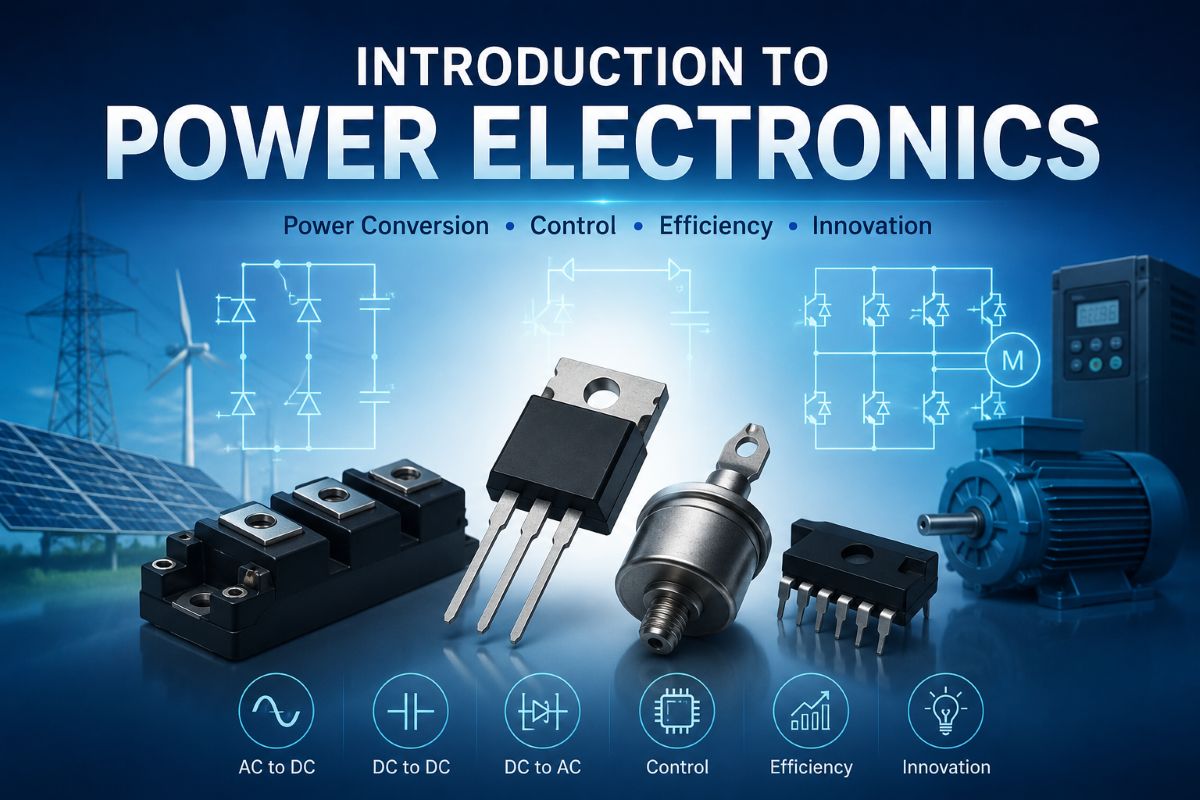
The principal switching devices include the Diode (uncontrolled rectification), SCR / Thyristor (phase-controlled AC-DC conversion), MOSFET (high-speed, low-voltage switching), IGBT — Insulated Gate Bipolar Transistor (high-power, medium-frequency applications), and GTO — Gate Turn-Off Thyristor (high-voltage industrial drives). Modern systems increasingly use wide-bandgap devices such as SiC and GaN transistors for ultra-high efficiency at elevated frequencies.
Application Areas of Power Electronics
Power electronics has penetrated virtually every sector of modern society. Its ability to efficiently convert and control electrical energy has made it indispensable across industrial, commercial, and domestic domains. The major application areas are outlined below.
Industrial Drives & Motor Control
Variable frequency drives (VFDs) and DC motor controllers use power electronics to regulate the speed and torque of motors in pumps, fans, conveyors, compressors, and machine tools — dramatically reducing energy consumption in industrial processes.
Renewable Energy Systems
Solar photovoltaic inverters convert DC from solar panels into grid-compatible AC. Wind turbine converters manage variable-speed generators. Battery energy storage systems (BESS) rely on bidirectional power converters to charge and discharge efficiently.
Electric Vehicles (EVs)
Onboard chargers, traction inverters, DC-DC converters, and regenerative braking systems in electric and hybrid vehicles are all power electronics applications. EVs are arguably the fastest-growing sector for power electronic innovation.
Consumer Electronics & SMPS
Switched-mode power supplies (SMPS) power laptops, televisions, mobile chargers, and home appliances. They replace bulky linear power supplies with compact, lightweight, highly efficient converters using high-frequency switching.
HVDC Power Transmission
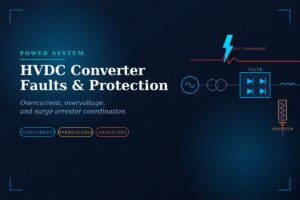
High Voltage Direct Current (HVDC) transmission systems use large thyristor or IGBT-based converters to transmit bulk electrical power over long distances with lower losses than AC transmission — critical for interconnecting national grids.
Medical & Aerospace
Medical imaging systems (MRI, X-ray), ventilators, and surgical equipment rely on precision power electronic supplies. In aerospace, power electronics manages onboard electrical systems, actuators, and avionics power conditioning on aircraft.
Power Electronics: The Engine of Modern Energy
From the tiny charger that powers a smartphone to the massive converters that link national power grids, power electronics is the invisible backbone of the electrified world. Its foundation — efficient switching, intelligent control, and compact semiconductor devices — enables society to generate, transmit, and consume electrical energy in smarter, cleaner, and more productive ways. As renewable energy adoption and electric mobility accelerate, the role of power electronics will only grow more central to engineering practice worldwide.