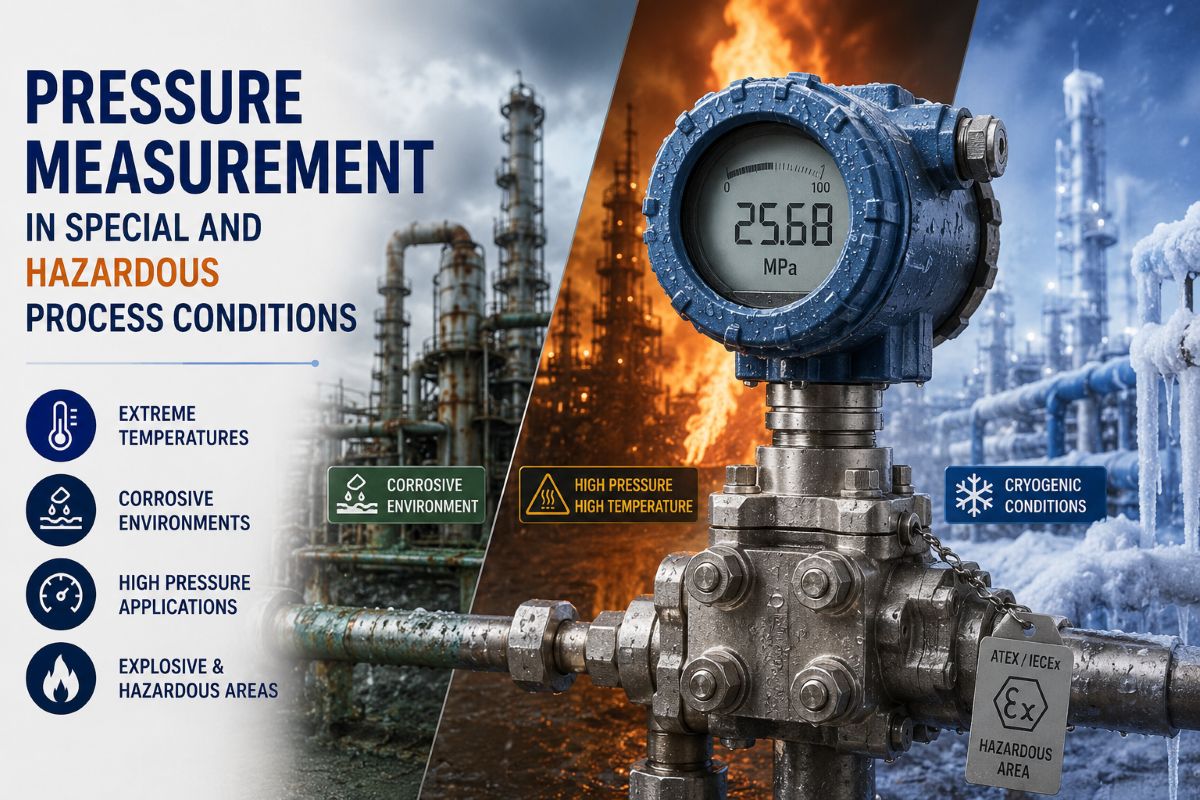
Pressure Measurement in Special and Hazardous Process Conditions
Pressure Measurement in Special and Hazardous Process Conditions
In industrial processes, Pressure Measurement is not always straightforward. Special precautions and instrument selection are required when the process fluid is corrosive, flammable, at high temperature, or highly viscous. This article covers the correct methods and instruments for each special condition.
1. Very Corrosive Liquid
Corrosive liquids such as acids, alkalis, chlorine solutions, and caustic chemicals can destroy standard instrument materials very quickly. Direct contact of the process liquid with the sensor element must be avoided.
Recommended methods:
Use a diaphragm seal system with a wetted diaphragm made from Hastelloy C, Tantalum, PTFE-lined, or Titanium, depending on the chemical
The diaphragm seal isolates the corrosive liquid from the pressure transmitter, and pressure is transmitted through a fill fluid (usually silicone oil)
Use corrosion-resistant pressure transmitters with 316L stainless steel or Hastelloy wetted parts for mild corrosives
For extremely aggressive acids like hydrofluoric acid or chlorine, use PTFE-lined diaphragm seals
Remote seal transmitters with capillary tubes allow the transmitter to be mounted away from the process
Liquid purge systems can also be used where a compatible liquid is continuously purged into the instrument to prevent process liquid from entering
2. Very Corrosive Gas
Corrosive gases such as chlorine, ammonia, hydrogen sulphide, SO2, and HCl vapours attack metal sensor elements and internal components of standard instruments.
Recommended methods:
Use pressure transmitters with wetted parts made from Hastelloy C-276, Monel, or PTFE-coated materials
For extremely aggressive gases, use a purge or padding method where a compatible inert gas is used to keep the process gas away from the sensing element
A cold trap or condensate pot can be installed in the instrument line to prevent liquid droplets of corrosive gas from entering the transmitter
PTFE-lined remote seal diaphragm systems are suitable for halogen-based corrosive gases
Avoid copper, brass, or standard carbon steel wetted parts in the presence of ammonia, chlorine, or sulphur compounds
For very low-pressure corrosive gas measurement, capacitance manometers with isolated Inconel or quartz sensors are used
3. High Temperature Steam
Steam at high temperatures and pressures (superheated or saturated steam above 200 degrees Celsius) will damage standard pressure sensors if allowed to enter the instrument directly.
Recommended methods:
Use a pigtail siphon (also called a coiled siphon or U-type siphon) installed between the steam line and the pressure instrument
The siphon traps condensed water in its loop, which acts as a liquid barrier, preventing steam from entering the Bourdon tube or sensor element
The siphon must be pre-filled with water before commissioning
For very high temperatures above 300 degrees Celsius, use a diaphragm seal with high-temperature silicone oil fill fluid connected via a capillary tube
The capillary extension increases the distance between the process and the instrument, allowing sufficient temperature drop
Use pressure gauges or transmitters rated for the full steam temperature and pressure in case of siphon failure
Glycerin-filled pressure gauges are preferred for steam service to dampen vibration and pulsation
4. High Temperature Liquid
Hot oils, molten materials, high-temperature water, and thermal fluid systems above 150 degrees Celsius require special treatment to protect instrumentation.
Recommended methods:
Use a cooling tower or cooling coil (capillary cooling element) installed between the hot process and the instrument to reduce the temperature before it reaches the sensor
Capillary tube remote seal systems with high-temperature fill fluid (silicone oil rated up to 400 degrees Celsius) are the preferred solution
For very high temperatures above 300 degrees Celsius, use WIKA 990.45 type high-temperature diaphragm seals or equivalent with flexible capillary connection
If the liquid solidifies or becomes viscous on cooling, avoid using a cooling tower because the line may clog. Instead, use a direct diaphragm seal with a high-temperature fill fluid
Use stainless steel construction throughout for high-temperature oil and thermal fluid applications
Sapphire-based pressure sensors are used in specialised applications above 200 degrees Celsius
5. Very Flammable Liquid
Flammable liquids such as petrol, naphtha, LPG condensate, ethanol, acetone, and similar hydrocarbon liquids require special safety precautions in addition to correct instrument selection.
Recommended methods:
Use pressure transmitters with intrinsically safe (IS) or flameproof (Ex d) certification as per IEC 60079 standards, suitable for Zone 1 or Zone 2 hazardous areas
Use liquid-filled (glycerin or silicone) pressure gauges with a solid front and a blowout back panel to protect operators in case of Bourdon tube failure
Install a diaphragm seal to prevent leakage of flammable liquid into the instrument internals
Use a manifold valve with isolation and vent to allow safe removal of the instrument for maintenance
Instrument lines should be metallic, not plastic, to prevent ignition from static electricity
Remote electronic pressure transmitters with 4-20 mA output are preferred over mechanical gauges for hazardous area installations
Secondary containment and area leak detection systems must be considered in the overall design
6. Very Flammable Gas
Flammable gases such as hydrogen, methane, propane, butane, ethylene, and acetylene require extremely careful instrument selection and installation to prevent fire and explosion hazards.
Recommended methods:
All instruments must be rated for the hazardous area zone. Use Ex ia (intrinsically safe) or Ex d (flameproof) certified pressure transmitters
For hydrogen service, use instruments with special seals because hydrogen permeates through standard elastomers. Use metal-to-metal seals or hydrogen-compatible O-rings
Keep all electrical connections sealed and gland-protected to prevent ignition from arcing
Use pressure transmitters with 4-20 mA output and install them remotely from the process via capillary or impulse tubing
Ensure all instrument impulse lines are leak-free and regularly tested
Install a safety valve or rupture disc on the instrument manifold to prevent instrument overpressure from damaging the sensing element
Gas detectors should be installed near all flammable gas pressure measurement points as an additional safety layer
7. Very Viscous Liquid Pipeline
Highly viscous liquids such as heavy crude oil, bitumen, molasses, resins, polymer melts, slurry, and thick pastes create unique problems because they can clog instrument impulse lines, making measurement unreliable or completely blocked.
Recommended methods:
Use a flush diaphragm seal or flush-mounted pressure transmitter where the diaphragm is flush with the pipe wall or vessel wall, preventing any dead zone or pocket where viscous liquid can accumulate
Flanged diaphragm seals mounted directly on the pipeline flange are the most common solution
For heavy crude and bitumen, heat-traced impulse lines or direct-mount heated diaphragm seals maintain the liquid in a flowable state
Never use conventional impulse tubing for viscous fluids because it will clog quickly
For slurry or abrasive viscous fluids, use an extended diaphragm or a remote seal with a large-bore flushing connection
Use purge systems (liquid or gas purge) to continuously flush the connection between process and instrument
Differential pressure transmitters with two diaphragm seals connected by a capillary are used for viscous liquid level measurement in tanks and vessels
Summary Table
The key principle in all these special applications is to isolate the sensitive measuring element from the harsh process fluid while still accurately transmitting the pressure signal. Diaphragm seals, remote seal systems with capillary tubes, special wetted materials, and hazardous area certified electronics are the four main tools used by instrumentation engineers to handle these challenging process conditions.