
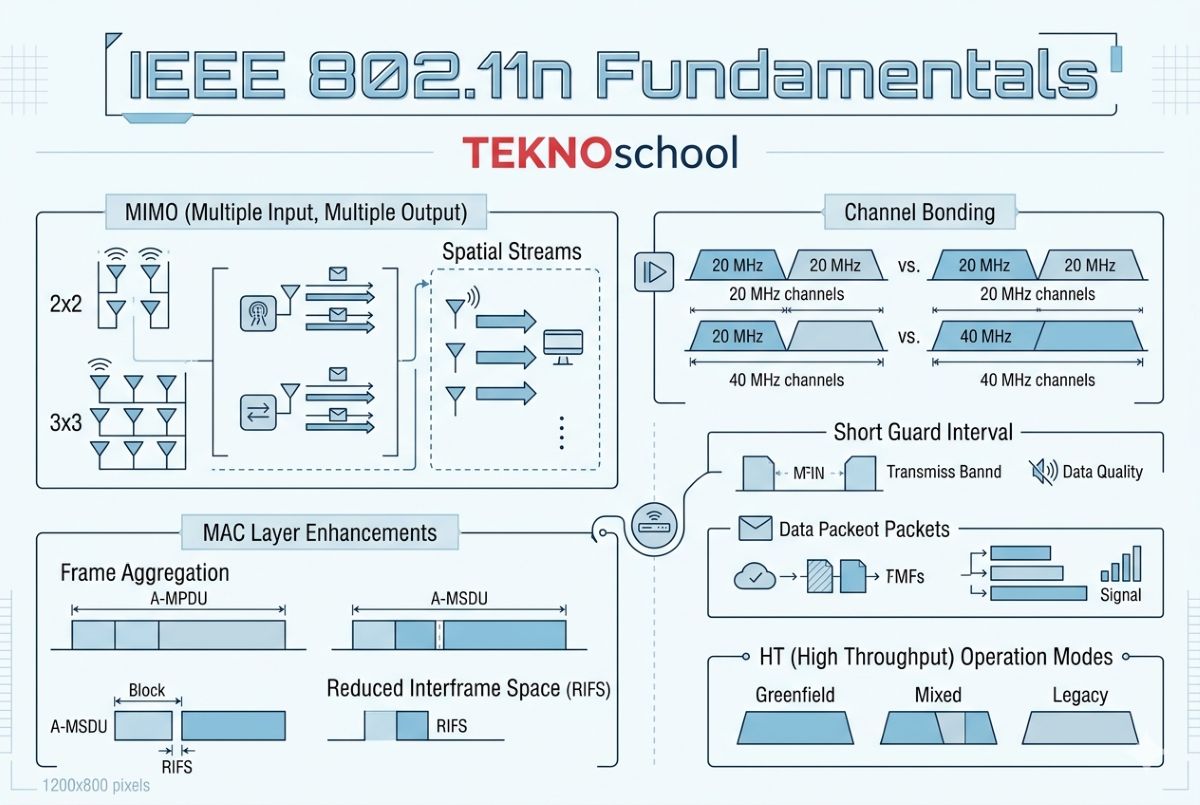
IEEE 802.11n Fundamentals
IEEE 802.11n Fundamentals: What It Is, Where It’s Used, and How It Works
🔰 What is IEEE 802.11n and where is it used?
IEEE 802.11n (commonly called Wi-Fi 4) is a wireless networking standard developed by the Institute of Electrical and Electronics Engineers. It defines how devices communicate over Wi-Fi, including speed, frequency bands, and data transmission techniques.
Where it is used:
IEEE 802.11n is widely deployed because it offers a balance of speed, range, and cost.
- 🏠 Home networks → routers, laptops, smart TVs
- 🏢 Offices & enterprises → Wi-Fi infrastructure, VoIP, laptops
- 🏭 Industrial automation → PLC communication, SCADA systems
- 🎓 Education systems → digital classrooms, labs
- 📡 Public Wi-Fi → airports, railway stations, campuses
👉 Even today, many industrial and commercial systems still rely on 802.11n due to its reliability and compatibility.
IEEE 802.11n Fundamentals: Understanding Frequency, Speed, Channels, and Streams
Wireless networking often feels confusing because terms like 2.4 GHz, 5 GHz, 600 Mbps, MIMO, and channel width are used interchangeably. In reality, each of these represents a different layer of how Wi-Fi works. This blog builds a clear foundation by connecting all these concepts into one simple, engineering-focused explanation.
📡 Where Wi-Fi Operates: Frequency Bands (2.4 GHz & 5 GHz)


Wi-Fi operates in the radio frequency (RF) spectrum, specifically in the microwave region.
- 2.4 GHz band → 2.400 to 2.4835 GHz
- 5 GHz band → ~5.150 to 5.825 GHz
Key physical difference:
- 2.4 GHz → longer wavelength (~12.5 cm)
- 5 GHz → shorter wavelength (~6 cm)
What this means:
- 2.4 GHz → travels farther, penetrates walls better
- 5 GHz → carries more data, but shorter range
👉 These are part of unlicensed ISM bands, which is why Wi-Fi works globally without special permission.
📶 Channel Structure: Where Data Actually Flows
2.4 GHz Channels
- Limited number of channels
- Only 3 non-overlapping channels: 1, 6, 11
- High interference due to crowding
5 GHz Channels
- Many more channels available
- Minimal overlap
- Supports wider channels → higher speed
🚀 Channel Width (20 MHz vs 40 MHz)
Channel width defines how wide the communication path is.
- 20 MHz → standard width
- 40 MHz → double width (channel bonding)
Simple idea:
- Narrow channel → less data
- Wide channel → more data
👉 40 MHz can double the data rate compared to 20 MHz
⚠️ Limitation:
- Not always usable in 2.4 GHz due to interference
🧵 Streams (1, 2, 4 Streams)
A stream is a parallel data path.
- 1 stream → one data flow
- 2 streams → two parallel flows
- 4 streams → four parallel flows
👉 More streams = more data transmitted simultaneously
📡 MIMO (Multiple Input Multiple Output)
MIMO is the technology that enables multiple streams.
Concept:
- Uses multiple antennas at the transmitter and receiver
- Sends different data streams at the same time
Benefits:
- Higher speed
- Better reliability
- Improved signal strength
👉 Example:
- 4 antennas → 4 streams → higher throughput
🔗 Channel Bonding
Channel bonding combines channels:
- 20 MHz + 20 MHz → 40 MHz
Purpose:
- Increase bandwidth
- Increase speed
👉 Think of it as merging two roads into a highway.
📦 Frame Aggregation
Frame aggregation improves efficiency.
Concept:
- Combine multiple small packets into one large packet
Benefit:
- Reduces overhead
- Improves throughput
👉 Like sending one big parcel instead of many small ones.
⚡ Data Rate (Speed) — What is 600 Mbps?
- Mbps = Megabits per second
- 600 Mbps = theoretical maximum speed in IEEE 802.11n
Important:
👉 This is not guaranteed real-world speed
Typical real speed:
- ~100 to 250 Mbps depending on conditions
🔍 How Speed and Frequency Are Related
Critical concept:
Speed ≠ Frequency directly
Instead:
Speed = Bandwidth × Efficiency × Streams
Where:
- Bandwidth → channel width (20/40 MHz)
- Efficiency → modulation, aggregation
- Streams → MIMO
🧠 Why 5 GHz Usually Gives Higher Speed
1. Wider channels available
- Supports 40 MHz easily
- Less congestion
2. Lower interference
- Cleaner spectrum
3. Better data density
- Higher frequency allows faster signal changes
📊 Putting It All Together
| Configuration | Speed |
|---|---|
| 1 stream + 20 MHz | ~72 Mbps |
| 2 streams + 40 MHz | ~300 Mbps |
| 4 streams + 40 MHz | ~600 Mbps |
👉 This is how 600 Mbps is achieved:
- 4 streams (MIMO)
- 40 MHz channel
- Efficient transmission
🏭 Practical Engineering Insight
Use 2.4 GHz when:
- Long distance required
- Many obstacles
- Basic industrial communication
Use 5 GHz when:
- High speed required
- Low interference needed
- Applications like:
- SCADA visualization
- Video monitoring
- HMI systems
🧩 Simple Mental Model
Think of Wi-Fi like a transport system:
| Concept | Meaning |
|---|---|
| Frequency | Road type |
| Channel width | Road width |
| Streams | Number of lanes |
| Mbps | Traffic flow |
👉 Final understanding:
- Frequency sets conditions
- Speed depends on design + configuration
✅ Final Technical Summary
- 2.4 GHz → longer range, lower speed, more interference
- 5 GHz → shorter range, higher speed, less interference
- Channel width increases capacity
- MIMO (streams) increases parallel data transfer
- Frame aggregation improves efficiency
- 600 Mbps is achieved by combining all these factors—not frequency alone
This foundation is essential for understanding not just IEEE 802.11n, but all modern Wi-Fi systems used in industrial automation, networking, and smart infrastructure.