Engine Cooling System
The Engine Cooling System is the unsung hero of any power generation setup — working silently in the background to keep operating temperatures within safe limits and ensure long, reliable engine life. Every diesel engine and gas turbine generates enormous amounts of heat during operation. If that heat is not removed efficiently and continuously, engine components overheat, lubrication breaks down, and catastrophic failure follows quickly.
🌡️ Why Engine Cooling Systems Are Critical
Internal combustion engines convert only a portion of the fuel’s chemical energy into useful mechanical work. A significant share of that energy becomes waste heat absorbed by engine components — cylinder walls, pistons, valve seats, and exhaust manifolds. Without an effective cooling system, metal temperatures would quickly rise beyond material limits, causing warping, seizure, and permanent damage.
Beyond protecting the engine itself, cooling systems also serve secondary roles — they maintain lube oil temperature within operational range, condition jacket water chemistry to prevent corrosion and scaling, and in many facilities, recover waste heat for building heating or other process uses. A well-maintained cooling system is therefore central to both equipment longevity and overall plant energy efficiency.
🏗️ Cooling System Design Features
Engine cooling systems are designed around one core principle — move heat away from critical engine surfaces and reject it safely into the environment. The design must account for the maximum heat-rejection load at the highest expected ambient temperature while also protecting against overcooling during low-load or cold-startup conditions. Multiple layers of control, bypass circuits, and redundancy are built in to achieve this balance reliably.
🔶 Jacket Water Cooling Circuit
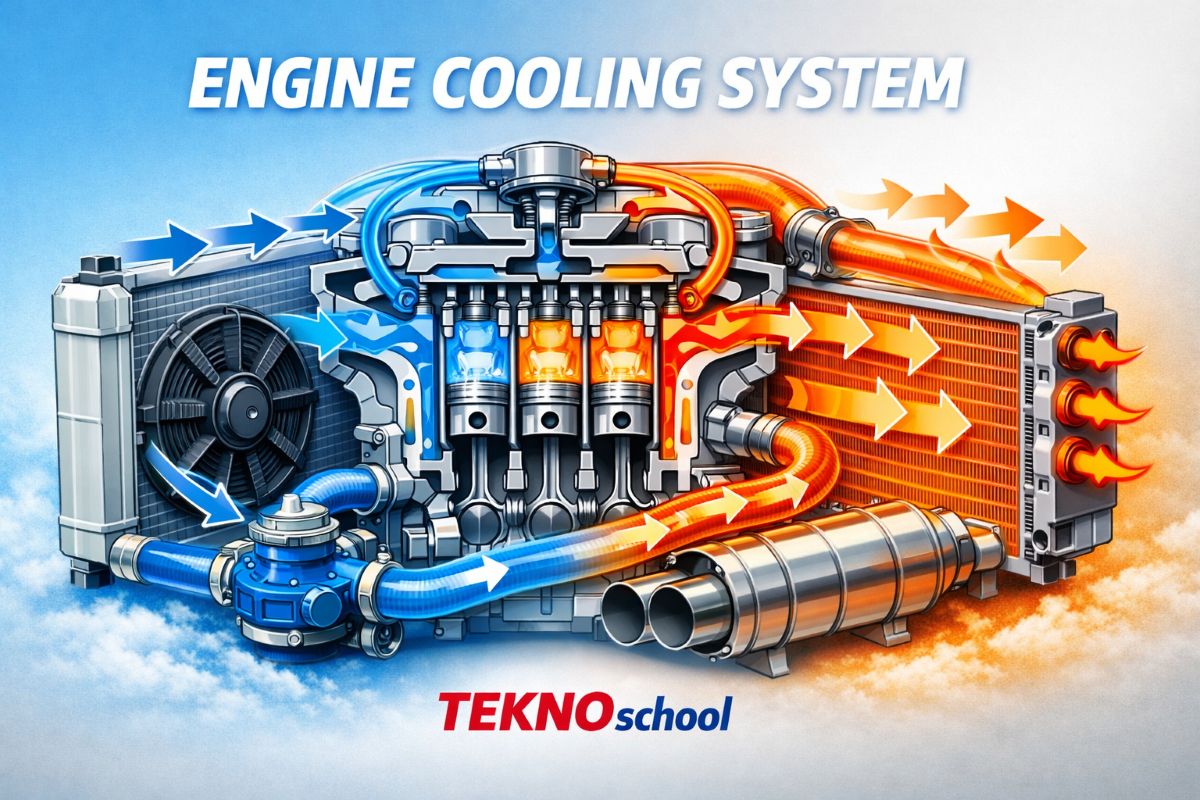
The jacket water circuit is the primary cooling loop for most diesel engines. Water circulates through passages cast into the engine block and cylinder head, absorbing heat directly from the combustion surfaces. A jacket water pump — typically engine-driven — forces this water through the circuit continuously. The heated water then passes through a heat exchanger or radiator, where the heat is rejected before the cooled water returns to the engine.
A thermostatic control valve plays a critical role in this circuit. During cold startups or light-load conditions, the thermostat bypasses the heat exchanger and recirculates warm water back to the engine directly — preventing overcooling and thermal shock to engine components. Only when the jacket water temperature rises to the set point does the thermostat open and direct flow through the heat exchanger for cooling.
🟩 Aftercooler Circuit
Turbocharged engines compress intake air before delivering it to the cylinders, which raises the air temperature significantly. Hot compressed air is less dense, meaning less oxygen enters the cylinder per charge — reducing power output and increasing thermal stress. An aftercooler (also called an intercooler or charge air cooler) cools this compressed intake air before it enters the engine, restoring air density and improving combustion efficiency.
Some engines use jacket water to cool the aftercooler, while larger or more demanding installations use a separate low-temperature aftercooler circuit with its own heat exchanger and coolant supply. The separate circuit allows aftercooler temperatures to be maintained lower than jacket water temperatures, maximizing the density benefit of charge air cooling.
🔷 Lube Oil Cooling
Lube oil absorbs heat from bearings, pistons, and other moving components. If the lube oil temperature rises too high, viscosity drops, oil film thickness reduces, and bearing surfaces suffer accelerated wear. A lube oil cooler — typically a shell-and-tube or plate-type heat exchanger — uses jacket water or raw water to cool the lube oil back to its optimal operating temperature range. Oil temperature is regulated by a thermostatic bypass valve similar to the jacket water circuit.
🔩 Major Cooling System Components
🔸 Heat Exchangers
Heat exchangers are the workhorses of any cooling system. They transfer heat from hot engine fluids (jacket water, lube oil, charge air) to a secondary cooling medium (raw water, air, or a secondary coolant loop) without the two fluids mixing. Common types used in engine cooling systems include:
- 🔴 Shell-and-Tube Heat Exchangers: Hot fluid flows through tubes while cooling fluid flows around the outside within a shell; robust and suitable for high-pressure, high-temperature applications
- 🟢 Plate-Type Heat Exchangers: Thin corrugated metal plates create alternating channels for hot and cold fluids; compact, highly efficient, and easy to disassemble for cleaning
- 🔵 Radiators (Air-Cooled): Jacket water passes through finned tubes and ambient air is blown or drawn across them; common where water supply is limited or for remote installations
🟩 Cooling Pumps
Coolant circulation depends on reliable pumping. Most engine cooling systems use centrifugal pumps for jacket water circulation — either engine-driven (direct-coupled to the engine crankshaft) or motor-driven as a separate unit. Engine-driven pumps are simple and reliable, but cannot operate independently of the engine. Motor-driven pumps offer the advantage of pre-circulation before startup and post-circulation after shutdown, both of which reduce thermal stress on the engine.
Critical facilities always maintain a standby pump on the cooling circuit so that if the primary pump fails, the standby unit starts automatically and cooling continues without interruption. Pump seals, bearings, and impellers are routine maintenance items that must be inspected and replaced on a scheduled basis.
🔶 Cooling Towers
In facilities where air-cooled radiators are insufficient to handle heat rejection loads — particularly in large prime power plants — evaporative cooling towers serve as the primary heat rejection device. Hot water from heat exchangers is pumped to the top of the cooling tower and distributed over a fill media. Air flows through the tower (either by natural draft or mechanical fans), and a portion of the water evaporates, carrying heat away from the remaining water. The cooled water collects in the tower basin and is recirculated back to the heat exchangers.
- 🔴 Drift Eliminators: Prevent water droplets from being carried out with the exhaust air — reducing water loss and preventing mineral deposits on surrounding structures
- 🟣 Makeup Water System: Replaces water lost to evaporation, drift, and blowdown to maintain proper basin level
- 🟠 Blowdown System: Periodically drains concentrated mineral-laden water from the basin to prevent scaling and corrosion in the system
- 🟢 Chemical Treatment: Biocides, scale inhibitors, and corrosion inhibitors are dosed into the tower water to maintain water quality and prevent Legionella growth
🔷 Thermostatic Control Valves
Thermostatic valves automatically regulate coolant flow between the heat exchanger and the bypass line based on coolant temperature. They require no external power or control signal — they respond directly to the temperature of the fluid passing through them. Most are wax-element type actuators that expand and contract with temperature changes, mechanically opening or closing the valve port. Regular inspection of thermostat operation is essential because a stuck-open thermostat causes chronic overcooling, while a stuck-closed thermostat causes rapid overheating.
🔸 Jacket Water Heaters
Standby engines that must start quickly in an emergency cannot afford the time penalty of warming up a cold engine. Jacket water immersion heaters — electrically powered — keep the engine coolant at a minimum standby temperature (typically 32°C to 38°C) at all times. This ensures that when the engine is called upon to start, metal temperatures are already within a safe operating range, drastically reducing startup thermal stress and improving reliability.
✅ Key Takeaway for Maintenance Teams
A cooling system failure is rarely a slow, gradual event — it is typically sudden and immediately threatening to the engine. Maintenance teams must regularly inspect heat exchanger surfaces for fouling and scaling, verify pump seal and bearing condition, test thermostat operation, check cooling tower fill media and chemical treatment levels, and confirm jacket water heater function on all standby units. Proactive cooling system maintenance is one of the highest-return activities in any engine maintenance program — protecting assets worth many times the cost of the inspection itself.