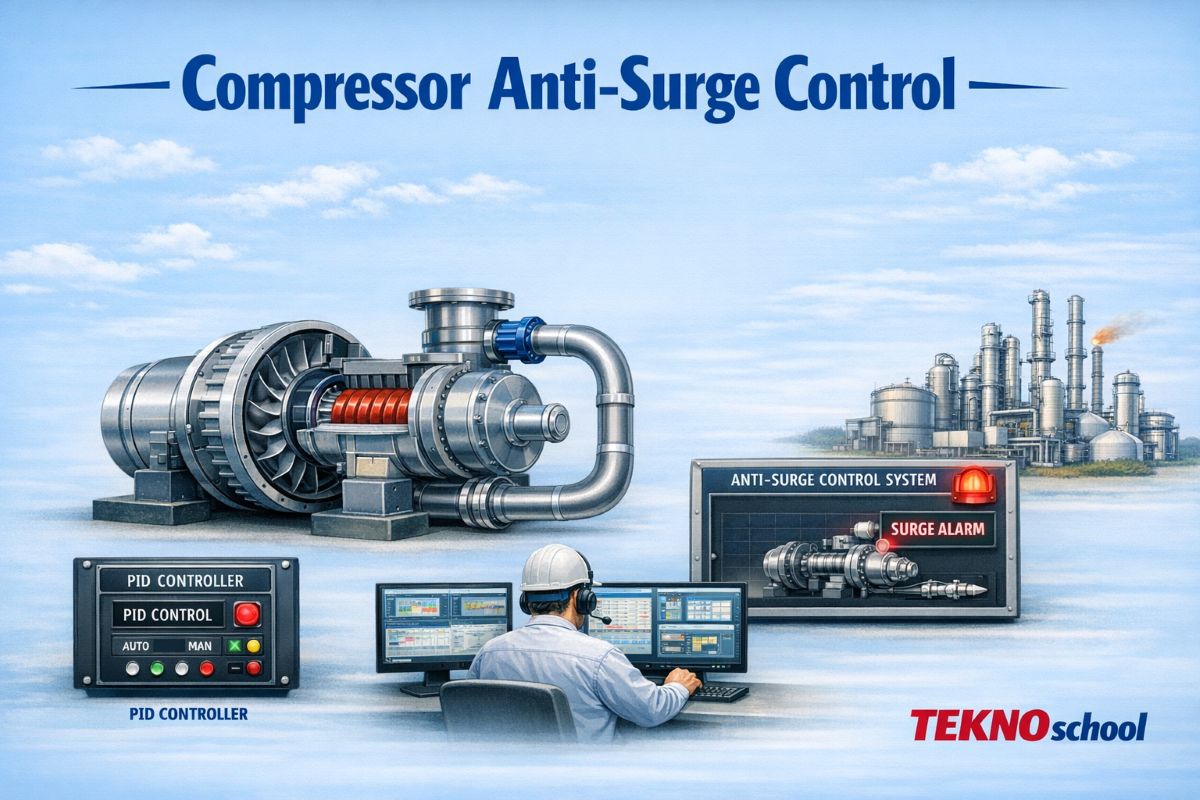
Compressor Anti Surge Control
Anti Surge Control
Understanding Compressor Anti Surge Control, Why It Matters, and How Modern Systems Handle It. Industrial compressors are the beating heart of many continuous‑process plants—air separation units, petrochemical complexes, refineries, and gas processing facilities all rely on them. But compressors also come with a dangerous adversary: surge. Surge is not just a performance issue; it is a violent instability that can physically damage the compressor within seconds. That is why anti‑surge control has evolved into one of the most critical protection strategies in rotating‑equipment automation.
What Exactly Is Surge?
A compressor is designed to push gas from a lower pressure to a higher pressure. But if the outlet pressure becomes too high relative to the flow passing through the compressor, the machine enters an unstable region. The flow can reverse momentarily, causing violent oscillations, loud noise, vibration, and severe mechanical stress.
Surges occur when the compressor outlet pressure is too high in relation to the flow through the compressor.
Left uncontrolled, a surge can bend blades, overheat bearings, and even destroy the compressor.
Why Anti‑Surge Control Is Essential
Anti‑surge control is not optional—it is a safeguard. The goal is simple:
Keep the compressor operating safely away from the surge line.
To do this, the control system constantly monitors flow and pressure, comparing real‑time operating conditions against a predefined surge curve. If the compressor approaches the danger zone, the system reacts instantly—typically by opening a recycle valve or blow‑off valve to increase flow and reduce differential pressure.
The anti-surge control consisted of two loops connected to a blow-off valve via a selector block.
This ensures the compressor never crosses into the surge region.
Inside a Real‑World Anti‑Surge Application
Typical 3 MW multi‑stage turbo compressor supplying air to an air‑separation plant. The process demanded a steady flow of around 80,000 Nm³/h, making surge protection even more critical.
The typical control system used:
- Standard DeltaV I/O
- Rosemount transmitters
- A DeltaV M3 controller
- A blow‑off valve for surge relief
The compressor had multiple stages, each compressing and cooling the air before sending it to the next stage. This multi‑stage design increases efficiency but also increases the risk of a surge if not controlled properly.
How the Control Strategy Works
1. Load Control
Load control ensures the compressor delivers the required process flow and pressure. Two loops—one for flow and one for pressure —send their outputs to a low selector. Whichever loop demands the lower guide‑vane position takes priority.
This prevents the compressor from being overloaded while maintaining stable operation.
2. Anti‑Surge Control
Anti‑surge control is more dynamic and protective in nature. It uses:
- Flow measurement
- Discharge pressure
- A calculated surge line and safety margin
- A fast‑acting blow‑off valve
The surge line is determined by testing the compressor at various pressure‑flow points. A safety line, slightly below the surge line, is used as the control reference.
From this line, a safety line a few percentage points below was created.
The controller continuously calculates how close the compressor is to this safety line. If it approaches too closely, the blow‑off valve opens to increase flow and pull the compressor back into a safe region.
Advanced Features: Gain Scheduling and Fast Scan Rates
Near the surge line, the system must react very quickly. That’s why the application uses.
- 100 ms scan rates for all control modules
- Gain scheduling to increase controller aggressiveness near the surge limit
If the control response has to be very quick near the surge line, a gain scheduling… may be used.
This ensures the controller becomes more responsive when the compressor is at a higher risk.
Why This Matters for Modern Plants
Anti‑surge control is not just a protective measure—it is a productivity enabler. A well‑designed system:
- Prevents catastrophic compressor damage
- Reduces downtime
- Improves energy efficiency
- Allows the compressor to operate closer to its optimal point
- Enhances plant reliability
In industries where compressors are mission‑critical, anti‑surge control is the difference between smooth operation and costly failures.
Final Thoughts
Compressor anti‑surge control is a sophisticated blend of process understanding, instrumentation, and advanced control logic. The DCS-based application demonstrates how modern automation systems integrate load control, surge protection, and fast‑acting logic to keep compressors safe and efficient.
For engineers, operators, and plant managers, understanding this strategy is essential—not just for safety, but for optimizing performance and ensuring long‑term reliability.