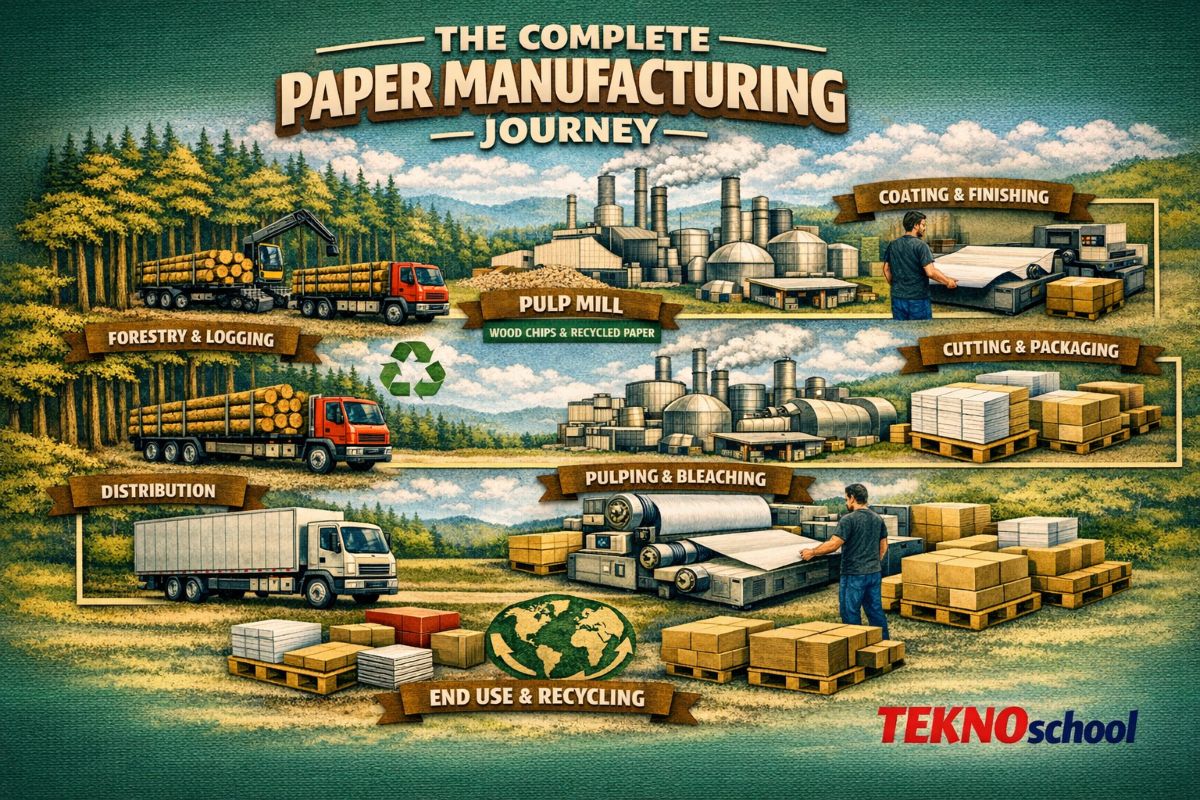
THE COMPLETE PAPER MANUFACTURING JOURNEY
🌲✨ THE COMPLETE PAPER MANUFACTURING JOURNEY
From Forest to Finished Sheet
🌳 1. Raw Material & Forest Management
Paper manufacturing begins long before a machine starts running. It starts in the forest, where trees are grown, harvested, and replanted in a sustainable cycle. Modern paper mills rely heavily on managed forests, where every harvested tree is replaced with new saplings. This ensures a continuous supply of raw material while protecting biodiversity and soil health. These forests are monitored for growth rate, moisture content, and disease resistance, ensuring that the wood reaching the mill is of consistent quality.
Once harvested, logs are transported to the mill and stored in wet yards. Sprinklers keep the logs moist, preventing cracking and fiber damage. This careful handling ensures that the wood retains its natural strength, which directly influences the quality of the final paper.
🪓 2. Debarking & Chipping
🪵 Debarking
The first mechanical step in the mill is debarking, where logs enter a large rotating drum. As the drum turns, friction between logs removes the bark. This process is fully automated in modern mills, replacing the labor‑intensive manual peeling used decades ago. The removed bark is not wasted — it becomes a valuable fuel source for boilers or is used as soil enrichment material.
✂️ Chipping
After debarking, logs move to the chipper, a high‑speed machine equipped with sharp knives. The goal is to produce uniform chips, typically around 2.5 cm long and 8 mm thick. Uniformity is crucial because inconsistent chip size leads to uneven cooking in the digester, affecting pulp quality. The chips are then screened to remove oversized or undersized pieces, ensuring only the best material enters the pulping process.
⚗️ 3. Pulping — Separating Fibers from Wood
Pulping is the heart of paper manufacturing. It involves breaking down wood into individual cellulose fibers, which form the basis of paper. The choice of pulping method determines the strength, brightness, and cost of the final product.
🌀 3.1 Mechanical Pulping
Mechanical pulping relies on physical force to separate fibers. Wood chips are ground or refined using large rotating discs. This method preserves most of the wood, resulting in a high yield of around 90%. However, the fibers produced are shorter and stiffer, making the paper less durable and more prone to yellowing.
Mechanical pulping is energy‑intensive, but it is ideal for products like newsprint, magazines, and packaging where brightness and longevity are less critical. Thermo‑Mechanical Pulping (TMP) improves fiber flexibility by heating chips with steam before refining, producing better quality pulp.
🧪 3.2 Chemical Pulping (Kraft / Sulphate Process)
Chemical pulping uses chemicals to dissolve lignin — the natural glue that binds wood fibers. The most widely used method is the Kraft process, also known as the sulphate process. Wood chips and cooking liquor are fed into a digester, where high temperature and pressure break down lignin without damaging the fibers.
The result is strong, flexible pulp suitable for high‑quality printing papers, packaging boards, and specialty grades. Although the yield is lower (around 50%), the fiber strength is significantly higher. The process also produces black liquor, a chemical‑rich byproduct that becomes a major energy source for the mill.
🧪➕🌀 3.3 Semi‑Chemical Pulping (CTMP / NSSC)
Semi‑chemical pulping combines mild chemical treatment with mechanical refining. Chemicals soften the lignin, making it easier for refiners to separate fibers. This method is commonly used for corrugation medium and fluting in packaging applications. It offers a balance between strength, yield, and cost.
🧼 4. Washing, Screening & Cleaning
After pulping, the fiber mixture contains dissolved chemicals, lignin fragments, and impurities. Washing removes these unwanted components using multiple stages of dilution and extraction. Clean pulp improves paper quality and reduces chemical load in downstream processes.
Screening removes knots, shives, and oversized particles, while cleaning systems eliminate sand, grit, and heavy contaminants. These steps ensure that only pure, uniform fibers move forward, preventing defects in the final sheet.
🔄 5. Chemical Recovery Cycle (Kraft Mills)
One of the most remarkable aspects of the Kraft process is its closed chemical recovery loop, which recycles chemicals and generates energy.
🟤 5.1 Black Liquor Evaporation
Black liquor from washing contains dissolved lignin, hemicellulose, and spent chemicals. It is concentrated using multi‑effect evaporators, where steam heats the liquor in stages. The solids content increases from 10–20% to 60–80%, making it suitable for combustion.
🔥 5.2 Recovery Boiler
The concentrated black liquor is burned in the recovery boiler, producing high‑pressure steam and recovering inorganic chemicals. This steam drives turbines and powers the mill. The recovery boiler is one of the most critical and complex units in the plant, requiring precise control to prevent hazards such as smelt‑water explosions.
🟢 5.3 Green Liquor → White Liquor Conversion
The molten smelt from the boiler dissolves in water to form green liquor, which contains sodium carbonate and sodium sulfide. This liquor is then causticized with lime to produce white liquor, the active cooking chemical for the digester. This cycle ensures minimal chemical waste and high energy efficiency.
💡 6. Energy Systems in Paper Mills
Paper mills are among the most energy‑intensive industries. Integrated mills consume large amounts of steam and electricity, especially during pulping and drying.
Boilers generate steam using fuels such as natural gas, biomass, black liquor, or coal. Steam turbines convert high‑pressure steam into electricity before the steam is used for process heating. Modern mills optimize energy use through heat recovery systems, condensate return, and advanced automation.
🧴 7. Stock Preparation — Engineering the Fiber Mix
Before entering the paper machine, pulp undergoes stock preparation, where fibers are refined, blended, and treated with additives. Refining increases fiber flexibility and bonding potential. Fillers like calcium carbonate improve brightness and opacity. Retention aids help retain fine particles during sheet formation. Deaeration removes entrained air, ensuring smooth flow and uniform sheet formation.
This stage is where the paper’s final properties — strength, brightness, printability, and texture — are engineered.
🏭✨ 8. The Paper Machine — A 100‑Meter‑Long Engineering Marvel
The paper machine transforms diluted pulp into a continuous sheet at speeds exceeding 1,000 meters per minute. It is divided into several sections, each performing a specific function.
🟦 8.1 Headbox
The headbox distributes the pulp evenly across the width of the machine. It controls flow rate, turbulence, and fiber orientation, ensuring uniform sheet formation.
🟩 8.2 Fourdrinier Table (Forming Section)
The diluted pulp flows onto a moving wire mesh. Water drains through gravity, table rolls, and vacuum boxes. Fibers interlock to form a wet sheet. This is where the paper’s structure begins to take shape.
🟧 8.3 Press Section
The wet sheet passes through a series of press rolls that squeeze out water. Pressing increases sheet density and improves fiber bonding. Modern presses use shoe press technology for higher dryness and better strength.
🔥 8.4 Dryer Section
The sheet weaves over steam‑heated cylinders, evaporating remaining moisture. This is the most energy‑intensive part of the machine. Infrared (IR) dryers and hot‑air hoods enhance drying efficiency and allow moisture profiling across the sheet.
🟪 8.5 Calendar Stack
Calendars smooth and compress the sheet, improving gloss, thickness uniformity, and printability. Different textures can be imparted using patterned rolls.
🟫 8.6 Reel
The finished sheet is wound into a jumbo reel, ready for converting.
✂️📦 9. Converting — From Rolls to Finished Products
Converting transforms large reels into usable products. Slitters cut the sheet into narrow rolls. Sheeters produce A4, A3, and other cut sizes. Embossers create patterns for tissue products. Laminators and coaters add functional layers for packaging applications.
🧴✨ 10. Paper Sizing — Surface Strength & Printability Enhancement
Sizing improves surface strength, reduces absorbency, and enhances printability.
🟦 10.1 Internal Sizing
Internal sizing agents are added during stock preparation to control water absorption. They help prevent ink from spreading and improve sheet stiffness.
🟩 10.2 Surface Sizing (Size Press)
Surface sizing applies a thin film of starch solution to the sheet. This strengthens the surface, improves ink holdout, and enhances coating adhesion.
Key Sizing Materials
- Starch
- PVA (Polyvinyl Alcohol)
- CMC (Carboxymethyl Cellulose)
- Latex
These materials modify surface chemistry, making the paper suitable for printing, packaging, and specialty applications.
🟧 10.3 Starch Cooking
Starch slurry is cooked with steam to gelatinize it. The cooked starch is diluted, cooled, and stored before being pumped to the size press. Proper cooking ensures consistent viscosity and performance.
🎨 11. Coating — Creating High‑Performance Surfaces
Coating adds pigments and binders to create glossy, matte, or specialty surfaces. Coated papers are used for magazines, brochures, labels, and premium packaging. Coating improves brightness, smoothness, and ink‑jet compatibility.
🧻 12. Tissue Machines — Special Design
Tissue machines use a Yankee Dryer, a massive steam cylinder with a high‑velocity air hood. This combination of conduction and convection drying produces soft, lightweight tissue suitable for toilet paper, napkins, and paper towels.
🔁 13. Recycling — The Second Life of Paper
Recycling reduces environmental impact and conserves resources. Waste paper is collected, sorted, pulped, and deinked. Recycled fibers are used in newsprint, tissue, packaging, and even writing papers. Modern mills use advanced flotation and washing systems to remove ink and contaminants.
🏗️ 14. Major Equipment in a Paper Plant
A modern paper plant contains hundreds of machines, but the major equipment includes:
🌲 Wood Handling
- Barking drum
- Chipper
- Conveyors
⚗️ Pulping
- Digesters
- Refiners
- Blow tanks
- Pulp washers
- Screens
🔥 Chemical Recovery
- Evaporators
- Recovery boiler
- Lime kiln
- Causticizing plant
🏭 Paper Machine
- Headbox
- Fourdrinier table
- Press section
- Dryer section
- Calendar stack
- Reel
✂️ Converting
- Slitters
- Rewinders
- Sheeters
- Embossers
🛠️ 15. Maintenance in Paper Plants
Maintenance is critical in paper mills due to high speeds, high temperatures, and chemical exposure. Regular maintenance prevents breakdowns, improves safety, and extends equipment life.
Key Maintenance Activities
- Wire and felt replacement
- Steam system inspection
- Pump and motor servicing
- Gearbox lubrication
- Boiler and turbine maintenance
- Chemical recovery system descaling
- IR dryer calibration
- Vacuum pump maintenance
Predictive Maintenance
Modern mills use:
- Vibration analysis
- Thermal imaging
- Oil analysis
- Online sensor monitoring
These techniques help detect issues before they cause failures.
⚠️ 16. Safety Issues in Paper Plants
Paper mills involve several hazards, making safety a top priority.
Major Risks
- High‑temperature steam
- Rotating equipment
- Chemical exposure
- Confined spaces
- Slippery floors
- High‑speed web breaks
- Dust explosions
Safety Measures
- Lockout–Tagout (LOTO)
- PPE (helmets, gloves, goggles)
- Chemical handling protocols
- Steam line insulation
- Emergency showers
- Fire suppression systems
- Machine guarding
🏭💡 17. Modern Paper Plants — Features & Innovations
Modern mills are designed for sustainability, automation, and efficiency.
Key Features
- DCS & PLC‑based automation
- Online moisture profiling
- Gas IR dryers
- Closed water loops
- High‑efficiency boilers
- Energy recovery systems
- Zero‑liquid‑discharge (ZLD) systems
- AI‑based predictive maintenance
- High‑speed machines (>1,000 m/min)
These innovations reduce energy consumption, improve quality, and minimize environmental impact.
🇮🇳 18. Top 5 Paper Plants in India
🏭 1. JK Paper Ltd.
JK Paper operates state‑of‑the‑art mills in Odisha and Gujarat. Known for copier paper and packaging board, the company uses modern pulping, bleaching, and coating technologies. Their sustainability initiatives include plantation programs and energy‑efficient operations.
🏭 2. ITC Paperboards & Specialty Papers Division
ITC’s Bhadrachalam and Kovai units are among India’s most advanced paper mills. They produce premium packaging boards, specialty papers, and eco‑friendly grades. ITC is known for its integrated operations and strong environmental practices.
🏭 3. West Coast Paper Mills
Located in Karnataka, West Coast Paper Mills is one of India’s oldest and most respected mills. It produces writing, printing, and specialty papers. The mill features modern recovery boilers, high‑speed machines, and advanced quality control systems.
🏭 4. Tamil Nadu Newsprint and Papers Ltd. (TNPL)
TNPL is globally recognized for using bagasse (sugarcane residue) as a raw material. This makes it one of the most eco‑friendly mills in India. The plant produces printing, writing, and packaging grades with a strong focus on sustainability.
🏭 5. Ballarpur Industries Ltd. (BILT)
BILT operates large mills in Maharashtra and Odisha. It produces writing and printing papers, office stationery, and specialty grades. The company has a strong distribution network and a long history in India’s paper industry.
🏁 Conclusion
Paper manufacturing is a fascinating blend of engineering, chemistry, energy systems, automation, and sustainability. From forests to finished sheets, every stage is optimized for quality, efficiency, and environmental responsibility. Modern mills operate at incredible speeds, producing the paper that powers education, packaging, hygiene, and communication across the world.