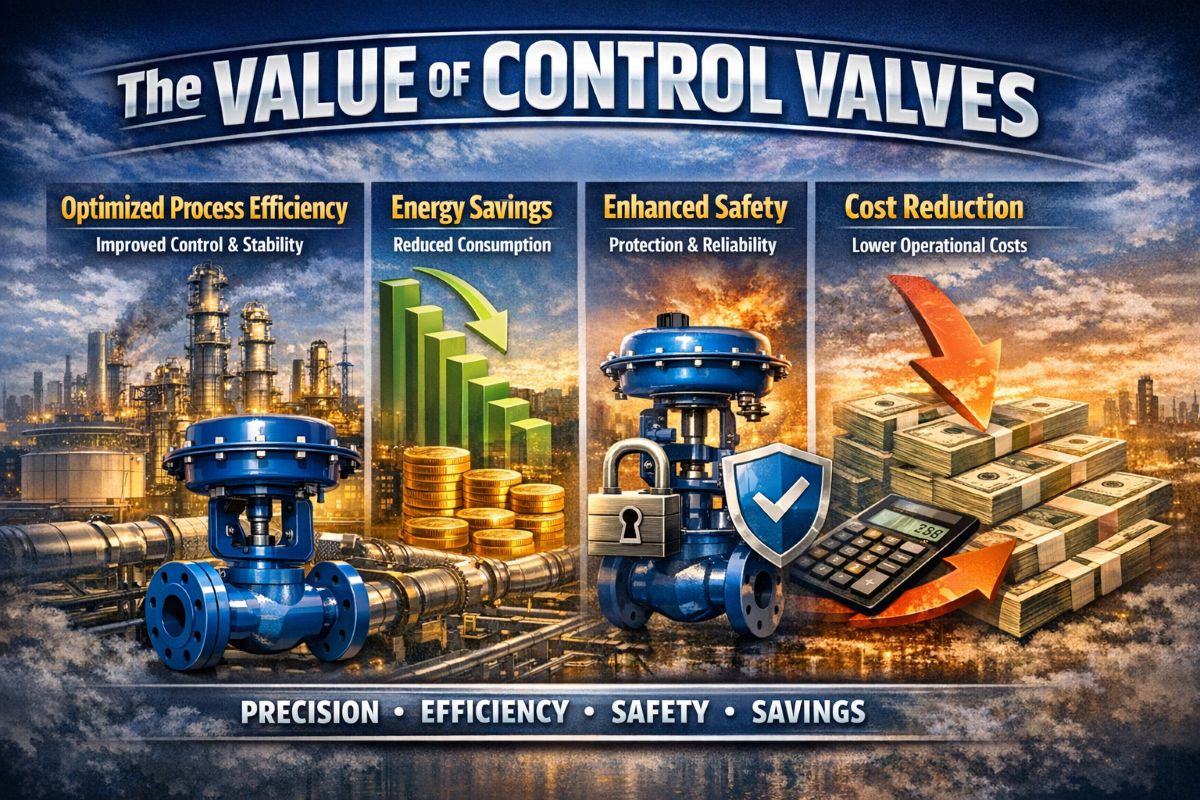
Control valves are not just final elements; they directly shape throughput, yield, quality, energy use, and waste reduction.
Even small improvements in valve performance can unlock major economic gains in refinery and process service.
A poor valve can force operators to run manually, lower setpoints, or tolerate unstable operation just to keep the unit safe.
⚙️ A real plant example
In one refinery case, the main feed valve to a cracking tower caused pressure swings of more than +/-10 psi.
The instability repeatedly lifted pressure relief valves and reduced confidence in automatic control.
After the faulty valve was replaced with a better globe valve, pressure variation dropped to about +/-1 psi, and production increased by 2000 bpd.
📉 How valves drive variability
Process variability can come from many sources, including bad loop design, out-of-tune instruments, and weak maintenance practices.
Control valves are often the biggest contributor, with audits showing up to 40% of variability tied to poor valve performance.
That means a control strategy is only as good as the field device that actually moves the process.
🧠 Digital valve intelligence
Modern digital valve controllers provide two-way communication, so operators and maintenance teams can see valve health in real time.
That visibility helps with diagnostics, calibration, startup, alarms, documentation, and ISO support.
Additionally, safer work practices because some checks and calibrations can be done remotely instead of in hazardous areas.
🛡️ Emissions and packing improvements
Fugitive emissions from stem packing and gaskets became a major design concern as environmental rules tightened.
Low-leakage packing systems, live loading, smooth stem finishes, and proper guidance are key to long-term sealing performance.
For many plants, these upgrades reduce leaks, maintenance work, and downtime even when emissions rules are not the main driver.
🔧 Why cage-style globe valves stand out
Cage-style trim allows one body casting to accept different cages and plugs, making it easier to match the valve to the service.
This design improves flow characteristic matching, throttling stability, maintenance access, and spare-part commonality.
Cage trim can also support severe-service needs such as cavitation control, noise reduction, and high shutoff classes.
🔇 Noise and severe service
High-pressure-drop services can create damaging aerodynamic noise, vibration, and pipe fatigue.
Advanced trim that splits pressure drop across stages and reshapes flow passages to cut noise by around 40 dBA in some cases.
That kind of performance matters because noise is not only a comfort issue; it is also a reliability and mechanical integrity issue.
🚀 Actuation and the future
Nowadays, actuator and instrumentation innovations are moving faster than basic valve-body changes.
Compact pneumatic actuator designs, integrated digital controllers, and fieldbus-ready systems all make control valves easier to install, operate, and maintain.
The core message is simple: better valve performance supports better plant performance, and better plant performance supports profitability.
✅ Final takeaway
The control valve should be viewed as a profit-impacting asset, not just a mechanical accessory.
When selection, diagnostics, packing, trim, and actuation are treated as a system, plants can reduce variability and improve output.
A strong control room cannot fully compensate for a weak final control element.