
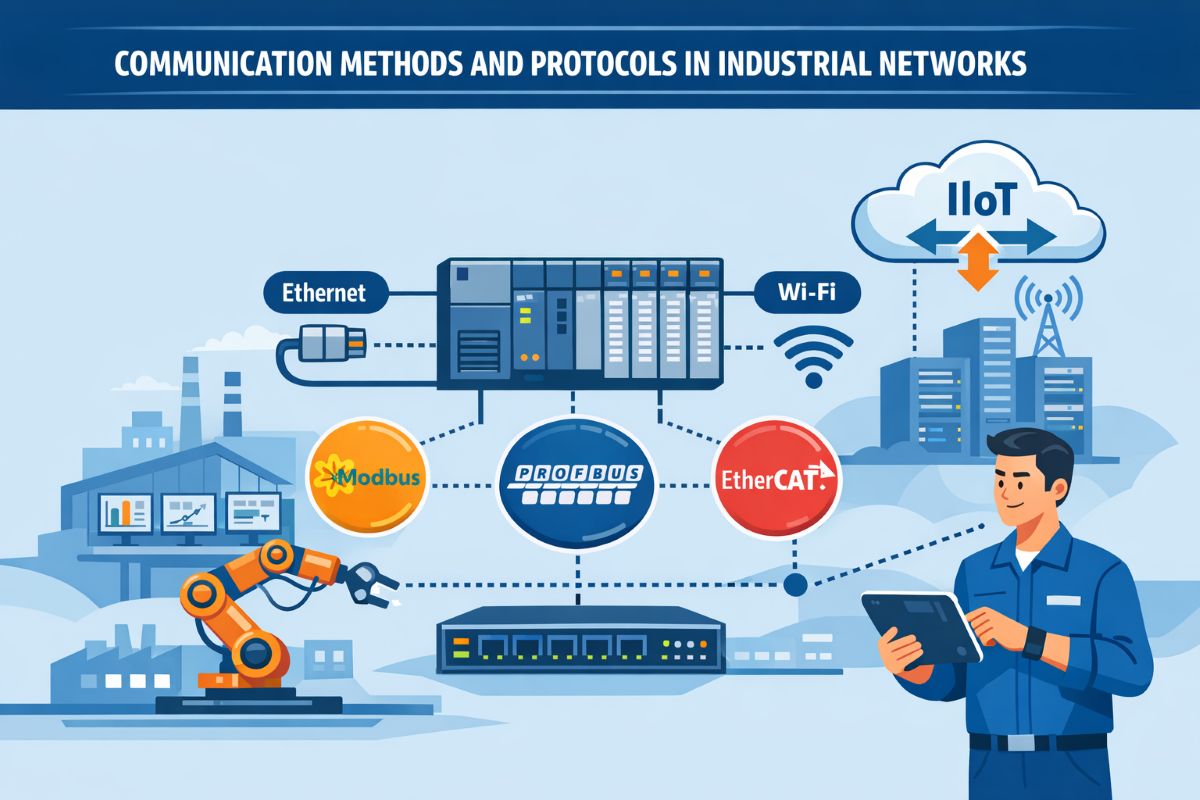
Communication Methods and Protocols in Industrial Networks
🌐 Communication Methods and Protocols in Modern Industrial Networks
Communication methods and protocols in industrial networks form the backbone of modern automation systems. Modern digital infrastructure relies heavily on reliable communication networks that connect computers, sensors, industrial machines, and cloud platforms. Whether it is a manufacturing plant, an IT network, or a global data infrastructure, communication systems ensure that devices exchange information efficiently and securely. These communication systems can operate through wired technologies such as Ethernet cables and fibre optics or through wireless technologies such as Wi-Fi, Bluetooth, and cellular networks.
In industrial environments and digital enterprises, communication occurs at multiple levels. Network computers communicate with each other inside a local network, enterprise networks connect computers to centralised data centres, data centres exchange information globally, and field sensors transmit operational data to network computers or cloud platforms. Understanding the different communication methods and protocols used in these scenarios is essential for building reliable digital systems.
🔗 Types of Communication Networks
Communication between digital devices can occur through different network architectures depending on distance, data requirements, and infrastructure availability. The most common communication networks include Local Area Networks, Wide Area Networks, Industrial Field Networks, and Cloud Networks.
| Network Type | Typical Range | Common Technology |
|---|---|---|
| Local Area Network (LAN) | Building or campus | Ethernet, Wi-Fi |
| Wide Area Network (WAN) | Cities or countries | Fibre, MPLS, Satellite |
| Industrial Field Network | Factory floor | Modbus, Profibus |
| Cloud Network | Global | Internet, APIs |
💻 Communication Between Network Computers
Communication between network computers occurs primarily through Local Area Networks using Ethernet cables or wireless technologies such as Wi-Fi. These networks enable computers within the same building or campus to share data, printers, servers, and software applications.
Ethernet is the most widely used wired communication technology for connecting computers in offices and industrial networks. Ethernet cables such as Cat5e, Cat6, and Cat7 provide high-speed data transmission and reliable connectivity. Wireless Wi-Fi networks provide mobility and flexibility for devices such as laptops, tablets, and smartphones.
📊 Computer Network Communication
Computer ➜ Ethernet Switch ➜ Router ➜ Network Server ➜ Other Computers
🏢 Communication Between Network Computers and Data Centres
In enterprise environments, network computers often connect to centralised data centres where applications, databases, and storage systems are hosted. This communication typically occurs through high-speed network infrastructure such as fiber optic cables, enterprise routers, and secure internet connections.
Protocols such as TCP/IP, HTTP, HTTPS, and FTP are commonly used to transfer data between computers and data centre servers. Secure communication is achieved using encryption technologies such as SSL and TLS, ensuring that sensitive data remains protected during transmission.
| Protocol | Purpose | Example Usage |
|---|---|---|
| TCP/IP | Basic internet communication | Network data transfer |
| HTTP / HTTPS | Web communication | Accessing web applications |
| FTP | File transfer | Uploading data to servers |
🌍 Communication Between Data Centres
Large enterprises and cloud providers operate multiple data centres located in different geographic regions. These data centres must communicate continuously to synchronise databases, replicate applications, and distribute workloads efficiently.
High-speed fibre optic networks form the backbone of global data centre communication. These networks provide extremely high bandwidth and low latency, enabling data centres to exchange massive amounts of information quickly and reliably.
📊 Global Data Centre Communication
Data Centre A ➜ Fibre Backbone ➜ Internet Exchange ➜ Fibre Backbone ➜ Data Centre B
📡 Communication Between Field Sensors and Network Computers
Industrial environments contain thousands of field sensors that measure parameters such as temperature, pressure, flow rate, vibration, and humidity. These sensors communicate with network computers or industrial controllers that collect and process operational data.
Common industrial communication protocols used for field devices include Modbus, Profibus, CAN bus, and OPC-UA. These protocols allow sensors, controllers, and industrial computers to exchange data efficiently in real time.
| Protocol | Industry Usage | Communication Type |
|---|---|---|
| Modbus | Industrial automation | Serial (Modbus RTU/Modbus ASCII) Ethernet(Modbus TCP) |
| Profibus | Factory automation | Fieldbus |
| OPC-UA | Industrial IoT | Secure Ethernet |
☁️ Communication Between Field Sensors and Cloud Platforms
With the rise of Industrial Internet of Things technologies, many field sensors now transmit data directly to cloud platforms. This allows organisations to analyse operational data from multiple facilities and implement predictive maintenance strategies.
Protocols such as MQTT, AMQP, and HTTPS are commonly used for communication between IoT devices and cloud servers. These protocols are designed to handle large numbers of connected devices and transmit data efficiently over the internet.
📊 Sensor to Cloud Communication
Field Sensor ➜ IoT Gateway ➜ Internet ➜ Cloud Platform ➜ Data Analytics Dashboard
📶 Communication Technologies Used in Industrial Networks
Different communication technologies are used depending on distance, bandwidth requirements, reliability, and environmental conditions. Both wired and wireless technologies play important roles in modern digital infrastructure.
| Technology | Type | Typical Use |
|---|---|---|
| Ethernet Cable | Wired | Office networks and industrial systems |
| Fiber Optic | Wired | High-speed data centres and telecom networks |
| Wi-Fi | Wireless | Office devices and mobile connectivity |
| Bluetooth | Wireless | Short-range device communication |
| Cellular (4G / 5G) | Wireless | Remote sensors and IoT devices |
🏁 Conclusion
Communication networks are the foundation of modern digital infrastructure. From local computer networks inside offices to global cloud platforms connecting millions of devices, communication technologies ensure that information flows smoothly between systems. Wired technologies such as Ethernet and fibre optics provide high reliability and speed, while wireless technologies such as Wi-Fi, Bluetooth, and cellular networks provide flexibility and mobility.
As industries continue adopting digital transformation strategies and Industrial Internet of Things technologies, communication networks will become even more important. Reliable connectivity between sensors, computers, data centres, and cloud platforms will enable smarter operations, real-time analytics, and advanced automation across industries.