Gas Turbine Fuel Oil System
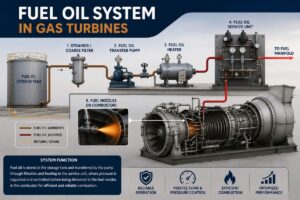
Gas and steam turbines are the workhorses of power generation, aviation, and industrial drive systems. But behind every smoothly spinning turbine is a carefully engineered fuel oil system — the lifeline that ensures the right fuel reaches the combustion zone at the right pressure, temperature, and flow rate. In this blog, we break down the turbine fuel oil system in full detail, from storage tanks to burner nozzles.
🔥 1. What Is a Turbine Fuel Oil System?
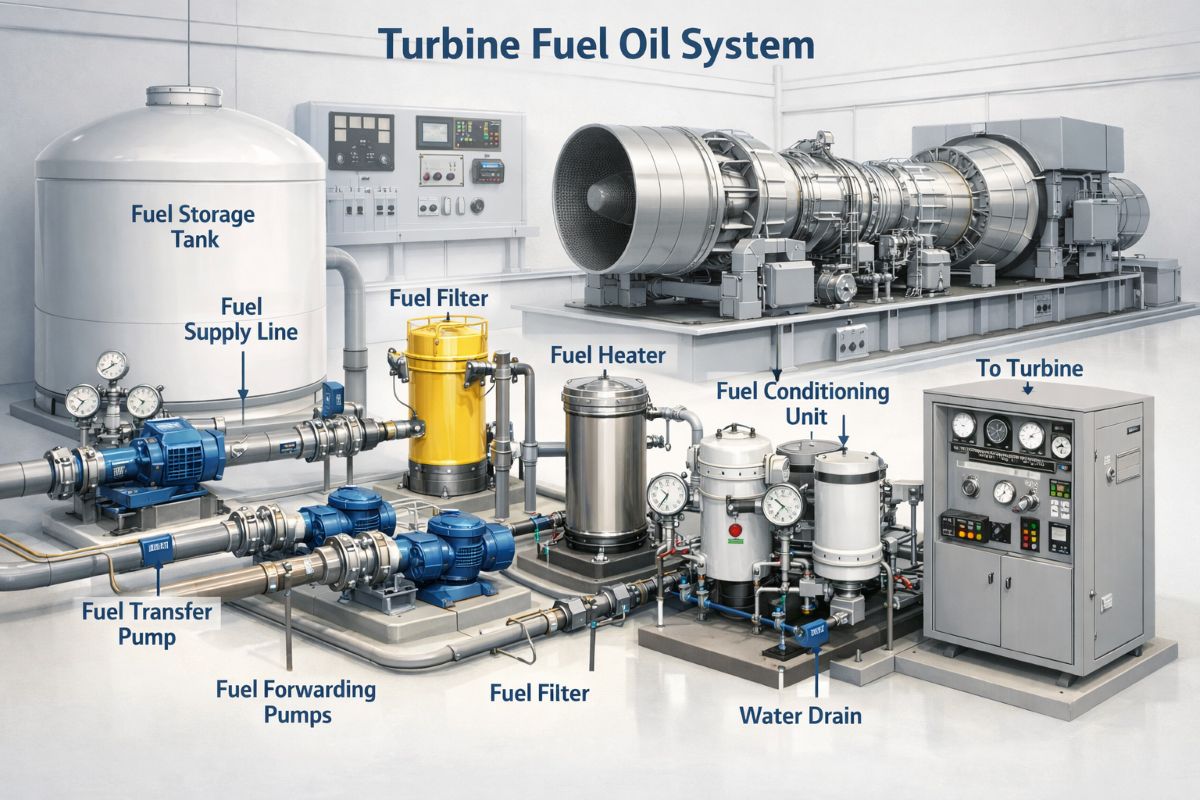
A turbine fuel oil system is a complete network of tanks, pumps, filters, heaters, control valves, and instrumentation that supplies liquid fuel — typically High-Speed Diesel (HSD), Light Fuel Oil (LFO), or Heavy Fuel Oil (HFO) — to the turbine combustion chamber at controlled conditions.
Unlike natural gas-fired turbines, liquid-fuel turbines demand precise management of fuel viscosity, temperature, and pressure. Any deviation can lead to combustion instability, turbine trip, or severe mechanical damage. That is why the fuel oil system is engineered with multiple layers of redundancy, filtration, and safety interlocks.
- 🛢️ Primary Function: Store, condition, and deliver fuel oil to the turbine at exact specifications
- ⚙️ System Scope: Covers day tank, transfer pumps, forwarding pumps, heaters, filters, flow control valves, and return circuits
- 🔁 Operating Mode: Continuous closed-loop circulation to maintain temperature and pressure stability
- 🏭 Applications: Gas turbines (GTs), steam turbines with oil burners, combined cycle plants, industrial drives
⛽ 2. Major Components of the Turbine Fuel Oil System
The fuel oil system is made up of several interconnected subsystems. Each one plays a critical role in ensuring safe and reliable turbine operation.
🛢️ 2.1 Fuel Storage and Day Tank
- ⬛ The main storage tank holds the bulk fuel supply, usually designed for 24–72 hours of full-load operation
- 🔲 A day tank (also called a service tank) is a smaller elevated or ground-level tank that directly feeds the forwarding system — typically sized for 8–12 hours of operation
- 📏 Level transmitters (LT) and level switches (LS) monitor tank levels continuously with high and low alarms wired to the DCS or PLC
- 🌡️ Tank heating coils maintain minimum fuel temperature, especially for HFO with high pour points
- 🛡️ Flame arrestors and pressure-vacuum (PV) vents on tank tops prevent vapor ignition and control tank breathing
⚡ 2.2 Transfer and Forwarding Pumps
- 🔄 Transfer pumps move fuel from the main storage tank to the day tank — usually gear pumps or screw pumps operating at low to medium pressure
- 💪 Forwarding pumps (also called booster pumps) supply fuel from the day tank toward the turbine — typically arranged as 2×100% (duty + standby) for reliability
- 🔀 Auto-changeover logic in the DCS/PLC automatically starts the standby pump if the duty pump trips or loses pressure
- 📊 Pressure gauges and pressure transmitters on pump discharge monitor performance and trigger alarms on deviation
- 🔩 Mechanical seals on pumps handling HFO require periodic monitoring for leakage due to high viscosity and temperature conditions
🌡️ 2.3 Fuel Oil Heaters
- 🔥 HFO must be heated to reduce viscosity before it can be pumped and atomized effectively — typical target viscosity is 12–15 cSt at the burner
- ♨️ Heating is done by steam-traced heaters or electric heaters — steam-based shell-and-tube heaters are most common in power plants
- 🎛️ A temperature controller (TC) with a control valve on the steam supply regulates heater outlet temperature automatically
- 🚨 High-temperature cutoff switches protect against overheating, which can cause fuel degradation or flashing
- 📉 For LFO and HSD, heating is generally not required, but trace heating on pipelines may be needed in cold climates
🔍 2.4 Filtration and Strainers
- 🧹 Duplex strainers (basket type) are installed on the pump suction side — one strainer operates while the other is isolated for cleaning without shutting down the system
- 🗂️ Fine filters (typically 25–100 micron) are placed downstream of forwarding pumps to protect control valves and burner nozzles from particulate damage
- 📈 Differential pressure (DP) transmitters across filters trigger high DP alarms, indicating filter clogging and the need for changeover
- 💧 Coalescer/separator filters remove free water from fuel — especially important for HSD stored in tanks susceptible to condensation
- 🛡️ Clean fuel is critical: even small solid particles can erode precision-machined fuel nozzle orifices, causing uneven spray patterns and combustion issues
🎛️ 3. Fuel Flow Control and Metering
Accurate fuel control is the heart of turbine performance. The fuel flow to the combustion chamber is modulated continuously based on load demand, turbine speed, and exhaust temperature signals.
🔧 3.1 Fuel Control Valve (FCV)
- ⚙️ The Fuel Control Valve is a fast-acting, high-precision modulating valve — typically a globe or rotary type with a pneumatic or electro-hydraulic actuator
- 📡 It receives a 4–20 mA signal from the turbine control system (TCS) and modulates fuel flow in real time
- 🚦 Fail-safe action is critical: the FCV is designed to fail-closed to prevent fuel supply in case of signal or actuator failure
- 🔁 A bypass valve with manual override is available for maintenance and emergency scenarios
📏 3.2 Flow Measurement
- 🌀 Coriolis mass flow meters are the preferred choice for accurate fuel measurement — they measure mass flow directly, unaffected by viscosity, temperature, or pressure changes
- 📐 Turbine flow meters and positive displacement meters are also used depending on fuel type and flow range
- 📊 Flow data feeds into the DCS for fuel consumption monitoring, efficiency calculations, and calorific value tracking
- ⚠️ Dual-channel flow transmitters are often used for critical turbines — one for control, one for safety shutdown logic
🛑 3.3 Fuel Shutoff Valves (SOV) and Safety Systems
- 🚨 Shutoff valves (also called stop valves or trip valves) are solenoid-operated valves that cut off fuel supply instantly on turbine trip — typical response time is less than 1 second
- 🔴 They are wired to the Emergency Shutdown System (ESD) and fire and gas (F&G) detection systems
- 🔒 Double block-and-bleed (DBB) valve arrangements are used in critical applications to ensure positive isolation
- 🔁 Automatic recirculation valves maintain minimum flow through forwarding pumps when the FCV is nearly closed, preventing pump overheating/oscillations.
- 📋 All SOVs undergo periodic proof testing as part of SIL (Safety Integrity Level) compliance under IEC 61511
🔁 4. Fuel Return and Recirculation Circuit
- ↩️ Fuel not consumed by the turbine returns to the day tank through a recirculation line — this keeps fuel continuously moving and maintains temperature stability
- 🌡️ A back-pressure control valve on the return line maintains the required system pressure across the fuel circuit
- 🔄 Continuous recirculation is especially important for HFO to prevent solidification in pipelines during standby or low-load conditions
- 📉 Heat exchangers or coolers on the return line may be needed to prevent excessive temperature rise in the day tank due to recirculated hot fuel
📡 5. Instrumentation, Control, and Alarms
Modern turbine fuel oil systems are fully integrated with the plant DCS or a dedicated Turbine Control System (TCS). Every critical parameter is monitored, logged, and alarmed.
- 🌡️ Temperature transmitters (TT): Heater outlet, day tank, fuel supply line to turbine — with high and low alarm setpoints
- 📊 Pressure transmitters (PT): Pump discharge, filter DP, fuel header pressure — with low-pressure trips for turbine protection
- 📏 Level transmitters (LT): Day tank high-high (overflow) and low-low (turbine trip) levels are hardwired safety functions
- 🌀 Flow transmitters (FT): Total fuel consumption, individual burner flow for multi-burner systems
- 🖥️ All alarms and trips are displayed on DCS HMI with clear color coding — typically yellow for warning and red for trip/shutdown
- 📋 Historical trending of fuel flow, temperature, and pressure is used for turbine performance monitoring and predictive maintenance
🏁 6. Common Problems and Troubleshooting
- 🔴 Low fuel pressure at turbine: Check forwarding pump health, filter DP (possible clogging), and FCV position feedback
- 🌡️ High fuel temperature: Check the steam control valve on the heater, heater bypass, or heat exchanger fouling on the return line
- 💧 Water in fuel: Drain the day tank water boot regularly, check the coalescer filter condition, and inspect the tank breather vents for condensation
- ⚡ Pump auto-changeover failure: Test standby pump start logic quarterly, check solenoid valve and motor contactor health
- 🔥 Combustion instability: Often linked to inconsistent fuel viscosity — check heater performance, thermocouple calibration, and steam supply pressure
- ⚠️ Spurious turbine trips on low fuel flow: Verify flow transmitter calibration, check for air entrainment in fuel lines, and inspect FCV positioner.