
CBSE Class 9 · Science
Structure of the Atom
Structure of the Atom-A complete tutorial on subatomic particles and atomic models, plus 11 worksheet types — MCQs, Assertion–Reason, Fill-ups, True/False, Match, VSA, SA, LA, Case-Based, HOTS and Numericals — each with answers.
What this chapter is about
In the last chapter you learned that atoms are the building blocks of matter. But is the atom really indivisible? In this chapter you discover the tiny charged particles inside an atom — electrons, protons and neutrons — and follow how scientists’ pictures of the atom evolved from Thomson to Rutherford to Bohr. You will also learn how electrons are arranged in shells, what decides valency, and what isotopes and isobars are.
1 · Charged Particles in Matter
By the late 1800s, experiments showed that atoms contain still smaller charged particles. Two of these — the electron and the proton — were identified first.
Electron (e⁻)
Discovered by J. J. Thomson through experiments on cathode rays. It carries a negative charge and has negligible mass (about 1/1836 that of a proton). Symbol: e⁻, relative charge −1.
Proton (p⁺)
Discovered by E. Goldstein through canal rays (anode rays). It carries a positive charge and has a relative mass of 1 u. Symbol: p⁺, relative charge +1.
2 · Thomson’s Model of the Atom
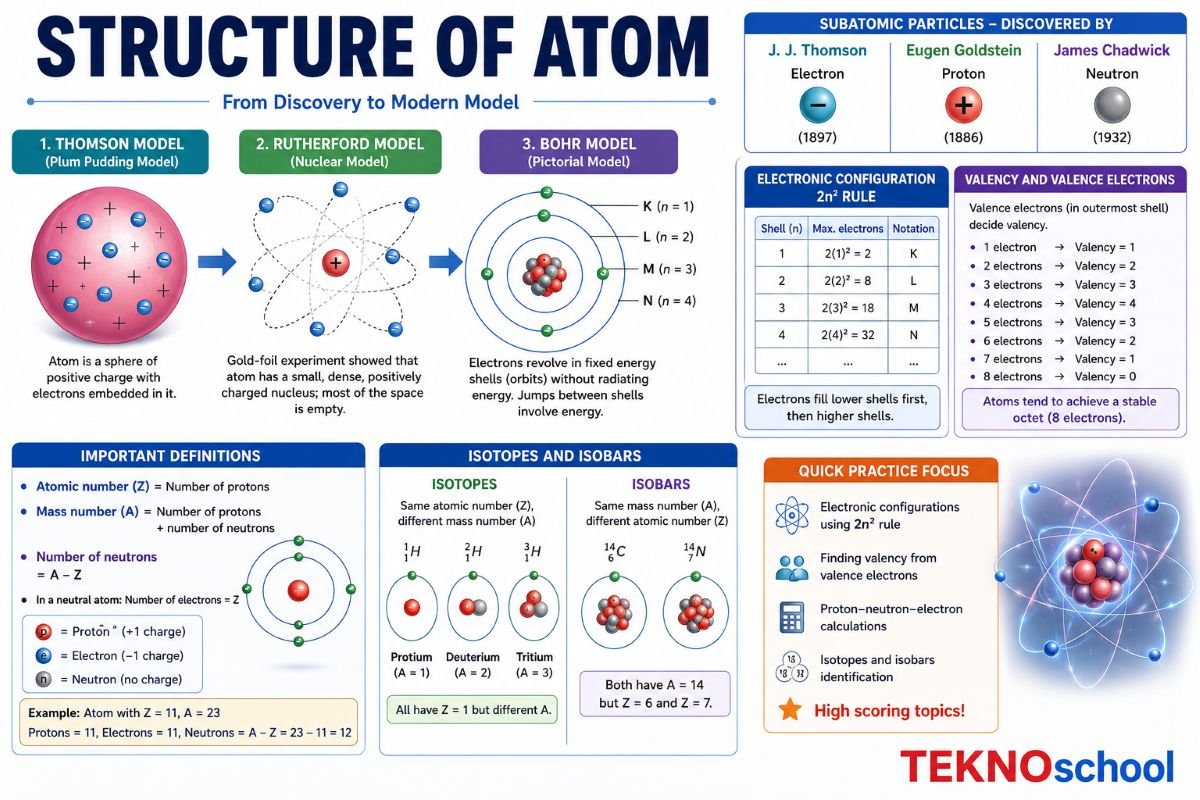
J. J. Thomson proposed that the atom is a sphere of positive charge with negatively charged electrons embedded in it — like seeds in a watermelon (or plums in a pudding). The positive and negative charges are equal in magnitude, so the atom as a whole is electrically neutral.
Its limitation
Thomson’s model could explain neutrality but could not explain the results of later scattering experiments, so it was soon replaced.
3 · Rutherford’s Alpha-Particle Scattering
Rutherford directed fast-moving, positively charged alpha particles at a very thin gold foil and observed where they went.
| Observation | Conclusion |
|---|
| Most alpha particles passed straight through | Most of the atom is empty space |
| Some were deflected by small angles | The positive charge is concentrated in a small region |
| Very few (1 in ~12,000) bounced straight back | A tiny, dense, positively charged nucleus exists at the centre |
Rutherford’s nuclear model
The atom has a small, dense, positively charged nucleus at its centre where almost all the mass is concentrated. Electrons revolve around the nucleus in circular paths. The nucleus is extremely small compared to the whole atom.
Its drawback
According to classical physics, a charged electron revolving in a circular orbit should continuously lose energy, spiral inward, and fall into the nucleus — making the atom unstable. But atoms are stable, so the model needed refinement.
4 · Bohr’s Model of the Atom
Neils Bohr solved the stability problem with two key ideas: electrons revolve only in certain discrete orbits called energy levels or shells, and while moving in these special orbits they do not radiate energy. These shells are named K, L, M, N … (for n = 1, 2, 3, 4 …).
Because electrons in these fixed shells do not lose energy, the atom remains stable. Each shell is associated with a fixed amount of energy, which is why they are also called energy levels.
5 · The Neutron
In 1932, James Chadwick discovered the neutron — a particle in the nucleus with no charge and a mass nearly equal to that of a proton (1 u). So the nucleus contains protons and neutrons (together called nucleons), while electrons revolve around it.
| Particle | Charge | Relative mass | Discovered by | Location |
|---|
| Electron | −1 | ≈ 1/1836 | J. J. Thomson | Shells |
| Proton | +1 | 1 u | E. Goldstein | Nucleus |
| Neutron | 0 | 1 u | J. Chadwick | Nucleus |
6 · Distribution of Electrons in Shells
Electrons are filled into shells using the Bohr–Bury scheme:
① Maximum electrons a shell can hold = 2n² (K = 2, L = 8, M = 18, N = 32).
② The outermost shell can hold a maximum of 8 electrons.
③ Shells are filled step by step — an inner shell is filled before the next one begins.
Examples: Sodium (Z = 11): 2, 8, 1 · Magnesium (Z = 12): 2, 8, 2 · Chlorine (Z = 17): 2, 8, 7 · Argon (Z = 18): 2, 8, 8
7 · Valence Electrons and Valency
The electrons in the outermost shell are called valence electrons. Valency is the combining capacity of an atom — the number of electrons it loses, gains or shares to complete an octet (8 electrons) in its outermost shell.
If the outermost shell has 1–4 electrons, valency usually equals that number (electrons lost). If it has 5–8 electrons, valency = 8 − (valence electrons). A full outermost shell (8, or 2 for helium) means valency 0 — the noble gases.
8 · Atomic Number and Mass Number
Atomic number (Z) = number of protons
Mass number (A) = number of protons + number of neutrons
In a neutral atom, the number of electrons equals the number of protons. Number of neutrons = A − Z. An element is represented as ZAX.
9 · Isotopes and Isobars
| Feature | Isotopes | Isobars |
|---|
| Atomic number (Z) | Same | Different |
| Mass number (A) | Different | Same |
| Element | Same element | Different elements |
| Example | Cl-35 & Cl-37; H-1, H-2, H-3 | Ca-40 & Ar-40 |
Uses of isotopes
Uranium-235 is used as fuel in nuclear reactors; cobalt-60 is used to treat cancer; and iodine-131 is used to treat goitre. The average atomic mass of chlorine (35.5 u) arises because natural chlorine is a mixture of Cl-35 and Cl-37 in a 3 : 1 ratio.
PRACTICE ZONE
Worksheets with Answers
11 types · 10 questions each · answers given inline
Atomic numbers used: H = 1, He = 2, Li = 3, C = 6, N = 7, O = 8, Na = 11, Mg = 12, Al = 13, S = 16, Cl = 17, Ar = 18, K = 19, Ca = 20.
Worksheet A · Multiple Choice Questions (10)
1. The electron was discovered by:
(a) Goldstein (b) Chadwick (c) J. J. Thomson (d) Rutherford
✓ Answer: (c) J. J. Thomson
2. The neutral particle in the nucleus is the:
(a) Electron (b) Proton (c) Neutron (d) Ion
✓ Answer: (c) Neutron
3. Rutherford’s scattering experiment used a thin foil of:
(a) Silver (b) Gold (c) Copper (d) Aluminium
✓ Answer: (b) Gold
4. The maximum number of electrons in the M shell is:
(a) 2 (b) 8 (c) 18 (d) 32
✓ Answer: (c) 18
5. The atomic number of an element equals its number of:
(a) Neutrons (b) Protons (c) Nucleons (d) Shells
✓ Answer: (b) Protons
6. Isotopes have the same:
(a) Mass number (b) Number of neutrons (c) Atomic number (d) Density
✓ Answer: (c) Atomic number
7. The electronic configuration of sodium (Z = 11) is:
(a) 2, 8, 1 (b) 2, 8, 8 (c) 8, 2, 1 (d) 2, 9
✓ Answer: (a) 2, 8, 1
8. Which model is called the ‘watermelon’ or ‘plum pudding’ model?
(a) Rutherford’s (b) Bohr’s (c) Thomson’s (d) Dalton’s
✓ Answer: (c) Thomson’s
9. Ca-40 and Ar-40 are examples of:
(a) Isotopes (b) Isobars (c) Ions (d) Isomers
✓ Answer: (b) Isobars
10. The isotope used to treat cancer is:
(a) Uranium-235 (b) Iodine-131 (c) Cobalt-60 (d) Carbon-14
✓ Answer: (c) Cobalt-60
Worksheet B · Assertion–Reason (10)
Choose: (a) Both A and R true, R correctly explains A · (b) Both true, R not the correct explanation · (c) A true, R false · (d) A false, R true.
1. A: Most of an atom is empty space. R: Most alpha particles passed straight through the gold foil.
✓ Answer: (a)
2. A: The nucleus is positively charged. R: A few alpha particles bounced straight back.
✓ Answer: (a)
3. A: Rutherford’s model fully explained atomic stability. R: Revolving electrons never lose energy.
✓ Answer: (d) — Rutherford’s model could not explain stability; classically a revolving electron would lose energy.
4. A: Bohr’s shells are called energy levels. R: Electrons in these shells do not radiate energy.
✓ Answer: (a)
5. A: The K shell can hold a maximum of 2 electrons. R: Maximum capacity of a shell is 2n².
✓ Answer: (a)
6. A: Neutrons contribute to the mass of an atom. R: Neutrons carry a positive charge.
✓ Answer: (c) — neutrons add mass but carry no charge.
7. A: Isotopes of an element have identical chemical properties. R: They have the same number of protons and electrons.
✓ Answer: (a)
8. A: Noble gases have valency zero. R: Their outermost shell is completely filled.
✓ Answer: (a)
9. A: The mass number is always greater than or equal to the atomic number. R: Mass number counts protons and neutrons together.
✓ Answer: (a)
10. A: The average atomic mass of chlorine is 35.5 u. R: Chlorine occurs as a mixture of Cl-35 and Cl-37.
✓ Answer: (a)
Worksheet C · Fill in the Blanks (10)
1. The proton was discovered by __________. → E. Goldstein
2. The neutron was discovered by __________. → James Chadwick
3. The central part of the atom is the __________. → nucleus
4. The maximum number of electrons in a shell is given by __________. → 2n²
5. Electrons present in the outermost shell are called __________ electrons. → valence
6. Atomic number is the number of __________ in an atom. → protons
7. Atoms with the same atomic number but different mass numbers are __________. → isotopes
8. The shell nearest to the nucleus is called the __________ shell. → K
9. Protons and neutrons are together called __________. → nucleons
10. The valency of a noble gas is __________. → zero
Worksheet D · True or False (10)
1. Electrons carry a positive charge. → False
2. Most of the mass of an atom is in the nucleus. → True
3. Thomson’s model has a nucleus at the centre. → False (Rutherford proposed the nucleus)
4. The L shell can hold a maximum of 8 electrons. → True
5. Isobars are atoms of the same element. → False (they are different elements)
6. Neutrons have no charge. → True
7. In a neutral atom, electrons equal protons. → True
8. Bohr’s model explains atomic stability. → True
9. Mass number = protons − neutrons. → False (it is protons + neutrons)
10. The outermost shell can hold at most 8 electrons. → True
Worksheet E · Match the Following (10)
| No. | Column A | Column B | Answer |
|---|
| 1 | Electron | (a) Chadwick | 1→d |
| 2 | Proton | (b) Nuclear model | 2→e |
| 3 | Neutron | (c) Plum pudding model | 3→a |
| 4 | Thomson | (d) J. J. Thomson | 4→c |
| 5 | Rutherford | (e) Goldstein | 5→b |
| 6 | Bohr | (f) Same mass number | 6→h |
| 7 | Isotopes | (g) 2n² | 7→i |
| 8 | Isobars | (h) Shells/energy levels | 8→f |
| 9 | Shell capacity | (i) Same atomic number | 9→g |
| 10 | K, L, M, N | (j) Energy shells | 10→j |
Worksheet F · Very Short Answer (10)
1. Name the three subatomic particles.
✓ Electron, proton and neutron.
2. Who discovered the neutron?
✓ James Chadwick.
3. Define atomic number.
✓ The number of protons in the nucleus of an atom.
4. What is the maximum number of electrons in the K shell?
✓ 2.
5. Write the electronic configuration of chlorine (Z = 17).
✓ 2, 8, 7.
6. What is the valency of magnesium?
✓ 2.
7. Define isotopes.
✓ Atoms of the same element with the same atomic number but different mass numbers.
8. Which particle has negligible mass?
✓ The electron.
9. Give one use of iodine-131.
✓ Treatment of goitre.
10. How many neutrons are in an atom with A = 23 and Z = 11?
✓ 23 − 11 = 12.
Worksheet G · Short Answer (10)
1. State the observations of Rutherford’s scattering experiment.
✓ Most alpha particles passed straight; some deflected slightly; very few bounced back.
2. Describe Thomson’s model and one of its features.
✓ A sphere of positive charge with electrons embedded, making the atom electrically neutral.
3. Why did Rutherford’s model fail to explain atomic stability?
✓ A revolving electron would continuously lose energy and spiral into the nucleus.
4. State the rules for filling electrons in shells.
✓ Max electrons = 2n²; outermost shell ≤ 8; inner shells fill before outer ones.
5. Differentiate between isotopes and isobars.
✓ Isotopes: same Z, different A (same element). Isobars: same A, different Z (different elements).
6. Define valence electrons and valency.
✓ Valence electrons are in the outermost shell; valency is the number lost, gained or shared to complete the octet.
7. How did Bohr improve on Rutherford’s model?
✓ He proposed fixed orbits (shells) in which electrons revolve without losing energy, giving a stable atom.
8. Write the electronic configuration and valency of aluminium (Z = 13).
✓ 2, 8, 3; valency = 3.
9. Why is the average atomic mass of chlorine 35.5 u and not a whole number?
✓ Because natural chlorine is a mixture of Cl-35 and Cl-37 in a 3:1 ratio; the average is 35.5 u.
10. State two uses of isotopes.
✓ Cobalt-60 treats cancer; uranium-235 fuels nuclear reactors.
Worksheet H · Long Answer (10)
1. Describe Rutherford’s alpha-scattering experiment, its observations and conclusions.
✓ Alpha particles were fired at gold foil: most passed straight (empty space), some deflected (concentrated positive charge), a few bounced back (tiny dense nucleus). Conclusion: a small, dense, positive nucleus with electrons revolving around it.
2. Compare the models of Thomson, Rutherford and Bohr.
✓ Thomson: positive sphere with embedded electrons. Rutherford: central nucleus with revolving electrons (unstable). Bohr: electrons in fixed energy shells that do not radiate energy (stable).
3. Explain the distribution of electrons using the Bohr–Bury scheme with two examples.
✓ Max = 2n², outermost ≤ 8, fill inner first. Magnesium (12): 2, 8, 2; Argon (18): 2, 8, 8.
4. Define atomic number and mass number and relate them to protons, neutrons and electrons.
✓ Z = protons (= electrons in a neutral atom); A = protons + neutrons; neutrons = A − Z.
5. What are isotopes? Give two examples and two uses.
✓ Same Z, different A — e.g. Cl-35/Cl-37, H-1/H-2/H-3. Uses: cobalt-60 (cancer), iodine-131 (goitre).
6. Tabulate the charge, mass, location and discoverer of the three subatomic particles.
✓ Electron (−1, ~1/1836 u, shells, Thomson); Proton (+1, 1 u, nucleus, Goldstein); Neutron (0, 1 u, nucleus, Chadwick).
7. Explain how valency is determined from electronic configuration with examples.
✓ From valence electrons: Na (2,8,1) loses 1 → valency 1; O (2,6) gains 2 → valency 2; Ne (2,8) full → valency 0.
8. Why is Bohr’s model considered more successful than Rutherford’s?
✓ It explains atomic stability by placing electrons in fixed, non-radiating energy shells, which Rutherford’s model could not.
9. An atom has 17 protons, 18 neutrons and 17 electrons. Find its Z, A and identify it.
✓ Z = 17, A = 17 + 18 = 35; the element is chlorine.
10. Calculate the average atomic mass of chlorine given 75% Cl-35 and 25% Cl-37.
✓ (35 × 75 + 37 × 25) ÷ 100 = 3550 ÷ 100 = 35.5 u.
Worksheet I · Case / Passage-Based (10)
Passage 1: In Rutherford’s experiment, a beam of alpha particles was aimed at a thin gold foil. Most passed through undeflected, a few turned aside, and about one in twelve thousand rebounded.
1. What does the straight passage of most particles indicate? → The atom is mostly empty space.
2. Why did a few particles rebound? → They struck the small, dense, positively charged nucleus.
3. Where is most of the atom’s mass located? → In the nucleus.
4. Name the model proposed from this experiment. → Rutherford’s nuclear model.
Passage 2: An atom of an element has atomic number 12 and mass number 24.
5. How many protons does it have? → 12.
6. How many neutrons does it have? → 24 − 12 = 12.
7. Write its electronic configuration and valency. → 2, 8, 2; valency = 2.
Passage 3: Hydrogen exists as three atoms — protium (¹H), deuterium (²H) and tritium (³H) — all with atomic number 1.
8. What are these three atoms called? → Isotopes of hydrogen.
9. How many neutrons does tritium (³H) have? → 3 − 1 = 2.
10. Why do all three show the same chemical behaviour? → They have the same number of electrons (and protons).
Worksheet J · HOTS (10)
1. If the nucleus were the size of a marble, roughly how big would the atom be — and what does this tell us?
✓ The atom would be enormous (like a stadium); the nucleus is extremely tiny and the atom is mostly empty space.
2. Why do isotopes of an element show identical chemical properties but different physical properties?
✓ Chemistry depends on electrons (same number), but mass-related physical properties differ due to different neutron numbers.
3. An ion X²⁺ has 10 electrons and a mass number of 24. Find its protons and neutrons.
✓ Neutral atom has 12 electrons = 12 protons (Z = 12); neutrons = 24 − 12 = 12.
4. Why could Thomson’s model not survive after Rutherford’s experiment?
✓ It had no concentrated nucleus, so it could not explain why some alpha particles rebounded.
5. Two atoms have (Z=20, A=40) and (Z=18, A=40). Are they isotopes or isobars? Explain.
✓ Isobars — same mass number (40) but different atomic numbers.
6. Why is valency of both sodium and chlorine equal to 1 though their configurations differ?
✓ Sodium loses 1 electron (2,8,1) and chlorine gains 1 (2,8,7) to reach a stable octet — both have valency 1.
7. How does the number of protons decide the identity of an element?
✓ The atomic number (protons) is unique to each element; changing it changes the element.
8. Why can the mass number never be less than the atomic number?
✓ Mass number = protons + neutrons, so it must be at least equal to the number of protons.
9. An element has configuration 2, 8, 8. Predict its reactivity.
✓ It has a full outermost shell (valency 0), so it is chemically inert (a noble gas, argon).
10. Why is the mass of an atom concentrated in the nucleus though electrons are also present?
✓ Protons and neutrons (in the nucleus) are ~1836 times heavier than electrons, so nearly all mass is nuclear.
Worksheet K · Numerical Problems (10)
1. An atom has Z = 11 and A = 23. Find protons, electrons and neutrons. → p = 11, e = 11, n = 12
2. Write the electronic configuration of magnesium (Z = 12). → 2, 8, 2
3. Number of valence electrons in oxygen (Z = 8). → config 2, 6 → 6
4. Maximum electrons in the N shell. → 2n² = 2(4²) = 32
5. Valency of chlorine (Z = 17). → config 2, 8, 7 → valency 1
6. An element has config 2, 8, 1. Give its atomic number and valency. → Z = 11, valency = 1
7. Number of neutrons in calcium (A = 40, Z = 20). → 40 − 20 = 20
8. Average atomic mass of Cl: Cl-35 (75%), Cl-37 (25%). → (35×75 + 37×25)/100 = 35.5 u
9. An atom has 6 protons and 8 neutrons. Find its mass number. → A = 6 + 8 = 14
10. An ion X²⁺ has 10 electrons and A = 24. Find its protons and neutrons. → protons = 12, neutrons = 12
Quick Recap
Atoms contain electrons (Thomson), protons (Goldstein) and neutrons (Chadwick). The picture evolved from Thomson’s positive sphere to Rutherford’s nuclear model (from the gold-foil experiment) to Bohr’s stable energy shells. Electrons fill shells by the 2n² rule, and valence electrons decide valency. Atomic number (Z) = protons, mass number (A) = protons + neutrons, and neutrons = A − Z. Isotopes share Z but differ in A; isobars share A but differ in Z. Practise electronic configurations, valency and the proton–neutron–electron calculations — they carry the most marks.