CBSE Class 9 · Science
Atoms and Molecules
Atoms and Molecules-A complete tutorial with laws, formulae and the mole concept, plus 11 worksheet types — MCQs, Assertion–Reason, Fill-ups, True/False, Match, VSA, SA, LA, Case-Based, HOTS and Numericals — each with answers.
What this chapter is about
Everything is built from tiny building blocks — atoms — that join together to make molecules and ions. In this chapter you learn the laws that govern how substances combine, Dalton’s atomic theory, how to write chemical symbols and formulae using valency, how to calculate molecular and formula-unit masses, and the powerful mole concept that lets chemists count atoms by weighing them.
1 · Laws of Chemical Combination
Law of Conservation of Mass (Lavoisier)
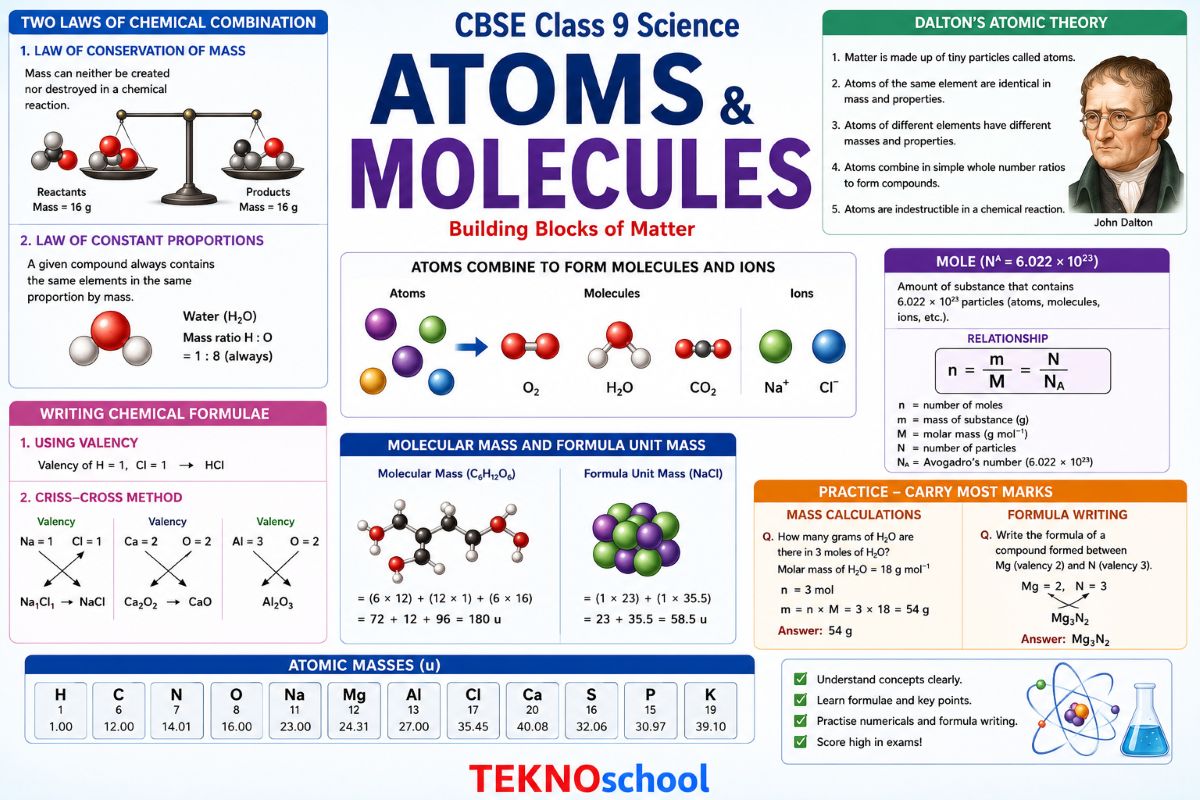
Mass can neither be created nor destroyed in a chemical reaction. The total mass of the reactants equals the total mass of the products. For example, when 12 g of carbon burns in 32 g of oxygen, exactly 44 g of carbon dioxide is formed.
Law of Constant (Definite) Proportions (Proust)
In a pure chemical compound, the elements are always present in the same fixed proportion by mass. Water, from any source, always contains hydrogen and oxygen in the mass ratio 1 : 8. Carbon dioxide always has carbon to oxygen in the ratio 3 : 8.
2 · Dalton’s Atomic Theory
John Dalton explained these laws by proposing that all matter is made of atoms. His main postulates:
① All matter is made of very small particles called atoms.
② Atoms are indivisible and cannot be created or destroyed in a chemical reaction.
③ Atoms of a given element are identical in mass and chemical properties.
④ Atoms of different elements have different masses and properties.
⑤ Atoms combine in small whole-number ratios to form compounds.
⑥ The relative number and kinds of atoms are constant in a given compound.
A modern correction
Dalton’s idea that the atom is indivisible is no longer fully true — atoms are made of still smaller particles (electrons, protons, neutrons). You will study this in the next chapter.
3 · Atoms — Size, Symbols and Mass
An atom is the smallest particle of an element that takes part in a chemical reaction. Atoms are extremely small — their radius is measured in nanometres (1 nm = 10-9 m).
Symbols of elements
IUPAC assigns each element a symbol — usually the first letter (capital) or first two letters (first capital, second small) of its name, e.g. H for hydrogen, Ca for calcium. Some come from Latin names: Na (Natrium = sodium), K (Kalium = potassium), Fe (Ferrum = iron), Au (Aurum = gold).
Atomic mass and the unit ‘u’
The atomic mass of an element is its mass relative to a standard. The standard is the carbon-12 atom, and 1 atomic mass unit (u) = 1/12 of the mass of one carbon-12 atom. So hydrogen = 1 u, oxygen = 16 u, carbon = 12 u.
4 · Molecules and Atomicity
A molecule is the smallest particle of an element or compound that can exist independently. The number of atoms in one molecule is its atomicity.
| Atomicity | Meaning | Examples |
|---|
| Monatomic | 1 atom | He, Ne, Ar |
| Diatomic | 2 atoms | H2, O2, N2, Cl2 |
| Triatomic | 3 atoms | O3 (ozone) |
| Polyatomic | Many atoms | P4, S8 |
Molecules of compounds contain atoms of different elements in a fixed ratio, e.g. water (H2O), carbon dioxide (CO2), ammonia (NH3).
An ion is a charged atom or group of atoms. A positively charged ion is a cation (e.g. Na+); a negatively charged ion is an anion (e.g. Cl–). Groups of atoms carrying a charge are polyatomic ions.
| Valency 1 | Valency 2 | Valency 3 |
|---|
| Na+, K+, Cl–, OH–, NO3–, NH4+ | Ca2+, Mg2+, O2-, SO42-, CO32- | Al3+, Fe3+, PO43-, N3- |
Valency is the combining capacity of an element — the number of electrons an atom loses, gains or shares to form a compound.
6 · Writing Chemical Formulae (Criss-Cross)
To write a formula, write the symbols with their valencies, then cross over the valencies as subscripts. Simplify the ratio and enclose polyatomic ions in brackets when more than one is needed.
| Compound | Ions / valency | Formula |
|---|
| Sodium chloride | Na+, Cl– | NaCl |
| Calcium oxide | Ca2+, O2- | CaO |
| Aluminium oxide | Al3+, O2- | Al2O3 |
| Calcium hydroxide | Ca2+, OH– | Ca(OH)2 |
| Ammonium sulphate | NH4+, SO42- | (NH4)2SO4 |
7 · Molecular Mass and Formula Unit Mass
Molecular mass is the sum of the atomic masses of all the atoms in a molecule (used for molecules). Formula unit mass is the same sum for ionic compounds, which do not exist as separate molecules.
Water (H2O): 2(1) + 16 = 18 u
Carbon dioxide (CO2): 12 + 2(16) = 44 u
Sodium chloride (NaCl): 23 + 35.5 = 58.5 u (formula unit mass)
Atoms are too small to count one by one, so chemists group them. One mole of any substance contains 6.022 × 10²³ particles — this number is called Avogadro’s number (NA).
Molar mass
The molar mass is the mass of one mole of a substance, expressed in grams. Numerically it equals the atomic or molecular mass in u. So the molar mass of water is 18 g, of oxygen atoms is 16 g, and of CO2 is 44 g.
Number of moles (n) = Given mass (m) ÷ Molar mass (M)
n = Number of particles (N) ÷ 6.022 × 10²³
Three Faces of the Mole
1 mole = 6.022 × 10²³ particles
1 mole = molar mass in grams
n = m ÷ M = N ÷ NA
PRACTICE ZONE
Worksheets with Answers
11 types · 10 questions each · answers given inline
Atomic masses (u): H = 1, C = 12, N = 14, O = 16, Na = 23, Mg = 24, S = 32, Cl = 35.5, Ca = 40. NA = 6.022 × 10²³.
Worksheet A · Multiple Choice Questions (10)
1. The law of conservation of mass was given by:
(a) Proust (b) Dalton (c) Lavoisier (d) Avogadro
✓ Answer: (c) Lavoisier
2. One atomic mass unit is defined as 1/12 the mass of one atom of:
(a) Hydrogen (b) Oxygen-16 (c) Carbon-12 (d) Nitrogen
✓ Answer: (c) Carbon-12
3. The value of Avogadro’s number is:
(a) 6.022 × 10²³ (b) 6.022 × 10²² (c) 3.011 × 10²³ (d) 6.022 × 10²⁴
✓ Answer: (a) 6.022 × 10²³
4. The atomicity of ozone (O3) is:
(a) 1 (b) 2 (c) 3 (d) 4
✓ Answer: (c) 3
5. Which is a cation?
(a) Cl– (b) O2- (c) Na+ (d) SO42-
✓ Answer: (c) Na+
6. The molecular mass of water (H2O) is:
(a) 16 u (b) 17 u (c) 18 u (d) 20 u
✓ Answer: (c) 18 u
7. The formula of aluminium oxide is:
(a) AlO (b) Al2O3 (c) Al3O2 (d) AlO3
✓ Answer: (b) Al2O3
8. The symbol Na for sodium comes from the Latin word:
(a) Natrium (b) Kalium (c) Ferrum (d) Aurum
✓ Answer: (a) Natrium
9. The number of moles in 36 g of water is:
(a) 1 (b) 2 (c) 0.5 (d) 4
✓ Answer: (b) 2
10. Which postulate of Dalton is now known to be wrong?
(a) Atoms of an element are identical (b) Atoms combine in whole-number ratios (c) Atoms are indivisible (d) Matter is made of atoms
✓ Answer: (c) Atoms are indivisible
Worksheet B · Assertion–Reason (10)
Choose: (a) Both A and R true, R correctly explains A · (b) Both true, R not the correct explanation · (c) A true, R false · (d) A false, R true.
1. A: Total mass is conserved in a chemical reaction. R: Atoms are neither created nor destroyed, only rearranged.
✓ Answer: (a)
2. A: Water always has H and O in a 1:8 mass ratio. R: This follows the law of constant proportions.
✓ Answer: (a)
3. A: Dalton’s postulate that atoms are indivisible is fully correct today. R: Atoms contain no smaller particles.
✓ Answer: (d) — atoms do contain electrons, protons and neutrons.
4. A: Noble gases like helium are monatomic. R: Their atoms exist independently as single atoms.
✓ Answer: (a)
5. A: The formula of calcium chloride is CaCl2. R: Calcium has valency 2 and chlorine has valency 1.
✓ Answer: (a)
6. A: NaCl has a formula unit mass, not a molecular mass. R: Ionic compounds do not exist as discrete molecules.
✓ Answer: (a)
7. A: One mole of oxygen atoms weighs 32 g. R: The atomic mass of oxygen is 16 u.
✓ Answer: (d) — one mole of O atoms weighs 16 g; 32 g is one mole of O2 molecules.
8. A: Symbols of elements are written with the first letter capital. R: IUPAC standardises element symbols.
✓ Answer: (a)
9. A: The mole lets chemists count particles by weighing. R: One mole always contains 6.022 × 10²³ particles.
✓ Answer: (a)
10. A: Ammonium sulphate is written (NH4)2SO4. R: Polyatomic ions taken more than once are enclosed in brackets.
✓ Answer: (a)
Worksheet C · Fill in the Blanks (10)
1. The law of __________ proportions was given by Proust. → constant (definite)
2. The smallest particle of an element is an __________. → atom
3. A positively charged ion is called a __________. → cation
4. The number of atoms in one molecule is its __________. → atomicity
5. The combining capacity of an element is its __________. → valency
6. 1 u is 1/12 the mass of a __________ atom. → carbon-12
7. One mole contains __________ particles. → 6.022 × 10²³
8. The mass of one mole of a substance is its __________ mass. → molar
9. The Latin name for iron gives the symbol __________. → Fe
10. The molecular mass of CO2 is __________ u. → 44
Worksheet D · True or False (10)
1. Mass is created during a chemical reaction. → False
2. Atoms of different elements have different masses. → True
3. An anion is positively charged. → False (it is negatively charged)
4. Oxygen gas (O2) is diatomic. → True
5. Ionic compounds exist as separate molecules. → False (they form formula units)
6. The valency of oxygen is 2. → True
7. The molecular mass of NH3 is 17 u. → True
8. One mole of any gas always weighs 22.4 g. → False (it occupies 22.4 L at STP; mass depends on the gas)
9. The symbol for potassium is K. → True
10. Avogadro’s number equals 6.022 × 10²³. → True
Worksheet E · Match the Following (10)
| No. | Column A | Column B | Answer |
|---|
| 1 | Lavoisier | (a) 6.022 × 10²³ | 1→f |
| 2 | Proust | (b) Sodium | 2→g |
| 3 | Avogadro number | (c) 44 u | 3→a |
| 4 | Na | (d) Triatomic | 4→b |
| 5 | CO2 mass | (e) Cation | 5→c |
| 6 | Ozone | (f) Conservation of mass | 6→d |
| 7 | Na+ | (g) Constant proportions | 7→e |
| 8 | SO42- | (h) 18 u | 8→i |
| 9 | Water mass | (i) Polyatomic anion | 9→h |
| 10 | He, Ne | (j) Monatomic | 10→j |
Worksheet F · Very Short Answer (10)
1. State the law of conservation of mass.
✓ Mass is neither created nor destroyed in a chemical reaction.
2. Define atomic mass unit.
✓ 1 u = 1/12 the mass of one carbon-12 atom.
3. What is a cation?
✓ A positively charged ion.
4. Give the formula of ammonium ion.
✓ NH4+.
5. Name a triatomic molecule.
✓ Ozone (O3).
6. What is the valency of aluminium?
✓ 3.
7. How many particles are in one mole?
✓ 6.022 × 10²³.
8. Write the formula of calcium hydroxide.
✓ Ca(OH)2.
9. Give the molar mass of oxygen gas (O2).
✓ 32 g.
10. What is the symbol derived from ‘Aurum’?
✓ Au (gold).
Worksheet G · Short Answer (10)
1. State and explain the law of constant proportions with an example.
✓ A pure compound always contains its elements in a fixed mass ratio; e.g. water always has H:O = 1:8 by mass.
2. Give any three postulates of Dalton’s atomic theory.
✓ Matter is made of atoms; atoms of an element are identical in mass; atoms combine in whole-number ratios.
3. Differentiate between an atom and a molecule.
✓ An atom is the smallest particle of an element that reacts; a molecule is the smallest particle that can exist independently, made of two or more atoms.
4. Define valency and give the valency of oxygen and sodium.
✓ Valency is the combining capacity of an element; oxygen = 2, sodium = 1.
5. Write the formulae of (i) magnesium chloride (ii) sodium sulphate.
✓ (i) MgCl2 (ii) Na2SO4.
6. Calculate the molecular mass of H2SO4.
✓ 2(1) + 32 + 4(16) = 98 u.
7. Why is NaCl said to have a formula unit mass and not a molecular mass?
✓ It is an ionic compound existing as a giant lattice, not as separate molecules.
8. Define one mole and molar mass.
✓ One mole = 6.022 × 10²³ particles; molar mass = mass of one mole in grams.
9. How many moles are present in 22 g of CO2?
✓ n = 22 ÷ 44 = 0.5 mole.
10. Explain atomicity with two examples.
✓ It is the number of atoms in a molecule — e.g. H2 is diatomic (2), P4 is polyatomic (4).
Worksheet H · Long Answer (10)
1. State the two laws of chemical combination and explain each with an example.
✓ Conservation of mass (mass of reactants = products; C + O₂ → CO₂, 12 + 32 = 44 g). Constant proportions (elements in fixed mass ratio; water H:O = 1:8).
2. Write the postulates of Dalton’s atomic theory and state which is no longer valid.
✓ Atoms make up matter; are indivisible; identical for one element; different for different elements; combine in whole numbers. The postulate that atoms are indivisible is no longer valid.
3. Explain how chemical formulae are written using the criss-cross method with two examples.
✓ Write symbols with valencies and cross them as subscripts; e.g. Al³⁺ + O²⁻ → Al₂O₃; Ca²⁺ + OH⁻ → Ca(OH)₂.
4. Define mole, Avogadro’s number and molar mass, and give the relation between them.
✓ Mole = 6.022 × 10²³ particles (Avogadro’s number); molar mass = mass of one mole in grams; n = m ÷ M = N ÷ NA.
5. Calculate the molecular masses of H2O, CO2, NH3 and glucose (C6H12O6).
✓ H2O = 18 u; CO2 = 44 u; NH3 = 17 u; glucose = 6(12)+12(1)+6(16) = 180 u.
6. Differentiate between molecular mass and formula unit mass with examples.
✓ Molecular mass applies to molecules (H2O = 18 u); formula unit mass applies to ionic compounds (NaCl = 58.5 u).
7. What are ions? Classify them and give two examples of each type.
✓ Charged particles: cations (Na⁺, Ca²⁺) and anions (Cl⁻, O²⁻); polyatomic ions include SO4²⁻ and NH4⁺.
8. How many molecules are present in 9 g of water? (M = 18)
✓ n = 9/18 = 0.5 mol; molecules = 0.5 × 6.022 × 10²³ = 3.011 × 10²³.
9. Explain why the mole concept is useful in chemistry.
✓ Atoms are too small and numerous to count individually; the mole links a countable number of particles to a weighable mass, so reactions can be measured by mass.
10. Write the formulae of: sodium oxide, calcium carbonate, aluminium sulphate, magnesium nitride, potassium chloride.
✓ Na2O, CaCO3, Al2(SO4)3, Mg3N2, KCl.
Worksheet I · Case / Passage-Based (10)
Passage 1: In an experiment, 12 g of carbon was completely burnt in 32 g of oxygen inside a closed flask, and the flask was weighed before and after.
1. What is the total mass of the product formed? → 44 g of CO2.
2. Which law does this verify? → Law of conservation of mass.
3. Why must the flask be closed? → So no gas escapes and the total mass is conserved.
4. Give the C:O mass ratio in CO2. → 12:32 = 3:8.
Passage 2: A chemist needs exactly 0.5 mole of glucose (C6H12O6, molar mass 180 g) for a reaction.
5. What mass of glucose should be weighed? → 0.5 × 180 = 90 g.
6. How many molecules does this contain? → 0.5 × 6.022 × 10²³ = 3.011 × 10²³.
7. Which formula relates moles, mass and molar mass? → n = m ÷ M.
Passage 3: A student writes the formula of aluminium sulphate by crossing over the valencies of Al³⁺ and SO4²⁻.
8. Write the correct formula. → Al2(SO4)3.
9. Why is the sulphate ion enclosed in brackets? → Because it is a polyatomic ion taken more than once.
10. Name the method used. → Criss-cross method.
1. Two samples of pure water from different rivers are analysed. What can you predict about their H:O ratio and why?
✓ Both will be 1:8 by mass — the law of constant proportions holds regardless of source.
2. Why does one mole of oxygen atoms (16 g) differ in mass from one mole of oxygen molecules (32 g)?
✓ A molecule O2 has two atoms, so its molar mass is double that of a single O atom.
3. Equal masses (say 1 g) of hydrogen and oxygen gas are taken. Which has more molecules and why?
✓ Hydrogen — it has a smaller molar mass (2 g), so 1 g gives more moles and more molecules.
4. A reaction seems to lose mass in an open beaker. Does this break the conservation law? Explain.
✓ No — a gaseous product escaped; in a closed system total mass is conserved.
5. Why did Dalton’s model need modification later?
✓ The discovery of subatomic particles showed atoms are divisible, contradicting his ‘indivisible’ postulate.
6. Predict the formula of a compound of X (valency 3) and Y (valency 2).
✓ X2Y3 (criss-cross the valencies).
7. 0.5 mole of an element weighs 16 g. Identify the element.
✓ Molar mass = 16 ÷ 0.5 = 32 g → sulphur (S).
8. Why can we not weigh a single atom on a normal balance, yet we can weigh a mole?
✓ A single atom is far too light; a mole (6.022 × 10²³ atoms) has a mass in grams that a balance can measure.
9. Which contains more atoms — 1 mole of water or 1 mole of oxygen gas? Explain.
✓ Water — each H2O has 3 atoms (3 NA), while O2 has 2 atoms (2 NA).
10. Nitrogen forms both NO and NO2. Which law explains that these are two distinct compounds with fixed compositions?
✓ The law of constant proportions — each compound has its own fixed N:O mass ratio.
Worksheet K · Numerical Problems (10)
1. Molecular mass of water (H2O). → 2(1) + 16 = 18 u
2. Molecular mass of CO2. → 12 + 2(16) = 44 u
3. Formula unit mass of NaCl. → 23 + 35.5 = 58.5 u
4. Molecular mass of H2SO4. → 2(1) + 32 + 4(16) = 98 u
5. Molecular mass of glucose C6H12O6. → 6(12) + 12(1) + 6(16) = 180 u
6. Number of moles in 36 g of water. → 36 ÷ 18 = 2 mol
7. Number of moles in 22 g of CO2. → 22 ÷ 44 = 0.5 mol
8. Number of molecules in 2 moles of water. → 2 × 6.022 × 10²³ = 1.2044 × 10²⁴
9. Mass of 0.5 mole of glucose (M = 180). → 0.5 × 180 = 90 g
10. Number of moles and atoms in 12 g of carbon. → 12 ÷ 12 = 1 mol; atoms = 6.022 × 10²³
Quick Recap
The two laws of chemical combination — conservation of mass and constant proportions — are explained by Dalton’s atomic theory. Atoms combine to form molecules and ions; formulae are built using valency and the criss-cross method. Molecular mass (and formula unit mass for ionic compounds) is the sum of atomic masses. The mole (6.022 × 10²³ particles) links counting to weighing, with n = m ÷ M = N ÷ NA. Practise the mass calculations and formula writing — they carry the most marks.