CBSE Class 9 · Science
Is Matter Around Us Pure?
Is Matter Around Us Pure?-A complete tutorial with clear concepts, tables and diagrams, plus 11 worksheet types — MCQs, Assertion–Reason, Fill-ups, True/False, Match, VSA, SA, LA, Case-Based, HOTS and Numericals — each with answers.
What this chapter is about
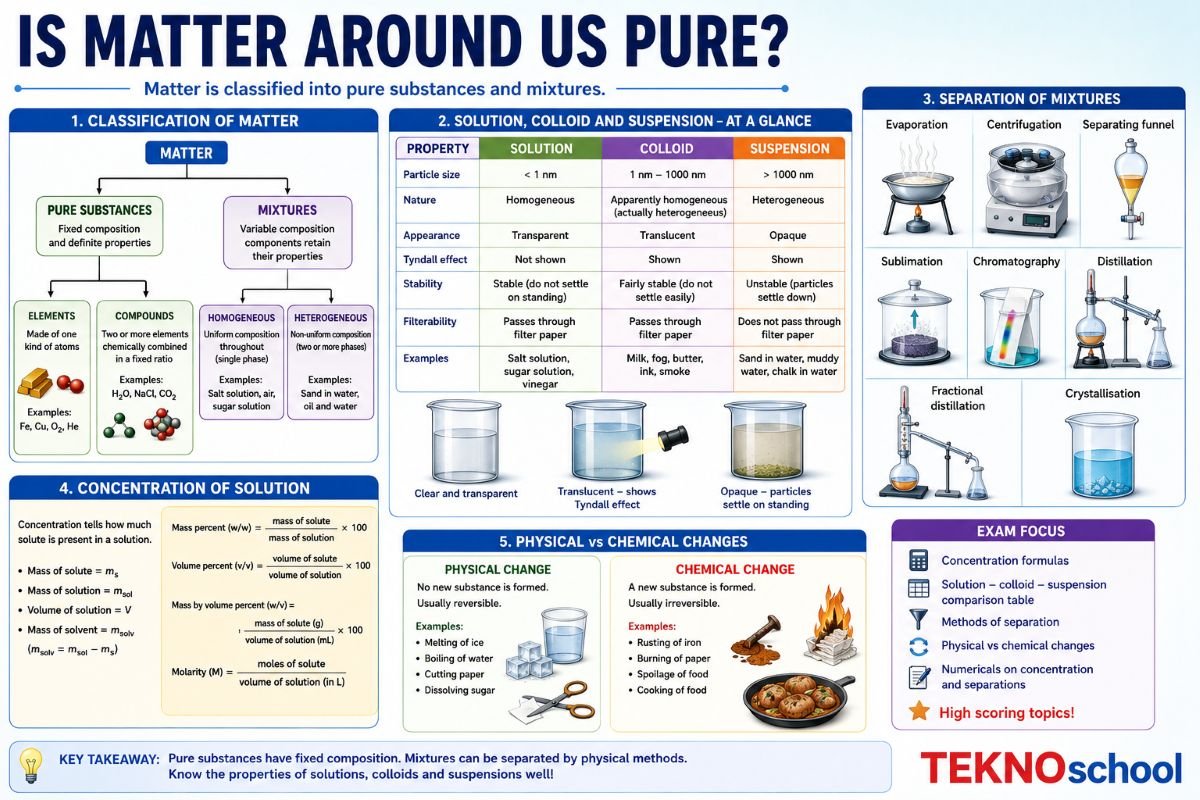
Almost nothing around us is truly “pure”. The milk you drink, the air you breathe, sea water, brass and even ink are all mixtures. In this chapter you learn how scientists classify matter into pure substances (elements and compounds) and mixtures, how to tell a solution from a suspension and a colloid, and the clever techniques — filtration, distillation, chromatography, crystallisation and more — used to pull mixtures apart.
1 · Pure Substances and Mixtures
A pure substance is made of only one kind of particle and has a fixed composition, e.g. gold, water, oxygen. A mixture contains two or more pure substances mixed in any ratio, e.g. air, sugar solution, soil.
Two kinds of mixtures
Homogeneous mixtures have a uniform composition throughout — you cannot see the separate parts (e.g. salt in water, air, alloys). Heterogeneous mixtures have a non-uniform composition with visible boundaries (e.g. sand + salt, oil + water, soil).
2 · Types of Pure Substances
Pure substances are of two types — elements and compounds.
Elements
An element is the simplest form of matter that cannot be broken down into simpler substances by chemical means, e.g. iron, oxygen, gold. Elements are classified as metals (iron, copper — lustrous, conduct heat/electricity, malleable, ductile), non-metals (sulphur, oxygen — dull, poor conductors), and metalloids (boron, silicon — intermediate properties).
Compounds
A compound is a pure substance made of two or more elements chemically combined in a fixed ratio, e.g. water (H₂O), carbon dioxide (CO₂). Its properties are entirely different from those of its constituent elements.
Iron + Sulphur — a classic example
A mixture of iron filings and sulphur powder can be separated by a magnet (iron is still attracted). But on heating, they form the compound iron sulphide (FeS) — a new substance that is not magnetic and has completely new properties.
3 · Compounds vs Mixtures
| Feature | Mixture | Compound |
|---|
| Composition | Any ratio (variable) | Fixed ratio |
| How formed | Physical mixing | Chemical reaction |
| Energy change | Usually none | Heat/light given out or absorbed |
| Properties | Of the components | New, different properties |
| Separation | Physical methods | Only chemical methods |
A solution is a homogeneous mixture of two or more substances, e.g. sugar in water, air, brass. The component that dissolves is the solute; the one in which it dissolves is the solvent. In salt water, salt is the solute and water is the solvent.
Properties of a true solution
It is homogeneous · particle size is smaller than 1 nm · particles cannot be seen even with a microscope · it does not scatter light (no Tyndall effect) · it is stable — particles do not settle · the solute cannot be separated by filtration.
Concentration of a solution
Concentration is the amount of solute present in a given amount of solution (or solvent). Common ways to express it:
Mass % = (Mass of solute ÷ Mass of solution) × 100
Mass by volume % = (Mass of solute ÷ Volume of solution) × 100
Volume % = (Volume of solute ÷ Volume of solution) × 100
Saturated, unsaturated & solubility
A saturated solution can dissolve no more solute at that temperature. An unsaturated solution can still dissolve more. Solubility is the maximum amount of solute that dissolves in 100 g of solvent at a given temperature. Solubility of most solids increases with temperature; solubility of gases decreases with temperature.
5 · Suspensions and Colloids
| Property | Solution | Colloid | Suspension |
|---|
| Nature | Homogeneous | Appears homogeneous, is heterogeneous | Heterogeneous |
| Particle size | < 1 nm | 1–1000 nm | > 1000 nm (visible) |
| Tyndall effect | No | Yes | Yes |
| Settle on standing? | No | No | Yes |
| Filterable? | No | No (needs centrifugation) | Yes |
| Example | Salt water | Milk, fog | Muddy water, chalk in water |
The Tyndall effect
The scattering of a beam of light by colloidal particles is the Tyndall effect. It is seen when sunlight passes through a canopy of trees in a forest, or through a small hole into a dusty room. A colloid has two parts: the dispersed phase (the solute-like particles) and the dispersion medium (the solvent-like part).
Common colloid types: sol (solid in liquid — paint, ink), gel (liquid in solid — jelly, cheese), emulsion (liquid in liquid — milk, face cream), foam (gas in liquid — shaving foam), and aerosol (liquid/solid in gas — fog, smoke).
6 · Separating the Components of a Mixture
| Method | Used to separate | Example |
|---|
| Evaporation | Non-volatile solid from its solution | Dye from black ink |
| Centrifugation | Fine suspended particles | Cream from milk, blood components |
| Separating funnel | Two immiscible liquids | Oil + water, kerosene + water |
| Sublimation | A subliming solid from a non-subliming solid | Ammonium chloride + salt |
| Chromatography | Dissolved solutes that dissolve in the same solvent | Colours in a dye/ink |
| Distillation | Two miscible liquids with a large boiling-point gap | Acetone + water |
| Fractional distillation | Miscible liquids with close boiling points | Gases from air, petroleum fractions |
| Crystallisation | Purifying a solid | Copper sulphate, sugar |
Why crystallisation beats evaporation
Crystallisation is better than simple evaporation for purifying solids because some solids decompose or char on strong heating, and impurities that were dissolved may remain in the dry residue after evaporation. Crystallisation leaves the impurities behind in the solution.
7 · Physical and Chemical Changes
| Physical change | Chemical change |
|---|
| No new substance is formed | A new substance with new properties forms |
| Usually reversible | Usually irreversible |
| Only physical properties change | Chemical composition changes |
| Melting ice, dissolving sugar, boiling water | Burning of paper, rusting of iron, cooking food |
Classification of Matter
MATTER
splits into ↓
PURE SUBSTANCES
MIXTURES
Pure → Elements + Compounds · Mixtures → Homogeneous + Heterogeneous
PRACTICE ZONE
Worksheets with Answers
11 types · 10 questions each · answers given inline
Worksheet A · Multiple Choice Questions (10)
1. Which of the following is a pure substance?
(a) Air (b) Milk (c) Distilled water (d) Sea water
✓ Answer: (c) Distilled water
2. A homogeneous mixture is:
(a) Sand + water (b) Sugar solution (c) Oil + water (d) Muddy water
✓ Answer: (b) Sugar solution
3. The Tyndall effect is shown by:
(a) True solution (b) Colloid (c) Element (d) Compound
✓ Answer: (b) Colloid
4. Which method separates cream from milk?
(a) Filtration (b) Distillation (c) Centrifugation (d) Sublimation
✓ Answer: (c) Centrifugation
5. Two immiscible liquids are best separated using a:
(a) Separating funnel (b) Filter paper (c) Magnet (d) Chromatography column
✓ Answer: (a) Separating funnel
6. Brass is an example of a/an:
(a) Compound (b) Element (c) Homogeneous mixture (alloy) (d) Suspension
✓ Answer: (c) Homogeneous mixture (alloy)
7. The particle size of a colloid lies between:
(a) < 1 nm (b) 1–1000 nm (c) > 1000 nm (d) 1–10 cm
✓ Answer: (b) 1–1000 nm
8. Which is a chemical change?
(a) Melting of ice (b) Dissolving sugar (c) Rusting of iron (d) Boiling water
✓ Answer: (c) Rusting of iron
9. Miscible liquids with a large difference in boiling points are separated by:
(a) Filtration (b) Simple distillation (c) Crystallisation (d) Sublimation
✓ Answer: (b) Simple distillation
10. In a sugar solution, the solvent is:
(a) Sugar (b) Water (c) Both (d) None
✓ Answer: (b) Water
Worksheet B · Assertion–Reason (10)
Choose: (a) Both A and R true, R correctly explains A · (b) Both true, R not the correct explanation · (c) A true, R false · (d) A false, R true.
1. A: A solution is a homogeneous mixture. R: Its particles are evenly distributed and cannot be seen.
✓ Answer: (a)
2. A: A colloid shows the Tyndall effect. R: Colloidal particles are large enough to scatter light.
✓ Answer: (a)
3. A: A suspension is a stable mixture. R: Its particles never settle down on standing.
✓ Answer: (d) — a suspension is unstable; particles settle down.
4. A: A compound has a fixed composition. R: Its elements combine in a definite ratio by mass.
✓ Answer: (a)
5. A: Air is a mixture. R: Its components can be separated by physical methods like fractional distillation.
✓ Answer: (a)
6. A: Crystallisation is preferred over evaporation to purify solids. R: Some solids decompose on strong heating.
✓ Answer: (a)
7. A: Rusting of iron is a physical change. R: No new substance is formed during rusting.
✓ Answer: (d) — rusting is a chemical change; a new substance (rust) forms.
8. A: Solubility of a gas in water decreases on heating. R: Heating gives gas particles more energy to escape the liquid.
✓ Answer: (a)
9. A: Milk is a colloid. R: It is an emulsion of liquid fat dispersed in liquid water.
✓ Answer: (a)
10. A: Iron filings can be separated from sulphur by a magnet. R: A mixture keeps the properties of its components.
✓ Answer: (a)
Worksheet C · Fill in the Blanks (10)
1. A substance made of only one kind of particle is called a __________ substance. → pure
2. The component present in a larger amount in a solution is the __________. → solvent
3. The scattering of light by colloidal particles is the __________ effect. → Tyndall
4. A mixture of two immiscible liquids is separated using a __________. → separating funnel
5. Substances that cannot be broken down further by chemical means are __________. → elements
6. Milk is a colloid of the __________ type. → emulsion
7. The maximum amount of solute that dissolves in 100 g of solvent at a given temperature is its __________. → solubility
8. Rusting of iron is a __________ change. → chemical
9. The components of petroleum are separated by __________ distillation. → fractional
10. Colours in a dye are separated by __________. → chromatography
Worksheet D · True or False (10)
1. A solution scatters a beam of light. → False
2. Air is a homogeneous mixture. → True
3. A compound can be separated into its elements by physical methods. → False (only chemical methods)
4. The particles of a suspension are large enough to be seen. → True
5. Brass is a compound. → False (it is an alloy/mixture)
6. Solubility of most solids increases with temperature. → True
7. Distillation separates two immiscible liquids. → False (it separates miscible liquids)
8. Melting of wax is a physical change. → True
9. A colloid settles down on standing. → False (it is stable)
10. Sublimation can separate ammonium chloride from common salt. → True
Worksheet E · Match the Following (10)
| No. | Column A | Column B | Answer |
|---|
| 1 | Milk cream | (a) Separating funnel | 1→e |
| 2 | Oil + water | (b) Fractional distillation | 2→a |
| 3 | Colours in ink | (c) Crystallisation | 3→f |
| 4 | Gases from air | (d) Sublimation | 4→b |
| 5 | Purifying copper sulphate | (e) Centrifugation | 5→c |
| 6 | NH₄Cl + salt | (f) Chromatography | 6→d |
| 7 | Salt water | (g) Suspension | 7→i |
| 8 | Milk | (h) Compound | 8→j |
| 9 | Muddy water | (i) True solution | 9→g |
| 10 | Water (H₂O) | (j) Colloid | 10→h |
Worksheet F · Very Short Answer (10)
1. Define a mixture.
✓ A substance made of two or more pure substances mixed in any ratio.
2. Name the two components of a solution.
✓ Solute and solvent.
3. Give one example of a homogeneous mixture.
✓ Sugar/salt solution (or air, brass).
4. What is a saturated solution?
✓ A solution that can dissolve no more solute at a given temperature.
5. Which colloid type is fog?
✓ Aerosol (liquid dispersed in gas).
6. Name a metalloid.
✓ Silicon (or boron).
7. Which technique separates dyes in black ink?
✓ Chromatography.
8. Give one example of a chemical change.
✓ Burning of paper (or rusting of iron).
9. What is the dispersed phase in milk?
✓ Liquid fat droplets.
10. Name the method to separate salt from sea water.
✓ Evaporation.
Worksheet G · Short Answer (10)
1. Distinguish between a homogeneous and a heterogeneous mixture with one example each.
✓ Homogeneous: uniform throughout, e.g. salt water. Heterogeneous: non-uniform with visible parts, e.g. sand + salt.
2. List three properties of a true solution.
✓ Homogeneous; particles <1 nm and invisible; does not scatter light and does not settle.
3. What is the Tyndall effect? Give one everyday example.
✓ Scattering of light by colloidal particles; seen when sunlight streams through mist or a forest canopy.
4. Why is crystallisation better than evaporation for obtaining pure crystals?
✓ Some solids decompose on heating and dissolved impurities stay behind in evaporation; crystallisation leaves impurities in solution.
5. Differentiate between a colloid and a suspension.
✓ Colloid: particles 1–1000 nm, do not settle, cannot be filtered. Suspension: particles >1000 nm, settle down, can be filtered.
6. How can a mixture of iron filings and sulphur be separated?
✓ By using a magnet — iron filings are attracted while sulphur is left behind.
7. Define solubility. How does temperature affect the solubility of a solid?
✓ Maximum solute dissolving in 100 g solvent at a given temperature; solubility of most solids increases with temperature.
8. Why is distillation used to separate acetone and water?
✓ They are miscible liquids with a large difference in boiling points, so the lower-boiling one vaporises and is condensed separately.
9. Give two differences between a compound and a mixture.
✓ A compound has a fixed composition and new properties; a mixture has a variable composition and shows its components’ properties.
10. Name and explain the method to separate the components of air.
✓ Fractional distillation of liquefied air — components boil off at different temperatures and are collected separately.
Worksheet H · Long Answer (10)
1. Classify matter into its types with a flow chart in words and one example of each.
✓ Matter → Pure substances (Elements — gold; Compounds — water) and Mixtures (Homogeneous — salt water; Heterogeneous — sand + salt).
2. Compare solutions, colloids and suspensions on the basis of particle size, Tyndall effect, stability and filtration.
✓ Solution: <1 nm, no Tyndall, stable, not filterable. Colloid: 1–1000 nm, shows Tyndall, stable, not filterable. Suspension: >1000 nm, shows Tyndall, unstable, filterable.
3. Explain any four methods of separating mixtures with an example of each.
✓ Evaporation (salt from water), separating funnel (oil + water), sublimation (NH₄Cl + salt), distillation (acetone + water).
4. Describe how you would obtain pure copper sulphate crystals from an impure sample.
✓ Dissolve in minimum hot water, filter to remove insoluble impurities, then cool the filtrate slowly so pure crystals form (crystallisation) while impurities stay in solution.
5. Distinguish between physical and chemical changes with two examples each.
✓ Physical: no new substance, reversible — melting ice, dissolving sugar. Chemical: new substance, irreversible — burning paper, rusting iron.
6. Explain the terms solute, solvent, saturated and unsaturated solution.
✓ Solute dissolves; solvent dissolves it; saturated holds the maximum solute at that temperature; unsaturated can dissolve more.
7. What is a colloid? Explain its two components and name four types with examples.
✓ A heterogeneous mixture that appears uniform; has a dispersed phase and dispersion medium. Types: sol (paint), gel (jelly), emulsion (milk), foam (shaving cream).
8. Why can the components of air be separated but the elements of water cannot be separated by physical means?
✓ Air is a mixture, so physical methods work; water is a compound in which elements are chemically bonded and need chemical methods (e.g. electrolysis).
9. Describe fractional distillation and why a fractionating column is used.
✓ It separates miscible liquids with close boiling points; the fractionating column provides surfaces for repeated evaporation–condensation so liquids separate more efficiently.
10. Give reasons: (i) milk shows the Tyndall effect; (ii) a suspension settles on standing; (iii) alloys are called mixtures.
✓ (i) Its colloidal fat particles scatter light. (ii) Its particles are large and heavy, so gravity pulls them down. (iii) Their composition can vary and their metals keep their properties.
Worksheet I · Case / Passage-Based (10)
Passage 1: Aditi shone a torch beam through three glasses — one with salt water, one with milk, and one with muddy water. The beam was invisible in the first but clearly visible in the other two. On standing, the muddy water settled at the bottom while the milk stayed uniform.
1. Which glass contains a true solution? → Salt water.
2. Why was the beam visible in milk and muddy water? → Their particles scatter light (Tyndall effect).
3. Classify milk and muddy water. → Milk = colloid; muddy water = suspension.
4. Why did only the muddy water settle? → Suspension particles are large and unstable, so they settle under gravity.
Passage 2: A student has a mixture of common salt, sand and ammonium chloride and is asked to separate all three.
5. Which component can be removed first by heating? → Ammonium chloride (by sublimation).
6. How is sand separated from the remaining salt? → Add water to dissolve salt, then filter out the insoluble sand.
7. How is pure salt recovered from the filtrate? → By evaporation (or crystallisation).
Passage 3: In a lab, 50 g of sugar was dissolved in 200 g of water to make a drink.
8. Identify the solute and solvent. → Solute = sugar; solvent = water.
9. Calculate the mass by mass % of the solution. → 50 ÷ (50+200) × 100 = 20%.
10. Is this a physical or chemical change? → Physical change (dissolving; no new substance).
1. Why does a beam of light become visible when passed through a colloid but not through a solution?
✓ Colloidal particles are large enough to scatter light (Tyndall effect); solution particles are too small to scatter it.
2. Sea water and distilled water look alike. How can you show sea water is a mixture?
✓ Evaporate both — sea water leaves behind salt residue, showing it is a mixture; distilled water leaves nothing.
3. Why are alloys considered mixtures and not compounds despite looking uniform?
✓ Their composition can vary, they show properties of their constituent metals, and no chemical bond forms in fixed ratio.
4. A gas dissolved in a cold drink escapes when the bottle warms up. Explain using solubility.
✓ Gas solubility decreases with rising temperature, so the dissolved CO₂ escapes on warming.
5. Why can two miscible liquids not be separated by a separating funnel?
✓ They mix completely and do not form separate layers, so distillation is needed instead.
6. During a chemistry practical, sugar chars on strong heating. Why is evaporation unsuitable to recover it?
✓ Sugar decomposes on strong heating, so crystallisation (gentle) must be used instead of evaporation.
7. Two students add the same salt to water; one gets a clear solution, the other sees undissolved salt at the bottom. Explain.
✓ The second solution is saturated (or the water was cooler/less), so extra salt cannot dissolve.
8. Why does milk appear white though its components are colourless liquids?
✓ Its colloidal fat particles scatter all wavelengths of light, making it look white.
9. How would you separate a mixture of alcohol and water (miscible, close boiling points)?
✓ By fractional distillation, using a fractionating column.
10. Rusting and burning both form new substances. What single term classifies both?
✓ Chemical changes.
Worksheet K · Numerical Problems (10)
Use Mass % = (mass of solute ÷ mass of solution) × 100.
1. 40 g common salt is dissolved in 320 g water. Find the mass %. → 40 ÷ 360 × 100 = 11.1%
2. 25 g sugar in 100 g water. Find the mass %. → 25 ÷ 125 × 100 = 20%
3. 5 g NaCl in 45 g water. Find the mass %. → 5 ÷ 50 × 100 = 10%
4. A 20% (m/m) solution has how much solute in 250 g solution? → 20/100 × 250 = 50 g
5. Solubility of a salt is 36 g per 100 g water at 20 °C. How much dissolves in 50 g water? → 36 × 50/100 = 18 g
6. 10 g sugar in a solution of total mass 200 g. Find the mass %. → 10 ÷ 200 × 100 = 5%
7. 20 mL alcohol in 100 mL of solution. Find the volume %. → 20 ÷ 100 × 100 = 20%
8. A 15% (m/v) solution — mass of solute in 200 mL solution? → 15/100 × 200 = 30 g
9. 8 g solute dissolved to make 40 g solution. Find the mass %. → 8 ÷ 40 × 100 = 20%
10. To make a 10% (m/m) solution using 90 g water, how much solute is needed? → Let solute = x; x ÷ (x+90) × 100 = 10 → x = 10 g
Quick Recap
Matter is classified into pure substances (elements and compounds) and mixtures (homogeneous and heterogeneous). Solutions, colloids and suspensions differ in particle size, Tyndall effect, stability and filterability. Mixtures are pulled apart by physical methods — evaporation, centrifugation, separating funnel, sublimation, chromatography, distillation, fractional distillation and crystallisation. Finally, physical changes form no new substance, while chemical changes do. Master the concentration formula and the three-way solution–colloid–suspension table — they carry the most marks.