CBSE Class 9 · Science
Matter in Our Surroundings
Matter in Our Surroundings-A complete tutorial with clear concepts, diagrams, and 11 worksheet types — MCQs, Assertion–Reason, Fill-ups, True/False, Match, VSA, SA, LA, Case-Based, HOTS and Numericals — each with answers.
What this chapter is about
Everything around you — the air you breathe, the water you drink, your pencil, even you — is matter. In this chapter you learn what matter is made of, why it behaves differently as a solid, liquid or gas, and how it changes from one state to another when you heat, cool or squeeze it. You will also understand everyday puzzles like why wet clothes dry, why an earthen pot keeps water cool, and why steam burns are worse than boiling-water burns.
Matter is anything that has mass and occupies space (has volume). A chair, a drop of water, a puff of smoke and even the air in a football are all matter.
Foundational idea
Early Indian philosophers classified matter into five basic elements — the Panch Tatva: air, earth, fire, sky and water. Modern science instead classifies matter physically (solid, liquid, gas) and chemically (elements, compounds, mixtures). Chapter 1 deals with the physical classification.
2 · Physical Nature of Matter
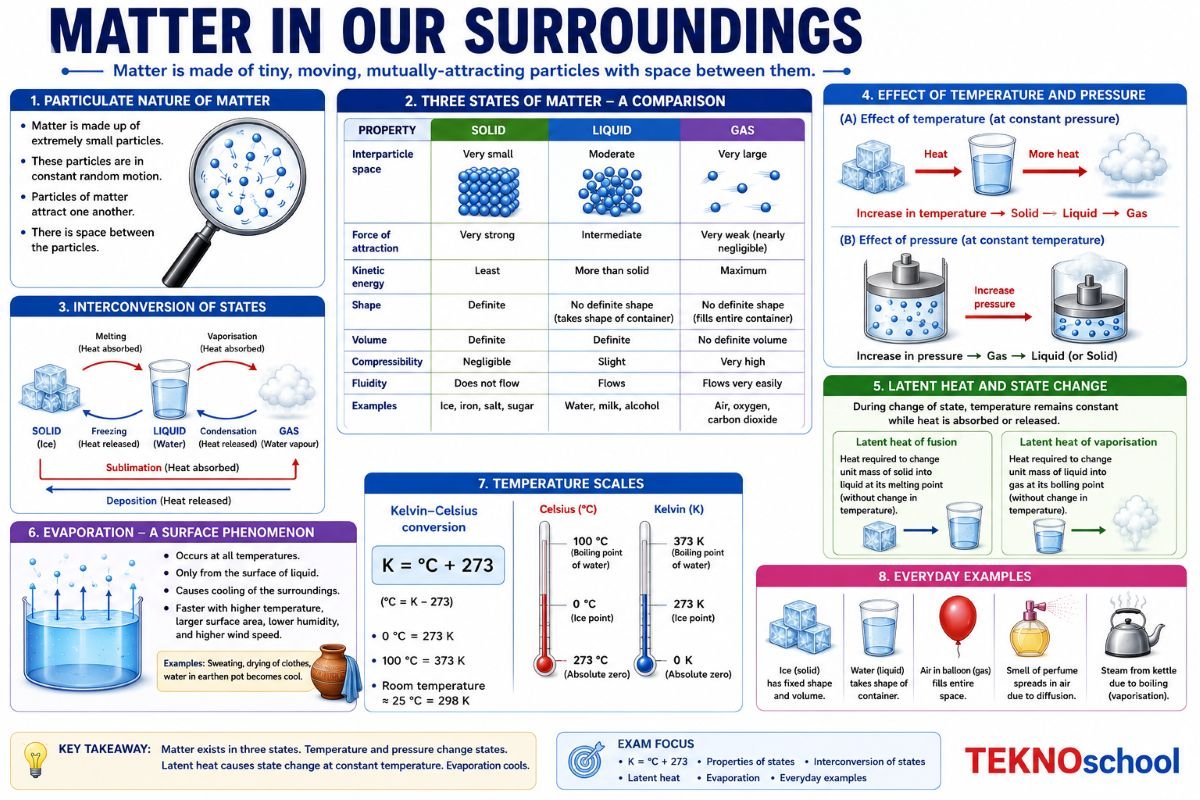
Matter is made up of tiny particles. When you dissolve a spoon of sugar or salt in water, the solid seems to disappear but its taste spreads everywhere — proof that matter is made of extremely small particles that fit into the spaces between water particles.
How small are the particles?
Take 2–3 crystals of potassium permanganate in water — the deep purple colour keeps spreading even after repeated dilution. This shows a single crystal contains millions of tiny particles, each of which can colour a large volume of water. Particles of matter are unbelievably small.
3 · Characteristics of Particles of Matter
Three key properties
① Particles have space between them. When sugar dissolves in water or tea absorbs water, particles fit into gaps between other particles — the level does not rise much.
② Particles are continuously moving. They possess kinetic energy. As temperature rises, they move faster. Their intermixing on their own is called diffusion (e.g. the smell of an incense stick reaching across a room).
③ Particles attract each other. A force of attraction holds particles together. It is strongest in solids and weakest in gases — that is why an iron nail is hard to break but air offers no resistance.
Remember
Diffusion becomes faster on heating because particles gain kinetic energy and move quicker. Diffusion is fastest in gases, slower in liquids, and negligible in solids.
4 · The Three States of Matter
Matter exists in three physical states — solid, liquid and gas — decided by how much space lies between particles, how strongly they attract, and how freely they move.
| Property | Solid | Liquid | Gas |
|---|
| Shape | Fixed | Takes shape of container | Takes shape of container |
| Volume | Fixed | Fixed | Not fixed |
| Space between particles | Very little | More | Very large |
| Force of attraction | Strongest | Medium | Weakest |
| Kinetic energy of particles | Lowest | Medium | Highest |
| Compressibility | Negligible | Very little | High |
| Fluidity (ability to flow) | Does not flow | Flows | Flows |
| Density | Highest | Medium | Lowest |
Common exam ordering
Interparticle space: Gas > Liquid > Solid · Force of attraction: Solid > Liquid > Gas · Kinetic energy: Gas > Liquid > Solid. Gases are highly compressible, which is why LPG and CNG are stored under pressure and oxygen is supplied to hospitals and divers in compressed cylinders.
5 · Can Matter Change its State?
Yes. By changing temperature or pressure, matter moves between solid, liquid and gas. These are physical changes — no new substance forms and the change is reversible.
Effect of change of temperature
Melting (Fusion)
On heating a solid, particles gain energy and vibrate faster until they break free of their fixed positions — the solid turns into liquid. The temperature at which this happens is the melting point. Melting point of ice = 273.15 K (0 °C). A high melting point indicates strong forces of attraction.
Boiling (Vaporisation)
On further heating, a liquid becomes a gas at its boiling point. Boiling point of water = 373.15 K (100 °C) at normal atmospheric pressure. Boiling is a bulk phenomenon — the whole liquid turns to vapour at the boiling point.
Latent heat — a critical concept
While a solid is melting or a liquid is boiling, the temperature stays constant even though heat is being supplied. This hidden heat, used to change the state (to break the forces of attraction) rather than raise temperature, is called latent heat.
• Latent heat of fusion of ice = 3.34 × 10⁵ J/kg
• Latent heat of vaporisation of water = 22.5 × 10⁵ J/kg
This is why steam at 100 °C causes more severe burns than water at 100 °C — steam carries the extra latent heat of vaporisation.
Effect of change of pressure
Applying high pressure and lowering temperature forces gas particles closer, liquefying the gas. So a gas can be turned into a liquid by compression + cooling. Solid CO₂ (dry ice) is stored under high pressure; when pressure is released it directly becomes gas without melting.
Interconversion of States
SOLID
↓ melting (fusion) | ↑ freezing
LIQUID
↓ boiling / evaporation (vaporisation) | ↑ condensation
GAS
SOLID ⇄ GAS directly = Sublimation / Deposition
Sublimation is the direct change of a solid into gas (and gas back to solid, called deposition) without passing through the liquid state. Substances that sublime include camphor, naphthalene balls, ammonium chloride, iodine and dry ice (solid CO₂).
Evaporation is the change of a liquid into vapour at any temperature below its boiling point. Some surface particles always have enough kinetic energy to escape into the air — this is a surface phenomenon (unlike boiling, which is a bulk phenomenon).
Factors affecting the rate of evaporation
Surface area ↑ → evaporation ↑ (clothes dry faster when spread out).
Temperature ↑ → evaporation ↑ (more particles gain escape energy).
Humidity ↑ → evaporation ↓ (air already holds a lot of water vapour).
Wind speed ↑ → evaporation ↑ (water vapour is carried away, making room for more).
Evaporation causes cooling
Evaporating particles absorb latent heat from the surroundings to escape, so the surroundings lose heat and cool down. This explains why we sweat on hot days, why an earthen pot (matka) keeps water cool, why we feel cold when acetone or perfume is put on the palm, and why people sprinkle water on rooftops on hot evenings.
Two scales are used: Celsius (°C) and the SI unit Kelvin (K). To convert:
K = °C + 273 | °C = K − 273
Key points: 0 °C = 273 K (melting point of ice) and 100 °C = 373 K (boiling point of water). Kelvin has no negative values and no degree symbol.
9 · Key Terms at a Glance
| Term | Meaning |
|---|
| Melting point | Temperature at which a solid becomes liquid. |
| Boiling point | Temperature at which a liquid becomes gas (bulk process). |
| Fusion / Vaporisation | Solid→liquid / liquid→gas change. |
| Condensation | Gas→liquid change on cooling. |
| Sublimation | Solid→gas directly, without becoming liquid. |
| Latent heat | Hidden heat that changes state at constant temperature. |
| Evaporation | Surface change of liquid to vapour below boiling point. |
| Diffusion | Spontaneous intermixing of particles of two substances. |
PRACTICE ZONE
Worksheets with Answers
11 types · 10 questions each · answers given inline
Worksheet A · Multiple Choice Questions (10)
1. Which state of matter has a fixed volume but no fixed shape?
(a) Solid (b) Liquid (c) Gas (d) Plasma
✓ Answer: (b) Liquid
2. The force of attraction between particles is maximum in:
(a) Gases (b) Liquids (c) Solids (d) Same in all
✓ Answer: (c) Solids
3. The temperature at which a solid changes to liquid is called its:
(a) Boiling point (b) Melting point (c) Dew point (d) Freezing point
✓ Answer: (b) Melting point
4. 0 °C is equal to:
(a) 273 K (b) 373 K (c) 0 K (d) 100 K
✓ Answer: (a) 273 K
5. Which of the following will sublime?
(a) Common salt (b) Sugar (c) Camphor (d) Sand
✓ Answer: (c) Camphor
6. Evaporation of a liquid causes:
(a) Heating (b) Cooling (c) No change (d) Boiling
✓ Answer: (b) Cooling
7. Steam causes more severe burns than boiling water because of its:
(a) High density (b) Latent heat of vaporisation (c) Low pressure (d) Colour
✓ Answer: (b) Latent heat of vaporisation
8. The rate of evaporation increases with:
(a) Increase in humidity (b) Decrease in surface area (c) Increase in temperature (d) Decrease in wind speed
✓ Answer: (c) Increase in temperature
9. Gases can be easily compressed because:
(a) Particles have no mass (b) There is large space between particles (c) Particles attract strongly (d) Particles do not move
✓ Answer: (b) There is large space between particles
10. Boiling is a ________ phenomenon.
(a) Surface (b) Bulk (c) Slow (d) Chemical
✓ Answer: (b) Bulk
Worksheet B · Assertion–Reason (10)
Choose: (a) Both A and R true, R is correct explanation of A · (b) Both true, R not the correct explanation · (c) A true, R false · (d) A false, R true.
1. A: Solids have a fixed shape. R: The force of attraction between particles of a solid is very strong.
✓ Answer: (a)
2. A: Gases are highly compressible. R: Particles in gases are very close together.
✓ Answer: (c) — gas particles are far apart, not close.
3. A: Evaporation causes cooling. R: Particles absorb latent heat from the surroundings to escape as vapour.
✓ Answer: (a)
4. A: The temperature remains constant while ice is melting. R: The heat supplied is used as latent heat to change the state.
✓ Answer: (a)
5. A: Diffusion is faster in gases than in liquids. R: Gas particles move faster and have more space between them.
✓ Answer: (a)
6. A: Kelvin temperature can be negative. R: Kelvin is the SI unit of temperature.
✓ Answer: (d) — Kelvin is never negative.
7. A: Naphthalene balls disappear over time without leaving a solid. R: Naphthalene undergoes sublimation.
✓ Answer: (a)
8. A: Water kept in an earthen pot becomes cool in summer. R: Water evaporates through the pores, absorbing heat.
✓ Answer: (a)
9. A: Boiling and evaporation are the same process. R: Both convert a liquid into vapour.
✓ Answer: (d) — boiling is a bulk process at the boiling point; evaporation is a surface process at any temperature.
10. A: A high melting point suggests strong interparticle forces. R: More energy is needed to break stronger forces of attraction.
✓ Answer: (a)
Worksheet C · Fill in the Blanks (10)
1. Matter is made up of tiny __________. → particles
2. The SI unit of temperature is __________. → kelvin
3. The change of a liquid into vapour below its boiling point is called __________. → evaporation
4. The direct change of solid into gas is called __________. → sublimation
5. The spontaneous mixing of particles of two substances is called __________. → diffusion
6. The heat energy absorbed to change state at constant temperature is called __________ heat. → latent
7. The boiling point of water is __________ K. → 373
8. Compressibility is highest in the __________ state. → gaseous
9. Evaporation causes __________ of the surroundings. → cooling
10. The change of gas into liquid on cooling is called __________. → condensation
Worksheet D · True or False (10)
1. Gases have a fixed shape and volume. → False
2. Particles of matter are continuously moving. → True
3. Solids are highly compressible. → False
4. The melting point of ice is 273 K. → True
5. Evaporation is a bulk phenomenon. → False (it is a surface phenomenon)
6. Diffusion is faster at higher temperatures. → True
7. Kelvin temperature can have negative values. → False
8. Water in an earthen pot cools due to evaporation. → True
9. Camphor leaves a solid residue when heated. → False (it sublimes)
10. The density of a gas is lower than that of a solid. → True
Worksheet E · Match the Following (10)
| No. | Column A | Column B | Answer |
|---|
| 1 | Solid → Liquid | (a) Condensation | 1→c |
| 2 | Liquid → Gas | (b) Sublimation | 2→d |
| 3 | Gas → Liquid | (c) Melting | 3→a |
| 4 | Solid → Gas | (d) Vaporisation | 4→b |
| 5 | 0 °C | (e) 373 K | 5→f |
| 6 | 100 °C | (f) 273 K | 6→e |
| 7 | Camphor | (g) Highest kinetic energy | 7→h |
| 8 | Gas particles | (h) Sublimes | 8→g |
| 9 | Latent heat of fusion (ice) | (i) 22.5 × 10⁵ J/kg | 9→j |
| 10 | Latent heat of vaporisation (water) | (j) 3.34 × 10⁵ J/kg | 10→i |
Worksheet F · Very Short Answer (10)
1. Define matter.
✓ Anything that has mass and occupies space.
2. Name the state with the highest compressibility.
✓ Gaseous state.
3. Convert 25 °C into kelvin.
✓ 25 + 273 = 298 K.
4. Name a substance that sublimes.
✓ Camphor / naphthalene / ammonium chloride / iodine / dry ice.
5. Why does a gas fill its container completely?
✓ Gas particles move rapidly in all directions with negligible force of attraction.
6. What is the physical state of water at 100 °C?
✓ Both liquid and gas (it is boiling).
7. Which has more energy — particles of ice or steam at the same mass?
✓ Steam (it also carries latent heat of vaporisation).
8. Name the phenomenon by which perfume spreads across a room.
✓ Diffusion.
9. What is latent heat of fusion?
✓ Heat needed to change 1 kg of solid into liquid at its melting point without change in temperature.
10. Is evaporation a surface or bulk phenomenon?
✓ Surface phenomenon.
Worksheet G · Short Answer (10)
1. Give three characteristics of particles of matter.
✓ They have space between them, are continuously moving, and attract each other.
2. Why do we see water droplets outside a glass containing ice-cold water?
✓ Water vapour in the air condenses on the cold surface into liquid droplets.
3. Differentiate between boiling and evaporation.
✓ Boiling occurs at a fixed boiling point throughout the liquid (bulk); evaporation occurs at any temperature only at the surface.
4. Why does the temperature of a boiling liquid stay constant despite heating?
✓ The heat is absorbed as latent heat of vaporisation to change the state, not to raise temperature.
5. State two ways to liquefy a gas.
✓ Increase the pressure and decrease the temperature.
6. Why do wet clothes dry faster on a windy day?
✓ Wind carries away water vapour, increasing the rate of evaporation.
7. Explain why solids have a definite shape.
✓ Strong forces of attraction hold particles in fixed positions, so the shape does not change.
8. Why is ice at 273 K more effective in cooling than water at the same temperature?
✓ Ice absorbs additional latent heat of fusion from the surroundings while melting, giving extra cooling.
9. How does increasing surface area affect evaporation?
✓ A larger surface area exposes more particles to escape, so evaporation increases.
10. Why do gases exert pressure on the walls of a container?
✓ Fast-moving gas particles constantly collide with the walls, exerting pressure.
Worksheet H · Long Answer (10)
1. Describe the three states of matter with reference to interparticle space, force of attraction and movement.
✓ Solids: least space, strongest attraction, particles only vibrate → fixed shape and volume. Liquids: more space, medium attraction, particles slide past each other → fixed volume, no fixed shape. Gases: very large space, weakest attraction, rapid random motion → neither fixed shape nor volume.
2. Explain, with an activity, that particles of matter have space between them.
✓ Dissolve sugar/salt in a full glass of water; it dissolves without overflowing because the solute particles occupy the gaps between water particles, proving interparticle space.
3. What is latent heat? Distinguish latent heat of fusion and vaporisation with values.
✓ Latent heat is the hidden heat used to change state at constant temperature. Fusion (solid→liquid) of ice = 3.34 × 10⁵ J/kg; vaporisation (liquid→gas) of water = 22.5 × 10⁵ J/kg.
4. Explain how evaporation causes cooling using the particle theory.
✓ High-energy surface particles escape as vapour; to escape they absorb latent heat from the remaining liquid and surroundings, lowering their temperature — hence cooling.
5. Describe the effect of temperature and pressure on the states of matter.
✓ Heating supplies energy to overcome attraction: solid→liquid→gas. Cooling reverses it. Increasing pressure pushes particles closer (helps liquefy gases); reducing pressure helps solids/liquids become gas.
6. List and explain the four factors affecting the rate of evaporation.
✓ Surface area (↑area↑rate), temperature (↑temp↑rate), humidity (↑humidity↓rate), wind speed (↑wind↑rate) — each changes how easily surface particles can escape.
7. Why is the melting point of a solid a measure of the strength of its forces of attraction?
✓ Stronger interparticle forces need more energy (a higher temperature) to break, so substances with strong forces have high melting points.
8. Give reasons: (i) a gas fills any container; (ii) LPG is stored in cylinders; (iii) we can walk through air but not a wall.
✓ (i) Fast-moving gas particles with weak attraction spread everywhere. (ii) Gases are highly compressible, so large amounts fit under pressure. (iii) A wall (solid) has strong forces and tightly packed particles; air particles are far apart with weak forces.
9. Sketch (describe) and explain the temperature–time behaviour when ice is heated to steam.
✓ Temperature rises to 0 °C (ice warms), stays constant at 0 °C while melting (latent heat of fusion), rises to 100 °C (water heats), stays constant at 100 °C while boiling (latent heat of vaporisation), then steam heats further. The two flat portions show state change at constant temperature.
10. Explain sublimation with two examples and one real-life application.
✓ Sublimation is the direct solid→gas change (e.g. camphor, dry ice). Application: dry ice is used for cooling and creating fog effects because it sublimes without leaving a wet residue.
Worksheet I · Case / Passage-Based (10)
Passage 1: On a hot afternoon, Riya sprinkled water on the terrace floor and soon felt the area cooler. She also noticed her wet handkerchief dried within minutes when spread on a clothesline in the breeze.
1. Name the process responsible for the terrace cooling. → Evaporation.
2. Why did the floor cool down? → Evaporating water absorbed latent heat from the floor and surroundings.
3. Why did the spread-out handkerchief dry faster? → Larger surface area increases evaporation.
4. How did the breeze help? → Wind removes water vapour, speeding up evaporation.
Passage 2: Aman heated a beaker of ice and recorded the temperature. He observed it stayed at 0 °C for a while even though the burner was on, then rose, and again paused at 100 °C.
5. Why did the temperature stay constant at 0 °C? → Heat was used as latent heat of fusion to melt the ice.
6. What is happening at 100 °C? → Water is boiling; heat is used as latent heat of vaporisation.
7. Express 100 °C in kelvin. → 373 K.
Passage 3: Meera’s grandmother stores drinking water in an earthen pot during summer, and keeps naphthalene balls in the wardrobe which slowly vanish.
8. Why does the earthen pot keep water cool? → Water seeps through tiny pores and evaporates, absorbing heat and cooling the water inside.
9. Why do the naphthalene balls disappear without a residue? → They sublime, changing directly from solid to gas.
10. Name the reverse of the process in Q9. → Deposition (gas to solid).
1. Why do we feel a burning sensation in our palm when we put a little acetone on it?
✓ Acetone evaporates quickly, absorbing heat from the palm, so the palm feels cold (a cooling, not actual burning, sensation).
2. A diver carries compressed air cylinders. Which property of gases makes this possible?
✓ High compressibility — large volumes of gas can be squeezed into a small cylinder.
3. Two blocks, ice and iron, are at the same temperature. Which will melt on heating and why?
✓ Ice — its melting point (0 °C) is far lower; iron has very strong forces of attraction and a very high melting point.
4. Why does food cook faster in a pressure cooker?
✓ Higher pressure raises the boiling point of water, so food cooks at a higher temperature and faster.
5. Why should we wear cotton clothes in summer?
✓ Cotton absorbs sweat and exposes it to air; the sweat evaporates, absorbing body heat and keeping us cool.
6. Naphthalene balls are kept in a closed cupboard yet the whole room smells of them. Explain.
✓ Naphthalene sublimes into gas, and its particles diffuse through the air across the room.
7. A bottle of perfume is opened in one corner of a hall; soon everyone smells it. Which two properties of particles are shown?
✓ Particles are continuously moving and have space between them (diffusion).
8. Why does steam feel hotter than boiling water though both are at 100 °C?
✓ Steam carries extra latent heat of vaporisation, releasing more heat on the skin.
9. Ice floats on water. What does this suggest about the density of ice compared with water?
✓ Ice is less dense than water (an exception among solids and liquids).
10. On a humid day, clothes take longer to dry. Why?
✓ High humidity means the air already holds much water vapour, reducing the rate of evaporation.
Worksheet K · Numerical Problems (10)
Use K = °C + 273 and °C = K − 273.
1. Convert 30 °C into kelvin. → 30 + 273 = 303 K
2. Convert 373 K into °C. → 373 − 273 = 100 °C
3. Convert 0 °C into kelvin. → 273 K
4. Convert 470 K into °C. → 470 − 273 = 197 °C
5. Convert −10 °C into kelvin. → −10 + 273 = 263 K
6. The melting point of ice is ____ K. → 273 K
7. Convert 300 K into °C. → 300 − 273 = 27 °C
8. The boiling point of alcohol is 78 °C. Express it in kelvin. → 78 + 273 = 351 K
9. Convert 42 °C into kelvin. → 42 + 273 = 315 K
10. How much heat (latent) is needed to melt 2 kg of ice at 0 °C? (Lf = 3.34 × 10⁵ J/kg) → Q = m × L = 2 × 3.34 × 10⁵ = 6.68 × 10⁵ J
Quick Recap
Matter is made of tiny, moving, mutually-attracting particles with space between them. Its three states differ in interparticle space, force of attraction and kinetic energy. Temperature and pressure interconvert these states; latent heat drives state change at constant temperature; and evaporation, a surface process, cools the surroundings. Master the Kelvin–Celsius conversion (K = °C + 273) and the everyday examples — they carry the most marks.