
Project Management 4
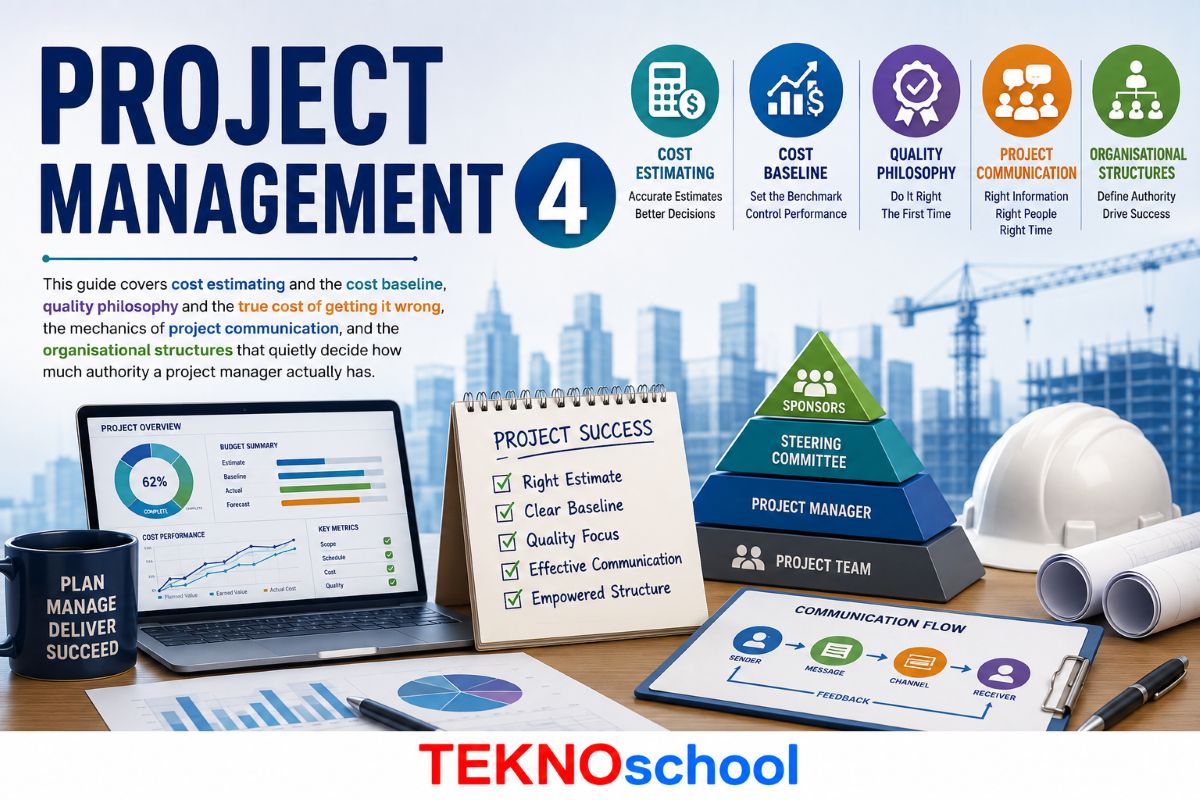
Project Management 4-A project schedule tells you when things will happen. It says nothing about what they will cost, whether they will be any good, whether anyone will know what is going on, or who has the authority to make a decision when two managers disagree. Those four questions — money, quality, communication and organisational structure — determine as much about a project’s fate as the network diagram does. This guide covers cost estimating and the cost baseline, quality philosophy and the true cost of getting it wrong, the mechanics of project communication, and the organisational structures that quietly decide how much authority a project manager actually has.
1. Cost Estimating
Cost is among the first considerations when taking on a new project, because it determines the financial outlay required. That money comes either from internal resources or from outside — bankers, financial institutions, investors — and borrowed money carries its own cost in the form of interest, on top of the ordinary cost of doing business.
Cost estimating exists to predict the most likely costs expected for the total resources required to complete the total work of the project. Note the word total appearing twice. Note also that estimating is not a one-off event performed at the outset — it should be done throughout the project as information improves.
Three Types of Estimate, Three Levels of Accuracy
Estimates get sharper as the project takes shape. The convention is to name them by the accuracy they can honestly claim.
| Estimate Type | Typical Accuracy | When It Is Used |
|---|---|---|
| Rough Order of Magnitude (ROM) | Very wide | The earliest stage, when minimum information exists. The PMBOK Guide places this at roughly −50% to +100%, narrowing as information improves. |
| Budget estimate | −10% to +25% | Once more of the work has been detailed out. |
| Definitive / bottom-up | −5% to +10% | Once detailed estimation from the work packages upward has been performed. |
Always quote the range. An estimate should be given as a base figure together with its level of accuracy in plus and minus terms. A number quoted without its tolerance invites everyone downstream to treat it as a commitment.
Before estimating anything, the manager must consider what is actually required to meet the project’s requirements. Five factors have to be covered: all resources the project will need across people, machinery and material; the time duration of resource usage; the rate for each resource; historical information from comparable past projects; and — critically — the WBS as the base document. The WBS contains the total work required, which makes it the backbone of all resource planning and costing.
The Estimation Techniques
Which technique you choose depends on two things: how much accuracy you need, and how much expense you are prepared to incur to obtain it. The relationship is direct — the more detailed the estimate, the more it costs to produce.
| Technique | How It Works | Character |
|---|---|---|
| Top-down / Analogous | Uses the actual costs of previously completed projects to predict costs for the project under consideration. Relies on expert judgement gained from similar past work, drawn either from experts directly or from a historical database. Accuracy depends entirely on how closely the past projects resemble the present one — the stronger the correlation, the better the estimate. | Order of Magnitude. Low accuracy, low cost, fastest. |
| Parametric modelling | Uses a statistical or mathematical model built on project characteristics, derived from empirical cost data accumulated over years. To price a house in a given locality, you would use parameters covering material types, land cost for that location and broad specifications, producing a figure such as a cost per square metre. | Also a top-down form, but considerably more precise than analogous because it rests on statistical data. |
| Bottom-up | Estimates each individual work package or activity from the WBS and aggregates them upward into a total project cost. | Highest accuracy, highest effort and expense. |
| Three-point estimate | Improves the accuracy of activity duration or cost estimates by averaging three separate figures — Optimistic, Most Likely and Pessimistic — into a single estimate. | Used where uncertainty is high; forms the basis of PERT. |
On that last point, PERT deserves a note. The Program Evaluation Review Technique is used primarily to arrive at likely activity durations in situations where there is little historical information about comparable past projects — R&D work being the archetypal case. It can be applied to costs as well as durations.
2. The Cost Baseline
Once the likely costs of all the resources needed for every work package have been estimated, those figures are aligned to the project’s time-phased schedule and aggregated. The result is the cost baseline — a time-phased budget used to measure and monitor the project’s cost performance. It forms part of the Project Management Plan.
Summing the estimated costs by period produces the familiar S-curve, which depicts the progressive cost summary across the life cycle. The shape is characteristic: spending accumulates slowly at first, steepens sharply through execution when most resources are consumed, then flattens again toward close-out.
Two Reserves That Must Be Budgeted
When allocating costs to actual work items, provision must also be made for risk. Planning for risk carries real costs — the work required to transfer, avoid or mitigate identified risks has to be paid for. Two distinct reserves handle this, and confusing them is a common error.
| CONTINGENCY Reserve | MANAGEMENT Reserve |
|---|---|
| Kept for all potential identified risks — the ones you have listed, assessed and planned responses for. | Kept for unidentified risks — the events nobody anticipated but which experience says will nonetheless occur. |
Larger projects may carry multiple cost baselines to measure different aspects of cost performance — a spending plan or cash-flow forecast, for instance, is a cost baseline for measuring disbursements specifically.
Why the baseline must be defended
Keeping the planned cost baseline intact through the life cycle is a major challenge, and changes in scope are what usually break it. As a principle, adhere to the planned baseline until there is a substantial reason to change it — because extra costs incurred during any phase are very difficult to recover without either reducing scope or compromising quality. Neither is a desirable strategy, and a manager who has already spent the money will find both options forced upon them.
3. Quality: Philosophy and Cost
The way management thinks about quality has shifted fundamentally. The older view accepted that errors and defects were an inherent part of any process, so the emphasis fell on controlling defects — and more inspection was assumed to mean better quality. That assumption has been abandoned.
Quality itself is defined as the conformance of a product or service to given specifications and requirements, and it is worth noting that both stated and implied needs count toward meeting quality requirements. The implied ones are where projects most often disappoint their customers while technically satisfying the contract.
Project quality management proceeds in three steps. Quality Planning comes first and belongs to the planning process group; Perform Quality Assurance and Perform Quality Control follow it. A distinction worth memorising: quality assurance is a managerial responsibility, not a technical one. Quality metrics support both assurance and control — they are the actual values and measurements that specify what something is, and at what level it should be.
The Three Categories of Quality Cost
| Category | What It Covers |
|---|---|
| Prevention | Costs incurred to stop defects arising in the first place — quality planning, training, process tools. |
| Appraisal | Costs of finding out whether defects exist — inspection, testing, evaluation, audits. |
| Failure | Costs of defects that occurred, split into internal failures found before the product reaches the customer, and external failures found afterwards. |
| Cost of CONFORMANCE | Cost of NON-CONFORMANCE |
|---|---|
| Planning Training and indoctrination Process tools Field testing Product design validation Test and evaluation Quality audits Maintenance of testing equipment | Scrap Rework Expediting Additional material and inventory Warranty and repairs Legal liabilities Product recalls Corrective actions for the product |
Internal failure costs include late payment of bills, inventory costs arising directly from defects, engineering costs to rectify defects, infant mortality or premature failure of products, and the cost of correcting documentation to reflect the defect corrections. External failure costs — those arising after the product reaches the customer — include warranty costs, training field personnel, recalling defective products, product liability suits, handling complaints, and future business lost because of defective products. That final item is unbounded and unrecoverable.
“Quality is free”
Crosby’s well-known assertion rests on a simple arithmetic: doing things right the first time saves considerably more than the prevention costs required to achieve it. The modern position goes further — any process that allows for defects in material or service actually increases the cost of the product. Failing to produce the right quality is itself an expense, not a saving. Investing resources in maintaining quality reduces the total cost of quality over the longer run.
A related saving comes from Just-In-Time working, or zero inventories. In a project environment it is desirable for materials to arrive just before they are needed rather than sitting in storage accumulating carrying costs and exposure to damage.
The Seven Tools of Quality
| # | Tool | Purpose |
|---|---|---|
| 1 | Flowcharts | Map the sequence of a process to expose where defects can enter. |
| 2 | Pareto charts | A special form of histogram ordered by frequency of occurrence, used to display the relative importance of problems by type or category of identified cause. |
| 3 | Run charts | Plot results over time to reveal trends and drift. |
| 4 | Scatter diagrams | Show the relationship between two variables to test suspected correlations. |
| 5 | Control charts | Track whether a process is operating within acceptable limits over time. |
| 6 | Histograms | Display the distribution of measured values across a range. |
| 7 | Cause-and-effect diagrams | Trace an observed problem back through its contributing causes. |
4. Communication
Communication provides the critical link between people, ideas and information, which makes it fundamental rather than supplementary to project management. Most of a project manager’s time is in fact spent in some form of communication.
Good communication exists in a project to direct, monitor, coordinate and control the work; to keep team members and stakeholders fully informed so they can make reliable and timely decisions; to provide feedback; and to motivate the team. Communication management specifically determines the total information needs of all the different stakeholders and ensures the correct and timely generation, gathering, dissemination, storage and disposition of project information. Those needs are not the same from one project to the next — they vary, and must be planned each time.
Three Forms of Communication
| Form | Character | Weakness |
|---|---|---|
| Verbal / oral | The method used most often by everyone. Quick, easy and fast. | The message is more likely to be forgotten, misunderstood or misinterpreted by the listener. |
| Written | A more formal and permanent form of communication, with less chance of misinterpretation. | Slower to produce and slower to act on. |
| Body language | Accompanies verbal communication, reflects inner feelings, adds to the spoken word and reveals how a person actually feels while speaking. | Easily missed, and absent entirely from written and remote channels. |
The available channels are numerous — paper, electronic media, letters and memos, presentations, telephone, fax, meetings, reports, e-mail, internet, design drawings and contracts. But the governing principle is that the method chosen matters far less than what is communicated. The one practical constraint is reachability: if you send an e-mail, the recipient must have ready access to a connection, or the message is never received at all.
Communication also runs in three directions within a project — downward to the team, upward to the sponsor, senior management and client, and horizontally among peers, co-workers, other departments and users. Each direction has its own conventions and its own failure modes.
The Communication Model, Step by Step
Sending and receiving a message is not one action but a chain of them. A failure at any single link means the message does not arrive, which is why apparently clear instructions so often produce the wrong result.
| Step | Stage | What Happens |
|---|---|---|
| 1 | Thinking | The sender frames the ideas and creates the message they intend to send. |
| 2 | Encoding | Formatting the message into a transmittable form — language, written or spoken words, facial expression, body language. |
| 3 | Symbols | Symbols stand in place of something previously experienced — a picture of a person is a symbol of that person. |
| 4 | Transmitting | Moving the message from sender to receiver, using airwaves, electronic means, visual signals or a combination. |
| 5 | Perceiving | The receiver must recognise that a message is arriving. Without perception there is no reception — the message must enter through at least one of the five senses. |
| 6 | Decoding | The receiver converts the message into a form they can work with. |
| 7 | Understanding | The message must carry meaning the receiver can grasp. If there is no understanding, there is no message. |
The Role of Interfaces
An interface is a connection or union of two objects, either physical or virtual. Interfaces matter because work requires teams and groups — the moment more than one party is involved, connections must be established and managed. They are significant not only during implementation but across every phase of the life cycle, and well-designed, well-managed interfaces are a genuine factor in meeting success criteria.
Internal interfaces cover relationships established within an organisation. In an era of partnership working, organisational boundaries move constantly, since contractors and other staff not on the payroll are treated as part of the company from a work perspective. This produces two sub-types: pure internal interfaces between people entirely within the organisation’s payroll or control, and hybrid internal interfaces covering everyone else who functions as part of the organisation without formally belonging to it. External interfaces cover the connections to parties genuinely outside the organisation.
5. Roles, Duties and Responsibilities
Four groups of people appear in every project: the Sponsor, the Project Manager, the team members, and the client. On larger structures a Programme Manager sits above them all.
| Role | Duties and Responsibilities |
|---|---|
| Sponsor | Represents the interests of those funding the project and is the primary risk taker. Defines the investment aims and is responsible for achieving the business benefits; arranges funding; links the project to the ongoing business; provides management commitment. Their activities include appointing the project manager, monitoring progress on behalf of senior management, keeping the Management Board informed, determining the priority between time, cost and quality, and acting as mediator in disputes over contract or other changes. |
| Project Manager | Accountable to the Sponsor and responsible for delivering the project on the agreed schedule, within the approved cost, to the correct technical specifications, and against the KPIs specified in the Business Case. |
| Team Members | Sit at the core of managing the project and actually execute the work. They maintain the harmony and unity of the team, resolve differences that arise, perform assigned work responsibly, act innovatively, cooperate with and secure cooperation from people outside the team, stay open and forthright, discuss problems before they get out of control, and assess their own work realistically. |
| Programme Manager | Responsible for developing the overall product or service of the business, of which the individual project forms one part. Implements the organisation’s business strategy through projects and manages resources across a portfolio of interrelated projects sharing a common aim. |
The Project Manager in Detail
| Required Skills | Key Responsibilities |
|---|---|
| Leader Integrator and coordinator Communicator Technological understanding — able to evaluate technical recommendations and assess risk Understanding of project economics, including life cycle costing Good team builder with excellent people management skills Problem solver | Developing the Project Management Plan — the manager owns the PMP Delivering on time, within budget, to specification Integrating, controlling and coordinating the entire project Managing customer expectations Developing and motivating the team into a high-performing unit, and managing conflict within it Maintaining the channel between team and senior management Ensuring all risks are identified, assessed, managed and re-assessed Developing the network schedules and determining resource requirements Monitoring, controlling, reviewing, reporting and acting to keep performance on track Ensuring all changes are documented in the corresponding plans Reviewing the project and documenting lessons learned |
Six behaviours that undermine a project manager
- Judging others and drawing comparisons between team members
- Assuming their own style of working is the best one, and ignoring the impact of local culture on work ethics
- Failing to recognise that methods and styles of work differ legitimately between organisations
- Applying their own sense of time, without grasping that urgency is not constant and varies by country and organisation
- Not delegating work
- Not acknowledging or appreciating the work team members have done
6. Organisation Structures
The structure within which a project is performed has a direct bearing on it, because structure determines roles, responsibilities and — above all — the availability of resources. A project is never executed in isolation; it operates inside the environment of its organisation, and private sector, government and social sector organisations each exert a different influence.
There are three main types, with the middle one subdividing into three variants.
Line / Functional Organisation
The traditional hierarchy, in which staff are grouped by specialty — marketing, engineering, sales, HR — with each division subdivided further. Reporting is straight and simple: every employee has one clear superior. It remains the most widely used structure in the world.
For projects, however, it is problematic. The project manager has very little or no formal project-based authority and must rely on personal influence and interpersonal skill to obtain resources. It is unsuitable for multiple concurrent projects because conflicts over resources and priorities proliferate. The project also suffers from the manager’s lack of formal authority and control, from team members who are more committed to their routine work than to the project, and from ineffective communication between project members. Functional organisations are best equipped for low-risk, relatively low-cost projects.
There are genuine advantages though. Career paths are clearly defined, which keeps people motivated. Resources are centralised and therefore used efficiently. Personnel work in close proximity, producing better mutual understanding. And a strong base of specialists grouped by discipline is a real asset for projects using new or complicated technology.
Project / Product Organisation
At the opposite end of the spectrum. The project manager holds maximum authority and independence, with substantial power to deploy whatever resources the project requires. Typically the whole organisation and all its resources are engaged in project work, which makes projectised structures the natural home for project-driven businesses.
The drawback is duplication. Human and equipment resources are replicated across projects, producing waste that a functional structure would avoid.
Matrix Organisation
The matrix was developed to capture the best of both. It maintains the vertical lines of authority of a functional organisation while adding a horizontal structure to support project work, allowing multiple projects to run without duplicating resources. Personnel belong simultaneously to a project team and to their functional department.
It is relatively difficult to introduce and leaves more room for conflict, precisely because people sit in two structures at once. Clear guidelines about roles and responsibilities therefore become essential rather than optional.
| Matrix Advantages | Matrix Disadvantages |
|---|---|
| Most efficient use of resources, with minimum duplication and idle time Better balance between time, cost, quality and performance The project manager has much better control over project resources The project manager has a say in choosing personnel More rapid response to contingencies Greater support for project work from functional departments, who are now genuinely involved | Project personnel have no clear line of authority — they answer to two bosses, the project manager and the functional manager Once project work ends, people often lack a clear promotion path, having been borrowed and now needing reassignment Personal conflict between the project manager and the functional manager is common, and creates problems for everyone below them |
How Much Authority Does the Project Manager Actually Have?
This single table explains more about why projects succeed or stall in particular organisations than almost any other piece of theory. Read it as a spectrum running from no authority at the top to full authority at the bottom.
| Structure | Project Manager’s Authority | Balance of Power |
|---|---|---|
| Line / Functional | There is no project manager at all. The line manager holds all the authority. | NONE |
| Weak Matrix | The project manager has to persuade rather than direct. | LOW |
| Balanced Matrix | Project manager and line manager hold equal authority. | EQUAL |
| Strong Matrix | The project manager has more authority than the line manager. | HIGH |
| Project / Task Force | The functional manager reports to the project manager. | FULL |
7. Quick Revision: The Definitions That Get Tested
A number of terms in this territory carry precise meanings that are easy to blur. These are the ones worth being exact about.
| Term | Precise Meaning |
|---|---|
| Assumption | A factor taken to be true for planning purposes without proof, which must be documented and monitored because it may turn out to be false. |
| Baseline | A plan that has been finalised and approved, then used as the base for execution so that changes flow through change control rather than occurring at random. |
| Scope baseline | The approved scope statement together with the WBS and its supporting detail — the agreed definition of what the project will produce. |
| Decomposition | Subdividing project deliverables into smaller, more manageable components until the work is defined in sufficient detail to be estimated, assigned and controlled. |
| Event | A point in time marking the start or finish of activities. Unlike an activity, an event consumes neither time nor resources. |
| Total float | Usually just called “float” — the time an activity can be delayed without delaying the project end date. It is shared by all activities on that path. |
| Free float | The time an activity can be delayed without delaying the early start of its immediate successor. Always equal to or less than total float. |
The Three Kinds of Dependency
Separate from the four dependency types (finish-to-start and its relatives), dependencies are also classified by where the constraint comes from. The distinction matters because only one of the three is genuinely non-negotiable.
| Dependency | Also Called | Description |
|---|---|---|
| Mandatory | Hard logic | Inherent in the nature of the work itself. Software must be coded before it can be tested — no amount of clever scheduling changes that. |
| Discretionary | Preferred, soft or preferential logic | Defined by the project team as a matter of preference or best practice. Should be used with caution, since it constrains the schedule without any underlying necessity requiring it. |
| External | — | A relationship between a project activity and a non-project activity — a regulatory approval, a supplier’s delivery, a seasonal window. Outside the team’s control. |
What to Take Away
Quote estimates with their tolerance. A rough order of magnitude figure and a definitive bottom-up figure are not the same species of number, and treating them as though they were is how budgets get set at the wrong level.
The WBS is the backbone of costing too. Every accurate bottom-up estimate traces back to it, which is why an incomplete WBS produces an underestimated budget as reliably as it produces an incomplete schedule.
Defend the cost baseline. Overspend in any phase can only be recovered by cutting scope or cutting quality. Both are bad outcomes, and both become inevitable once the money is gone.
Prevention is cheaper than failure. Any process that tolerates defects raises the cost of the product. External failure costs, including business lost to a reputation for poor quality, have no upper bound.
If there is no understanding, there is no message. Communication is a chain of seven steps and breaks at the weakest link — transmitting is not the same as being understood.
Structure determines authority. The same competent manager will struggle in a functional organisation and succeed in a strong matrix, because the two grant entirely different powers over the same resources.
These four areas are where projects quietly succeed or fail long before anyone declares a crisis. A schedule that slips is visible immediately. A budget estimated at the wrong tolerance, a quality process that tolerates rework, a communication chain that transmits without being understood, or a manager placed in a structure that denies them authority — these do their damage slowly, and by the time they surface as a schedule problem, the cheap opportunity to fix them has usually passed.