Project Management 1 Foundation
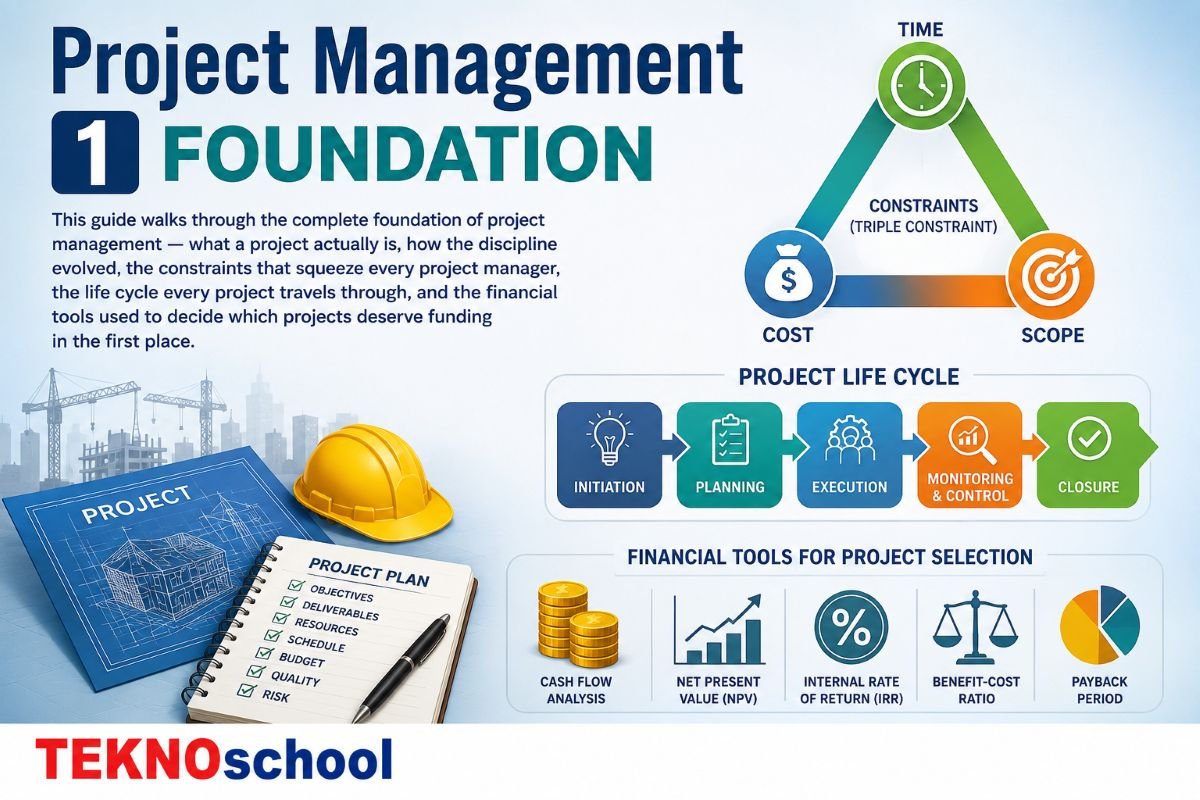
Project Management 1-Every bridge that gets built, every vaccine that reaches a village, every piece of software that ships, and every wedding that actually starts on time has one thing in common: somebody, somewhere, converted an idea into a finished thing inside a fixed window of time and money. That conversion process has a name. It is called a project, and the discipline that governs it is one of the fastest-growing professional fields in the world. This guide walks through the complete foundation of project management — what a project actually is, how the discipline evolved, the constraints that squeeze every project manager, the life cycle every project travels through, and the financial tools used to decide which projects deserve funding in the first place.
1. What Exactly Is a Project?
A project is the mechanism by which a vision, a dream, or a need becomes reality. That need might be commercial, personal, or social — but in every case there is a gap between the way things are and the way somebody wants them to be, and a project is the organised effort to close that gap.
Projects appear in every corner of society. Business uses them to launch products. Industry uses them to build plants and commission machinery. Governments use them to deliver roads, power, water, and welfare schemes. The social sector uses them to run literacy drives and health campaigns. There is no sphere of organised human activity where projects are absent.
What makes the concept slippery is the sheer range of scale. A project can be a massive, complex, multi-billion-rupee undertaking or a modest one-afternoon effort. It can occupy a single person for three days or a hundred thousand people for two decades. It can live inside one department, span several departments, or stretch across multiple organisations operating at multiple locations in multiple countries. Anyone, at any level of an organisation, can initiate one.
How the Authorities Define It
Because projects vary so wildly, different authorities have arrived at the definition from different angles. Reading them side by side is instructive — each one emphasises a slightly different truth.
| Source | The Definition, in Essence | What It Emphasises |
|---|---|---|
| Webster’s Dictionary | A proposal for something to be done — a scheme, a plan, an organised undertaking, a special unit of work, an extensive public enterprise. | Breadth and intent |
| Project Management Institute (USA) | A temporary undertaking whose purpose is to create a unique product or service. | Temporariness and uniqueness |
| Buchanan & Body | One-of-a-kind ventures with a clear start and finish, carried out by people to reach agreed goals inside limits of cost, schedule and quality. | People and the three limits |
| Cleland & King | A complex effort to hit defined objectives against schedule and budget targets, generally cutting across organisational lines and not normally repeated within the organisation. | Cross-functional complexity |
The Seven Defining Characteristics
Strip away the differences of scale and sector and every project on earth shares the same seven features. If a piece of work is missing several of these, it probably is not a project at all — it is routine operations wearing a project’s clothing.
| # | Characteristic | What It Means in Practice |
|---|---|---|
| 1 | Temporary | There is a definite beginning and a definite end. The project exists to achieve specific goals and closes the moment those goals are met. Note that temporary says nothing about duration — a fifteen-year dam project is still temporary. |
| 2 | Unique | No matter how similar two projects look, they differ in some respect — site, team, market conditions, technology, regulations. No project is ever an identical copy of another. |
| 3 | Pre-defined goals | The objectives are settled before work begins. They may be financial, social, economic, or a blend of all three. |
| 4 | Fixed budget and schedule | Every project is handed a sum of money and a window of time inside which the work must be completed. |
| 5 | Quality criteria | The performance standard the deliverable must meet is agreed at the outset, not negotiated afterwards when things start slipping. |
| 6 | Limited resources and manpower | Money, people, equipment and material are always finite. Scarcity is the permanent condition of project work. |
| 7 | Known and unknown risks | Uncertainty is built in. Some risks can be listed in advance; others cannot. Both can derail successful completion. |
| 8 | A life cycle | Projects travel through recognisable phases from initiation to completion. This progression is one of the sharpest markers separating projects from ordinary work. |
The range is the point. A project can be organising a family lunch, arranging a wedding, developing a new financial product, building a flyover, implementing a revised procurement procedure, running an R&D programme, designing software, mounting a poverty-alleviation campaign, or putting a human being on the Moon. The management principles are the same in each case — only the magnitude changes.
2. Projects Versus Operations: The Line That Divides Them
Organisations perform two fundamentally different kinds of work, and confusing the two is one of the more expensive mistakes a management team can make. Operations cover the routine, ongoing, repetitive activity that keeps the business running. Their objective is to sustain the existing business and to make current activity progressively more efficient. Operations are not in the business of introducing change — that is precisely what projects are for.
Yet in daily practice the two look remarkably similar, which is why people mix them up. Both are performed by people. Both operate under limited resources. And both fail unless they are properly planned, executed and controlled. The similarity is real; it just is not the whole story.
The decisive difference is purpose. Operations exist to maintain. Projects exist to change. Everything else follows from that single divergence.
| Dimension | PROJECTS | OPERATIONS |
|---|---|---|
| Nature | Unique — performed once | Ongoing — performed continuously |
| Duration | Temporary — definite start and finish | Repetitive — no natural end point |
| Objective | Achieve the stated goals, then close down | Sustain and support the running business |
| Time orientation | Future-focused | Present-focused |
| Core activity | Creating something new | Maintaining what already exists |
| Strategic role | Deliver the strategic vision; grow market share | Protect the market share already won |
| Uncertainty | High at the outset, falling as work proceeds | Low and stable — the work is well understood |
3. How Project Management Evolved
As a human activity, project management is as old as civilisation itself. The Pyramids, the Taj Mahal and the Great Wall of China were all executed centuries before anyone drew a network diagram, yet each consumed staggering quantities of labour and material and each demanded extraordinary feats of planning, organising and control. Hundreds of thousands of workers had to be fed, housed, directed and supervised. The techniques were not modern; the challenge absolutely was.
What changed over the last fifty years is that project management stopped being an intuitive craft practised by exceptional individuals and became a formal, teachable, certifiable discipline. And the reason it became one is worth understanding, because it explains why the field is growing so fast today.
If the twentieth century was the industrial age, the twenty-first is the age of communication. Global human networks now form instantly; mind-to-mind exchange across continents is a matter of seconds. Under globalisation, gradual change is no longer sufficient. The pace of change has become so rapid that organisational transition is now complex and non-linear rather than smooth and predictable. Both institutions and individuals must repeatedly reinvent themselves simply to stay in the race. Project management is the discipline purpose-built for managing change — which is exactly why its use has become critical to competitive advantage, and why the field has expanded so dramatically.
The Shifting Balance of Scope, Time and Cost Through History
Here is an elegant way to read the whole history of project management: watch which of the three great parameters — scope, time and cost — each era actually cared about. In the earliest ages only one or two mattered. Today all of them matter simultaneously, plus several more.
| Era | Defining Character | Parameters That Actually Mattered |
|---|---|---|
| Stone Age | Survival itself was the project — finding food, and avoiding becoming food. The need was self-evident and the planning required was of a very low order. | Scope only |
| Kings & Queens | Monuments built to make a ruler’s existence immortal. The Taj Mahal, the Pyramids, the Great Wall. The end result was everything; the ruler was untroubled by schedule or expense. | Scope dominant |
| Domination | Territorial conquest. Scope was well defined and timing became critical — when to launch the attack decided victory. Cost mattered less, since it could be recovered from taxation, booty and the surpluses of the conquered territory. | Scope + Time |
| Industrial | Machines and men in symbiosis. Factories had to create wealth, become competitive, and build marketplaces that raised living standards. Managing two sides of the triangle was no longer good enough. | Scope + Time + Cost |
| Competitive | Production outran demand, rival firms multiplied, and the customer climbed into the driving seat. Japanese manufacturers pushing into global markets accelerated the shift. Through the 1960s and 1970s, Quality emerged as the fourth parameter. | + Quality |
| Globalisation | National markets merged into one world market, dragging a whole new set of concerns to the surface. | + Risk, Procurement, HR, Communication, Integration |
| E-Technology | Relentless pressure to cut time and cost without touching scope or compromising quality. Think of the triangle’s area: the base (scope) cannot shrink, so the only way to reduce the area is to lower the height — that is, to compress time and cost proportionately. This is the defining squeeze on the modern corporation. | All parameters, compressed |
Modern Project Management, Decade by Decade
The formal discipline as we recognise it today was assembled over roughly seventy years, and it is possible to point at specific decades and specific organisations for specific inventions.
| Decade | What Was Invented, Formed or Established |
|---|---|
| 1950s | Industrial engineering techniques were turned on project work. Flowcharts began representing project activities, and Henry Gantt’s bar chart — plotting planned activity against a calendar — entered general use. Independently and almost simultaneously, DuPont developed the Critical Path Method, using arrows for activities and circular nodes for events (the Arrow Diagramming Method), which calculates the earliest possible completion date for a project. The US Navy developed PERT, the Project Evaluation Review Technique, using rectangular nodes instead of arrows. PERT was built for the Polaris submarine and missile programme, where hundreds of contractors had to be monitored and both time and cost optimised across an enormous undertaking. |
| 1960s | Fast computing arrived and changed everything. Computers began generating project networks and running the accompanying analysis. Cost control and resource scheduling merged with network diagramming to form something recognisably modern. President Kennedy’s commitment to landing a man on the Moon gave the whole field an extraordinary push. Two professional bodies were founded: the European umbrella body INTERNET in 1965, and the Project Management Institute in the United States in 1969. |
| 1970s | The lessons of the 1960s hardened into a formal discipline. Software houses began shipping packages built around computerised project networks, and these grew steadily more popular. The construction industry worldwide adopted project management methods as an integral part of how it worked — which is precisely why, even today, many people instinctively associate project management with construction. |
| 1980s onward | Project management was formally recognised as a fast-growing discipline in its own right. Its knowledge base widened decisively beyond the traditional quartet of time, scope, cost and quality to include risk, communication, procurement, human resources and integration. Professional associations sprang up country by country. INTERNET was renamed the International Project Management Association (IPMA) and grew to draw membership from forty countries, while PMI became the largest such body in the world with chapters across the globe. |
| Late 1990s onward | Certification exploded. The very first project manager was certified in 1986; within a few decades hundreds of thousands of professionals held credentials, with the total multiplying eight to ten times over in the space of a handful of years. Companies in both IT and non-IT sectors began demanding certification as a hiring condition. |
4. What Is Project Management?
Information now multiplies while available time shrinks, which makes the rate of change unprecedented. Time has become the sharpest strategic weapon a firm possesses. Everyone recognises the syndrome in which every deliverable was apparently due yesterday. Under those conditions, the ability to deliver on time, within budget, and without compromising quality is not a nice-to-have; it is survival.
Project management is the art and science of converting vision into reality and the abstract into the concrete.
It can equally be called dream management or change management. Worldwide it is regarded as the most efficient known method of introducing change — and introducing change well is the central problem of both business and personal life.
In operational terms, project management applies specific knowledge, skills, tools and techniques to project activities so that the aims for which the project was launched are actually met. It works through a set of disciplined procedures: building a plan to achieve the objectives and then genuinely following that plan; managing everything required to reach those objectives safely inside the agreed limits of time, cost, quality and technical performance; deploying appropriate tools to plan, monitor and maintain progress; and staffing the effort with people who understand how to balance the competing demands of scope, time, cost, risk and quality.
One duty deserves special mention. The team must manage every party connected to the work — clients, customers, contractors, and everyone else directly or indirectly involved. These are the project’s stakeholders, and because they hold different and often contradictory expectations, keeping them collectively satisfied is genuinely difficult.
Modern practice recognises two halves of the discipline. The hard side is the tools and techniques — networks, schedules, estimates, earned value, risk registers. The soft side is people: teams, motivation, negotiation, communication, leadership. Neither half works without the other. A perfect schedule executed by a demoralised team fails; an inspired team without a plan produces expensive chaos. As the work advances, project management supplies what might be called the single point of integrative responsibility — the one place where accountability for the whole outcome sits.
Eight basic processes run through the discipline: conceptualise, plan, organise, implement, control, integrate, deliver, and leverage knowledge. These map directly onto the project life cycle discussed shortly.
5. The Triple Constraints
Conventionally a project is governed explicitly by three considerations — scope, time and cost — with a fourth, quality, implied throughout. These three are traditionally drawn as the sides of an equilateral triangle, because all three carry equal weight, with quality placed at the centre to show that it touches every side and can never be traded away.
Scope defines the total set of products or services the project will provide. It marks the boundaries of the work in terms of deliverables to the customer, and it is the foundation on which everything else rests — which is why it is drawn as the base of the triangle. Time and cost form the other two sides, and crucially, both are computed from the scope. This is the reason scope must be nailed down before anything else can be estimated with confidence.
The standard mechanism for pinning down scope is the Work Breakdown Structure (WBS), which decomposes the entire project into every task that must be performed. Once a WBS exists, two things become possible: the project can be costed from the actual tasks and resources involved — bottom-up estimation, which is far more defensible than a top-down guess — and the duration can be assessed and managed realistically.
| Constraint | Unit of Measure | Role in the Triangle |
|---|---|---|
| SCOPE | Deliverables | The base of the triangle. Everything else is derived from it. Defined through the Work Breakdown Structure. |
| TIME | Years, months, weeks, days | A dependent side — calculated from scope, never assumed independently of it. |
| COST | Monetary currency | The other dependent side — best estimated bottom-up from the WBS. |
| QUALITY | Conformance to specification | Sits at the centre because it interacts with all three sides. There can be no compromise on quality at any phase of the life cycle. |
The practical significance of the triangle is what happens when one side moves. Change the cost and the shape distorts; change the time and it distorts differently; change the scope and the base itself shifts, dragging the other two with it. Managing any two sides of this triangle is comparatively straightforward. The real difficulty — and the reason competent project managers are valuable — lies in holding all three simultaneously without letting any one of them slip.
So which one do you protect?
Ideally, a balanced approach preserving the proper relationship between scope, time, cost and quality. In real life that is often impossible. Every organisation holds its own policy on which parameter takes precedence when something has to give, and that policy — not the project manager’s personal instinct — should guide the decision. What is certain is that emphasising one parameter will move the others.
6. The Project Life Cycle
The project life cycle defines the beginning and the end of a project, from conceptualisation through to close-out and handover, taking in every milestone and every event of significance to stakeholders along the way. Organisations break projects into phases for one overriding reason: management control.
And management control does not mean control by senior management alone. It should be exercised by every person in the project, to the extent of whatever set of activities they are responsible for performing or coordinating. A second major advantage of phasing is resource management — the skills needed in detailed planning are not the same as those needed during execution, so dividing the work into phases makes it far easier to bring the right people in at the right moment and release them afterwards.
The Eight Phases
| Phase | Name | What Happens |
|---|---|---|
| 1 | Conceptualise | The vision, dream or strategy is projected — and then tested. This phase does not merely capture the idea; it analyses whether the idea is viable and practicable given the organisation’s real boundaries. Only once viability is established is the project declared to exist. Key deliverable: the Project Charter, which is the green signal to proceed. |
| 2 | Plan | The charter is the input; the plan is the output. Planning is the core of any action — execution without it is simply ad-hocism, and nothing solid emerges from ad-hocism. The plan builds a complete road map from the present state to the desired state. A good plan with detailed steps secures a substantial share of the eventual success. |
| 3 | Organise | Establishes the availability of resources — human, material, capital and machinery — against the timeline, and settles the organisational structure to be used, whether functional, matrix or fully projectised. This phase deliberately overlaps with planning, since any plan already assumes something about how the work will be organised. |
| 4 | Implement | Results live in action. The project manager is the principal actor here — effectively a miniature chief executive, responsible for turning the plan into deliverables that satisfy stakeholders. Human resource management, communication, and negotiating for resources are the dominant challenges. Leadership matters: the manager must be willing to decide from conviction while carrying the team along. |
| 5 | Control | Like any system, a project without feedback is unstable. Control measures implementation against the deliverables in the domains of time, cost and quality. Maturity is essential here — control must be neither excessive nor too thin. It is not a device for those who enjoy exercising power; it is the component that ensures the right deliverables emerge from the right processes. |
| 6 | Integrate | Components are assembled into the final product. The order of integration matters enormously, and the skills required differ from those needed during planning. A foolproof conformance mechanism must confirm the integrated product matches the specification. Rigour here is cheap; laxity here means rework and customer dissatisfaction later. |
| 7 | Deliver & Close Out | The interface with the ultimate customer, who is the key player in accepting the output. There may be one delivery or many depending on the plan, but it is complete delivery that must be accepted. This is also where conflict most often erupts between those who built and those who are accepting — and the project plan, with its documented specifications, timings and quality criteria, is what resolves it. |
| 8 | Knowledge Leveraging | Nominally the eighth and final phase, but in truth a continuous one running from conceptualisation right through to delivery. Knowledge sharing and acquisition are not discrete, time-boxed events. The experience of the current project must improve the next one — and individual learning must be institutionalised into a corporate knowledge database rather than walking out of the door when a person leaves. |
Phase Gates, Kill Points and the Courage to Stop
A phase is considered complete when its deliverable or set of deliverables is finished. A deliverable is tangible, verifiable, and carries value. Some deliverables go outside the project to a customer; others are internal, produced so that other project work can proceed.
At the end of each phase a decision is made about whether to enter the next one. Sometimes that decision is to abandon the project altogether. These reviews go by several names — phase exits, stage gates, or bluntly, kill points. Errors are detected and corrected here, and lessons learned are captured.
The psychological trap at these gates is well known. Once a project has begun, commitment hardens and the instinct is to press on regardless. But beginning a project does not oblige anyone to finish it irrespective of financial reality. An honest evaluation of the cost of continuing versus the profit or loss from stopping should be made, with sunk costs — money already spent and unrecoverable — properly accounted for. The counterweight is equally important: this scrutiny must not spill into a general atmosphere of doubt about whether the project will survive, which can be disastrous for the company and everyone attached to the work. Objective assessment at every stage is the balance point.
Four Curves Every Project Manager Should Know
Certain quantities behave predictably across the life cycle, and understanding their shape changes how a manager sequences decisions.
| Quantity | Early Phases | Late Phases | What It Means for You |
|---|---|---|---|
| Potential for value addition | MAXIMUM | MINIMUM | Invest your best thinking at the start. That is when assumptions, constraints and information gaps can still be shaped. |
| Cost of making a change | MINIMUM | MAXIMUM | Redoing work always costs far more than doing it right the first time — and the penalty grows steeply toward close-out. |
| Risk and uncertainty | MAXIMUM | MINIMUM | Uncertainty stays high through initiation and planning, then falls as execution converts unknowns into knowns. A steeper decline signals genuine due diligence. |
| Amount at stake / sponsor commitment | LOW | HIGH | Cancellation is cheap and likely at the outset; by the later phases, enormous sums are committed and abandoning becomes painful. |
| Staffing and resource demand | LOW | PEAKS AT EXECUTION | The bulk of project resources is consumed during implementation, which is also where the product or service is actually created. |
The single most useful conclusion from these curves: add as much value as you possibly can at the beginning of the life cycle. Early value addition is constructive; the same effort applied late in the project is largely destructive, because it drags rework and change costs behind it.
A final point on phases versus processes, which are routinely confused. Phases are sequential stages of the project. Processes — initiation, planning, execution, control, close-out — repeat within each phase. And there is a systems-optimisation subtlety worth internalising: what is optimal for a single phase may be badly sub-optimal for the project as a whole. Optimise across the entire life cycle, not phase by phase.
7. Stakeholders and Their Requirements
Stakeholders are all the individuals, groups and organisations directly involved in a project, or affected by its activities and its outcome. British Standard 6079 frames a stakeholder as a person or group holding a vested interest in the success of an organisation and in the environment within which that organisation operates.
Stakeholders come in several varieties. There are key stakeholders such as the project manager, and secondary stakeholders such as end users. Some are passively involved with the project and its deliverables. Some are actively involved in the work and the outcome. And some are negative — actively opposed to the project going ahead at all. Keeping this entire population satisfied is one of the project manager’s most demanding responsibilities, particularly when different stakeholders hold contradictory expectations.
| Key Stakeholder | Responsibility and Interest |
|---|---|
| Project Manager | Carries overall responsibility for ensuring the project meets its goals and objectives. |
| Project Sponsor | Represents top management. Ensures funds are available and supplies high-level direction. Owns the Business Case and issues the Project Charter. |
| Project Team Members | Sit at the core of the effort and actually perform the key parts of the work. A good team is essential to success. |
| Customer / Client | The individual, group or organisation that will use the deliverables. A project may have one customer or several. |
| Performing Organisation | Employs the people doing the project work, whether the project is internal or being executed for an external customer. |
Expectations genuinely diverge. A marketing head may want a system that tracks every product change; the sales manager may want the same system to track customer preferences instead. Both are legitimate. Neither is automatically the priority.
This is why a stakeholder analysis belongs in the Project Management Plan, not in a corridor conversation during implementation — by then it is far too late to act on what you discover. The process runs as follows: list every stakeholder; for each one, understand the requirements that must be met for them to be satisfied, the likelihood of obtaining their support, and the changes they are likely to demand; rate the interest and potential impact of each on a scale — for instance vital, significant, some effect on time/cost/quality, and no effect; determine the actions needed to meet the important objectives of each stakeholder and what help each can offer; and finally, fold the resulting changes into the project’s Work Breakdown Structure. A simple analysis table with columns for stakeholder name, their interest and potential impact, the manager’s assessment of that impact, actions to increase their support, and actions to reduce their opposition is enough to run this properly. Done well, it earns cooperation and defuses resistance before it hardens.
8. Where Projects Come From: The NEED Life Cycle
Before there is a project, there is a need — a lack of something wanted, or something deemed necessary by the circumstances of a case. Markets shift constantly and competition never rests, so the perpetual corporate quest for market share and customer satisfaction throws up needs continuously: needs to seize the opportunities a dynamic market offers, and needs to blunt the threats it carries. A need can surface at any level of the hierarchy and from any functional unit. But not every need deserves to become a project, and the NEED life cycle is the filter.
| Stage | What Happens |
|---|---|
| 1. Need Emergence | Market dynamics generate both opportunities and threats, and a need arises to seize the first and mitigate the second. Needs can also be internally driven — a drive for productivity or excellence generates needs even for a market leader under no external pressure. |
| 2. Need Recognition | Every emergent need is cross-examined, because no organisation of any size can afford to chase all of them. The screening tests validity against the organisation’s vision, urgency, viability in financial and resource terms, impact on the bottom line, and impact on the emotional framework of employees or society. Needs are then ranked by quartile, and generally only those in the top 25 per cent proceed. |
| 3. Need Articulation | The surviving need is evaluated in detail against the parameters operating in the company — financial viability and resources required, impact on competitiveness or on society, the historical record of previously articulated needs, and urgency on the time plane. If approved, the need is formally articulated in a document of approval, and only then does it become eligible to be transformed into a project. |
The NEED life cycle ends at articulation. Think of it as the first leg of a relay race — at articulation the baton is handed to the project life cycle.
9. The Business Case
The Business Case is among the most important documents a project will ever produce, because it answers the “why” — the justification for taking the project on at all. It defines the need or reasons behind the project, the changes the project is expected to accomplish, and the key requirements needed to achieve the stated business goals. It must confirm that the project is worth doing and that it aligns with the organisation’s overall business strategy.
It is developed during conceptualisation, before detailed planning can begin. It is authorised by top management and owned by the Sponsor, though the project manager, if already appointed, may be asked to draft it. Justification must weigh both financial factors — investment appraisal through payback period, net present value and internal rate of return — and non-financial ones, including operational survival, competitive position, and comparative analysis against alternatives.
A well-built Business Case does considerably more than justify spending. It links the project to corporate strategy; identifies every stakeholder and their needs; states the project’s priority within the overall business plan and the level of management support it can expect; identifies the critical success factors of time, cost, scope and quality along with key performance indicators; documents scope, constraints and assumptions; details the preferred option from the feasibility study, including a genuine do-nothing option; describes the likely impact on other projects and any conflicts that could arise between them; and records the major risks and any opportunities perceived.
Two disciplines around it matter. First, the Business Case should be reviewed regularly throughout the project to confirm the original objectives remain valid — at phase-end reviews it is the yardstick against which continued relevance is checked. Second, when estimating costs, many industries now include not only implementation costs but also the expected operations, maintenance and eventual disposal costs, which gives a far more honest picture of financial feasibility. Once the project is complete, a formal evaluation should establish whether the stated business benefits were actually delivered — treated explicitly as a learning exercise that feeds the knowledge base for future work.
10. Investment Appraisal: Choosing Which Project to Fund
A project manager is in essence the chief executive of a small enterprise. Whatever their technical specialisation, they must be an all-rounder — team builder, communicator, motivator, and integrator of the efforts of staff, sub-contractors and partners. And like any chief executive, they need a working grasp of how financial viability is assessed, even where a separate group of specialists performs the formal appraisal.
The underlying question is simple: if you have a sum of money, where should it go so that it grows? The honest first question is how much of it you are prepared to lose. Total safety points toward government securities and bonds, with returns that are correspondingly modest. Appetite for total loss points toward high-risk equities, or frankly toward lotteries. Between those extremes sits the third case — investing in a project to grow market share or earn a better return than a bank deposit would provide. The best deployment of capital is generally where the return is highest and the investment aligns with strategic objectives. That said, not every investment aims to multiply capital; social objectives may justify projects whose returns are never measured in money at all.
Five techniques do most of the work. The table below sets them side by side.
| Technique | What It Measures | Decision Rule | Strengths | Weaknesses |
|---|---|---|---|---|
| Payback Period | The point at which cumulative year-wise cash flow equals the initial investment. | Shorter payback is preferred. | Simple, standard worldwide, useful in high-risk situations, gives a clear read on liquidity. | Ignores the time value of money; ignores all cash flow after payback; ignores depreciation. |
| Discounted Cash Flow | Restates future money in today’s terms, recognising that purchasing power erodes over time. | Underpins NPV and IRR rather than standing alone. | Corrects the central flaw in payback. | Requires a defensible discount rate. |
| Net Present Value | Sum of the year-wise present values of all cash flows, less the initial investment. Quantifies profit in absolute terms. | Select the highest positive NPV. Reject anything not positive. | Accounts for time value; compares everything in today’s money; covers the full project span; supports what-if analysis. | Only as good as the cash-flow and interest-rate estimates; ignores non-financial data; biased toward short-term projects; uses a fixed rate. |
| Internal Rate of Return | The discount rate at which the project’s NPV becomes zero — the break-even interest rate. Expresses profitability as a percentage. | Higher IRR is better. If IRR is below what a bank would pay, do not invest. | Directly comparable against the cost of borrowing; neutralises the time-value distortion. | Found by trial and error, recalculating NPV at successive rates. |
| Benefit–Cost Ratio | Quantifiable benefits divided by the costs incurred to obtain them (B/C). | Above 1 is good; exactly 1 is break-even; below 1 means costs exceed benefits. | Works for non-revenue projects by using cost savings as the benefit. | Undiscounted ratios flatter a project; discounted figures are more honest. |
| Return on Investment | Average annual cash flow divided by the initial investment, expressed as a percentage. | Higher is better. | Very quick to compute and easy to communicate. | Considers neither depreciation nor the time value of money. |
Seeing the Techniques Disagree — and Agree
The value of running several techniques becomes obvious with a worked comparison. Take three candidate projects, each with a five-year life. Project A requires an initial investment of $100,000, Project B needs $150,000, and Project C needs $200,000. Applying all five methods to their projected inflows and outflows produces the following picture.
| Measure | Project A | Project B | Project C |
|---|---|---|---|
| Initial investment | $100,000 | $150,000 | $200,000 |
| Payback period | 4 years 2.57 months | 4 years | 5 years |
| NPV at 10% discount | +$12,100 | +$64,100 | −$72,200 |
| Internal Rate of Return | 14% | 19% | 0% |
| B/C ratio (discounted) | 1.041 | 1.131 | 0.907 |
| Return on Investment | 31% | 44% | 20% |
| Verdict | Feasible | BEST CHOICE | REJECT |
Every technique points to Project B and every technique rejects Project C. But notice the interesting scenario buried in these numbers. Suppose only $100,000 is available. Project A fits the budget exactly. Project B, the superior investment, needs an extra $50,000. If the bank lends at 10 per cent while Project B returns 19 per cent, borrowing the shortfall and taking B still leaves a nine-point margin on the borrowed capital. The financially literate project manager spots that; the one who stops at “we can only afford A” does not.
11. PESTLE: Reading the Project’s Environment
Projects are launched into a real environment, not a laboratory. A PESTLE analysis — also called an environmental impact analysis — examines six external forces systematically. Note that when we say projects are unique, we are talking about the context being unique, not the methodology. The tools stay the same; the environment never does.
| Factor | What to Examine | |
|---|---|---|
| P | Political | Resources are always finite, so project selection and prioritisation are never wholly scientific or free of politics. Good companies minimise internal politics but none eliminate it. Beyond the firm there is state and national politics, foreign governments and suppliers, media influence, and lobby groups — plus the behaviour and attitudes of regulatory bodies, the team, contractors and the client. The task is not to pretend politics is absent but to recognise the framework and turn it toward the project. |
| E | Economic | Operates on three levels. Micro-economic factors — the client’s financial health, the sector’s condition, the project’s own viability — lie within the control of sponsor and manager. Macro-economic factors such as interest rates, exchange rates and equity markets sit at national fiscal level and cannot be controlled. Supra-macro-economic factors such as trade tariffs operate geopolitically and are equally beyond reach. |
| S | Social | Publicly funded projects may require approval from local communities and bodies. When land must be vacated by inhabitants to build a hydroelectric station, that is a social issue before it is an engineering one, and it deserves equal weight in evaluation. |
| T | Technical | What technology is being used? Is it readily available and reliable? Do competitors have it? Is it tried and tested, or new? What is the impact of technological advancement over the project’s life cycle? Technical issues must be resolved early — a forced technical change late in the project is expensive and disruptive. |
| L | Legal | Conflict is inevitable when large numbers of people inside and outside the organisation are involved, so a legal framework is essential. Consider the rules and regulations to be adhered to, the contractual relationships between stakeholders, the laws governing contracts and disputes, and any laws binding foreign partners, clients or contractors. |
| E | Environment | The actual physical setting: is the site earthquake- or typhoon-prone? Is it on land, offshore, underground? What are local weather conditions? Will hazardous materials be used? A new project should not cause ecological degradation. Note that this environmental context is a different thing from the health, safety and environment plans used during execution — the two are easily confused. |
One point of accountability that is often misassigned: monitoring the project context, and any shifts in it, is the responsibility of the Sponsor rather than the project manager — because the sponsor is responsible for the investment. Note too that the approach itself varies with the type of change involved. An evolutionary change enhances the organisation’s current business; a revolutionary change introduces something entirely outside existing operations. They should not be managed identically.
12. The Project Charter
The Project Charter formally authorises the project to proceed and forms the link between the project and the ongoing work of the organisation. Once top management approves the Business Case and decides to go ahead, that approved Business Case effectively becomes the Charter. A contract can also serve as one. The Charter may be issued from outside the performing organisation — by a sponsor, initiator, funding agency or government department. Responsibility for issuing it rests with the Sponsor.
Timing matters: the project manager should ideally be appointed while the Charter is being developed, because the Charter is what grants the manager authority to draw on organisational resources. A manager appointed after the fact inherits decisions they had no hand in shaping.
A complete Charter should carry the organisation’s vision and mission statement; the business need behind the project and its purpose or justification; the results of the feasibility study; expected investment together with IRR and ROI; the customer’s requirements and expectations; expected stakeholder influences; the departments and organisations that will be involved; the identity of the project manager and their level of authority; a high-level description of the product or service to be delivered; the expected budget; assumptions and constraints regarding external, environmental and organisational factors; and a milestone schedule summarising required completion dates.
13. Costs, Resources and Risk: The Working Vocabulary
Three areas generate most day-to-day project vocabulary, and getting the distinctions right saves a great deal of confusion.
| Area | The Essentials |
|---|---|
| Types of project cost | Direct material costs, direct labour costs, indirect or overhead costs, variable costs, opportunity costs, inflation costs, contingency costs, and sunk costs. |
| Resource planning | Resources come in three types — human, equipment and material. Planning them means answering two questions for each: how much is required, and when it is required. |
| Risk management | The art and science of identifying, analysing and responding to risk factors throughout the life cycle, in the interests of the project’s objectives. It is continuous, not a one-time exercise. Risk identification should be performed throughout the life cycle. |
| Risk versus problem | A risk does not exist yet but has the potential to occur. A problem exists right now. Confusing the two produces either paralysis or negligence. |
| Types of risk | Business risks involve the possibility of profit or loss. Pure risks can only be deflected or transferred to another party — typically through insurance covering legal liabilities, direct property damage, personnel costs and indirect losses. |
| Probability and Impact | A qualitative analysis tool. Both the likelihood of a risk occurring and its impact are rated as high, medium, low or very low. The analysis applies to each specific risk event, not to the project as a whole. |
| Risk tolerance | Not uniform. Different stakeholders and different organisations tolerate risk very differently — which is itself a source of friction that must be managed. |
| Force majeure | Unforeseen events entirely outside anyone’s control — an earthquake, for instance — that prevent fulfilment of a contract. |
The Ideas Worth Carrying Away
Projects change things; operations sustain them. Every difference between the two flows from that one divergence of purpose.
Scope is the foundation. Time and cost are calculated from it, never independently of it, which is why the Work Breakdown Structure earns its place at the start of the work.
Front-load the thinking. Value addition is cheapest and most powerful at the beginning; changes are cheapest then too. Both curves invert by close-out.
Phase gates are permission to stop. Sunk cost is not a reason to continue. Objective assessment at every stage is the discipline that separates managed projects from runaway ones.
Run more than one appraisal technique. Payback alone will mislead you; NPV, IRR, B/C and ROI together give a picture worth acting on.
Manage the people as deliberately as the plan. The hard side and the soft side of the discipline are not alternatives — a project fails just as completely from a demoralised team as from a broken schedule.
The discipline is expanding for a reason that has nothing to do with fashion. In an environment where change is continuous, non-linear and unforgiving, the organisations that survive are the ones that can reliably convert intention into outcome — on time, within budget, at the required quality. That capability is what project management is, and it is why the demand for people who genuinely possess it keeps climbing.