
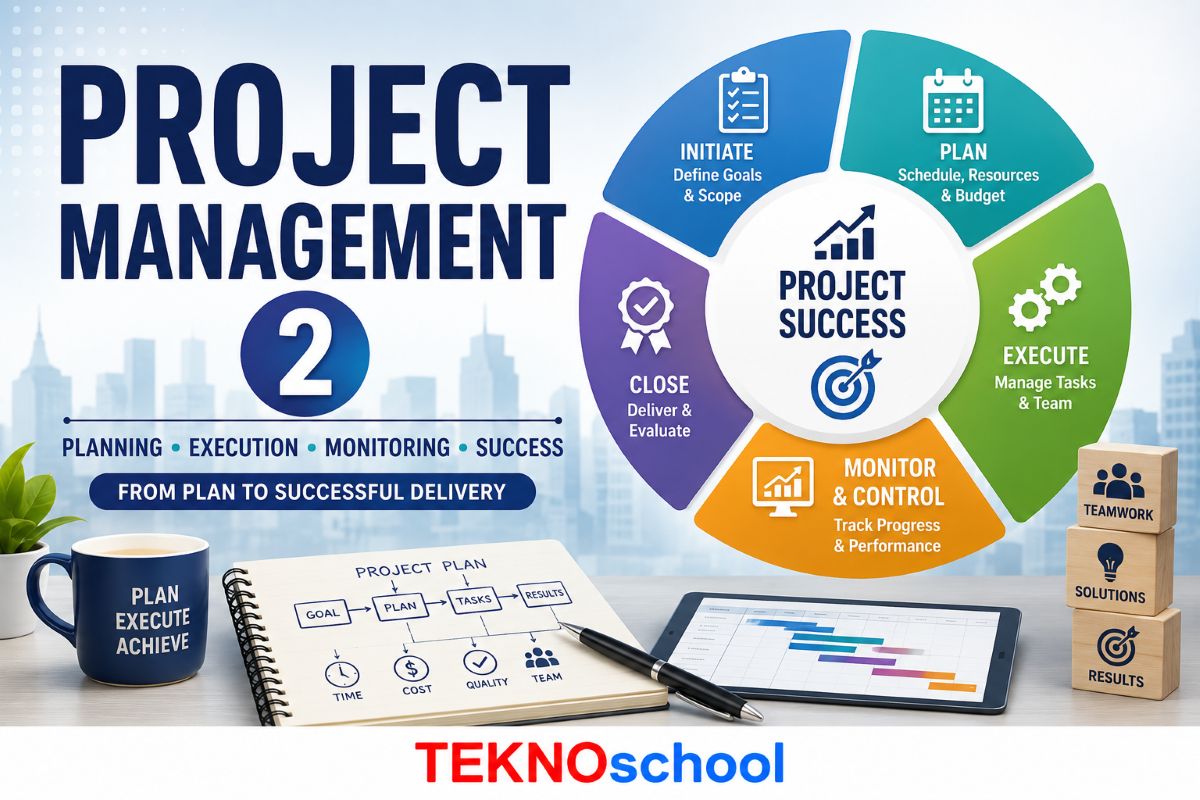
Project Management 2
Project Management 2-Some knowledge is best absorbed as narrative. Other knowledge is best absorbed as answers — short, precise, and structured so you can find the one you need in seconds. Project management is full of the second kind: definitions that must be exact, distinctions that examiners and clients both care about, and lists that either come to mind under pressure or do not. What follows is a complete revision reference covering roughly seventy of the questions that matter most, grouped by theme and laid out so you can scan, test yourself, and move on.
How to use this reference
Cover the right-hand column of any table and work down the questions. Where an answer runs to a list, the list itself is usually the answer — the number of items is often what is being tested. The ten sections below move from fundamentals through to general management skills, so you can drill one area at a time rather than working front to back.
Section 1 — Projects and Project Management
These are the foundation questions. Almost everything else in the discipline is built on getting these definitions exactly right, particularly the distinction between a project and ordinary operations, which is where a surprising amount of organisational confusion originates.
| Question | Answer |
|---|---|
| Define a project. | A temporary endeavour with a definite beginning and a definite end — noting that temporary says nothing about being short. It is undertaken for a specific purpose, creates unique products or services, has interrelated activities throughout, and sits in line with the organisation’s overall strategic plan. |
| What does a project focus on? | The delivery of specific outcomes. |
| Why are projects undertaken? | To solve a known problem (constructing, maintaining or renewing a facility, meeting a social need); to exploit a known opportunity such as increasing profitability; or to deal with an unplanned, unknown problem or opportunity such as new legislation or a market shift. |
| What is the key difference between projects and operations? | Projects are unique and temporary and end once their objectives have been achieved. Operations are repetitive, ongoing work performed to sustain the business. |
| What is project management? | The most efficient way of implementing unique changes. It is the set of processes and the body of knowledge — specific skills, tools and techniques — used to deliver projects successfully. Put more memorably, it is the art and science of converting vision into reality. |
| How does project management actually manage a project? | By identifying the scope, time, cost and quality criteria; ensuring changes are kept to a minimum and formally accepted when they occur; bringing structure, plan and order to the work; ensuring risks are identified, reduced and planned for; and forming a cross-functional, multi-disciplinary team to carry it out. |
| How is a project managed? | Through project management tools and techniques, skills and knowledge, people, and facilities. |
| What is a project management methodology? | The set of project management processes together with their interrelated processes and functions. Which processes are used, and how deeply, depends on the requirements of the specific project. Typical components include standard templates, simulation programs, project management software and kick-off meetings. |
| What are subprojects used for? | Breaking a large project into smaller projects so that it becomes easier to manage. |
| What is the project context? | The overall internal and external environment within which a project is undertaken. Its aspects are technical, political, legal, environmental, economic and social. |
| What is a trend analysis? | Examining project results over time to establish whether performance is improving or deteriorating. |
| What is the role of the Project Management Plan? | It is the key document of the project, defining how the project will be executed, monitored, controlled and closed. It is not produced in one pass — it is iterated several times before being finalised. |
Why Projects Fail — and Why Scope Definition Sits at the Centre of It
One question deserves expanding rather than compressing into a table row, because it explains the majority of project post-mortems ever written.
Q. Is proper scope definition critical to project success?
Yes. Where scope is poorly defined, final project costs are very likely to exceed the plan, because vague scope generates a stream of changes. Those changes then:
- break the continuity of the work
- create rework
- increase the project’s duration
- lower both the productivity and the morale of the workforce
The underlying principle is simply stated: it is difficult to achieve an objective while remaining vague about what that objective is.
| Q. What can project failure largely be attributed to? | |
|---|---|
| 1 | Poor scope definition |
| 2 | Lack of project leadership |
| 3 | No proper demarcation of responsibilities — responsibility is mixed, and nobody is ultimately accountable for completing the work |
| 4 | Lack of team functioning |
| 5 | Insufficient authority granted to the project manager |
Section 2 — The Project Life Cycle and Its Phases
The life cycle is where most of the discipline’s practical leverage sits, and the questions here tend to probe two things: whether you understand that phase counts are variable rather than fixed, and whether you can explain why phasing produces better outcomes.
| Question | Answer |
|---|---|
| What is a project life cycle? | A set of sequential project phases followed in implementing the project across time from beginning to finish. The number and the names of those phases are not fixed — they depend on the type, size, complexity and sector of the project and on the organisations involved. |
| What is a project phase? | A part of the overall project in which the key processes share distinct characteristics. Each phase is marked by completion of one or more deliverables — a finalised design, a report, a completed test — which must be approved before the next phase begins. Each phase also acts as a decision gate, including the decision on whether to proceed at all. |
| How many phases does a project have? | Generally four to five, though size and complexity can push this to eight or nine, and in some cases beyond ten. There is no single fixed life cycle, but all projects follow a common generic sequence. |
| Describe a generic eight-phase life cycle. | Conceptualise → Plan → Organise → Implement → Control → Integrate → Deliver & Close Out → Knowledge Leverage. |
| What is an extended life cycle? | A normal life cycle generally runs up to the operations and management phase. An extended life cycle continues beyond that point to include disposal or replacement of the product or service. |
| What are the key aspects of the Conceptualisation phase? | Also called the Feasibility, Initiation or Definition phase. The need or proposal is refined into a fully scoped, defined plan settling what is to be done, how, when, and by whom. The Business Case is finalised here and used to decide whether proceeding is viable. |
| When is the project’s product or service actually created? | During the implementation phase — which is also where the majority of project resources are consumed. |
| When are errors cheapest to correct? | As early in the life cycle as possible, because the cost of rework plus the cost of redoing associated work is at its lowest then. Phasing helps by surfacing errors early through phase-end reviews and checkpoints. |
| How does the cost of change vary across the life cycle? | Exponentially. A change costing one unit at feasibility costs a multiple of that during design, a larger multiple during execution, and a larger one still at close-out. |
| When do stakeholders have maximum influence over project costs? | In the early stages of the project. |
| Q. What are the advantages of managing through a life cycle approach? | |
|---|---|
| Decision gateways | Each phase provides a checkpoint at which the sponsor and project manager can formally review progress and continued viability. |
| Better tool selection | The most appropriate tools and techniques for each stage can be identified more accurately. |
| Easier risk work | Risk identification and planning become simpler when handled phase by phase. |
| Simpler monitoring | Monitoring and control of the project become considerably easier. |
| Manageable parts | The project is broken into smaller, better-defined, more manageable pieces. |
| Efficient resource use | Resources can be obtained as and when needed, and personal responsibilities fixed far more clearly. |
| Forced discipline | The manager and team are compelled to plan the project properly rather than improvising. |
| Visibility | The main features of the project become visible to everyone, and key milestones can be drawn up. |
Section 3 — Resources and Costs
Resource questions look simple until you are asked to classify rather than merely list. The three-way classification below is the one worth committing to memory, because it drives entirely different procurement and planning behaviour for each category.
| Resource Class | Behaviour | Examples |
|---|---|---|
| Replenishable | Consumed by the project, but can be obtained again. | Cement, money |
| Exhaustible | Consumed by the project and non-renewable — once used, they are gone. | Natural resources |
| Re-usable | Used for project work but remain intact afterwards. | Machinery, human resources |
| Question | Answer |
|---|---|
| What are project resources? | People, objects and materials. |
| What is resource planning? | Determining which types of resource the project needs — human resource, equipment and material — and then answering two questions for each: how much of that resource is required, and when it will be required. |
| What are the different types of project cost? | Direct material costs, direct labour costs, indirect or overhead costs, variable costs, opportunity costs, inflation costs, contingency costs and sunk costs. |
| Explain “do the right thing right the first time.” | It states that doing work correctly at the first attempt is both easier and less costly than doing it again. The key differentiator is attitude, and the concept trains people to recognise that doing the work correctly first time need not take any longer than doing it wrongly. |
Section 4 — Risk Management
Risk is the area where precise vocabulary matters most, because the words are used loosely in ordinary speech and precisely in project work. The distinction between a risk and a problem, in particular, is a favourite test — and misunderstanding it in practice produces either paralysis or negligence.
The definition to memorise
Risk management is the art and science of identifying, analysing and responding to risk factors throughout the project life cycle, in the best interests of the project’s objectives.
Note the two things that phrase quietly establishes: risk management is a continuous process rather than a one-off exercise, and risk identification should therefore be performed throughout the life cycle rather than only at the start.
| Question | Answer |
|---|---|
| What is a problem, and how does it differ from a risk? | A risk does not exist yet but has the potential to occur. A problem exists at present. |
| What are the two types of risk? | Business risks, which carry the possibility of either profit or loss in a venture; and pure risks, which can only be deflected or transferred to another party. |
| Is risk tolerance the same for all stakeholders? | No. Different stakeholders and different organisations have varying tolerance for risk — which is itself a source of friction requiring management. |
| What is risk probability? | The likelihood that a risk will occur. |
| What is Probability and Impact (PI)? | A tool and technique used for qualitative risk analysis. Both the probability of the risk occurring and its impact on the project are prioritised in qualitative terms — high, medium, low, very low. Crucially, the analysis is applied to each specific risk event identified, not to the project as a whole. |
| What is a decision tree? | A diagram structured as a tree that illustrates both the implications and the probability of an event occurring, together with the implications and probability of it not occurring. Its branches represent the possible alternatives along with the risks and rewards attached to each path, and it reveals which decision path offers the highest expected value. |
| How does documenting risks help? | It allows the current project to be evaluated against a historical database, keeps a proper record of the status of risk events, and builds a record for future use. |
| What is force majeure? | Any unforeseen act over which there is no control — an earthquake, for instance — that prevents fulfilment of a contract. |
Types of Insurable Risk
Pure risks are the ones that can be transferred, and insurance is the usual transfer mechanism. Four categories cover most of what a project will need to insure against.
| Category | Typical Cover |
|---|---|
| Legal liabilities | Faulty design; public bodily injury. |
| Direct damage to property | Theft, loss, vehicle damage, damage to equipment, contractor property and project material; plus cover against natural calamities. |
| Personnel-related costs | Employee replacement costs; employee injury and worker compensation. |
| Indirect losses | Protection for contractors against third-party losses; replacement of equipment. |
Section 5 — Project Selection
Selection questions frequently hinge on one point that is easy to overlook: the organisation’s strategic plan is a primary factor, not a secondary consideration applied after the financial numbers look attractive.
| Question | Answer |
|---|---|
| What is project selection criteria? | Criteria defined in terms of the merits of the product of the project. They can cover the full range of management concerns — financial return, market share, public perception and more. |
| What is the role of the strategic plan in project selection? | The strategic plan of the performing organisation must be treated as a primary factor in selection decisions, because every project should support and align with the organisation’s strategic goals. |
| What are the two broad categories of selection method? | Benefit measurement methods — the more common category, using a comparative approach through scoring models and economic analysis such as payback period, NPV and IRR. Constrained optimisation methods — mathematical models applying linear, non-linear, integer and dynamic programming algorithms. |
| Who can provide expert judgement on selection criteria? | Professional and technical associations; industry groups; consultants; other units within the performing organisation; and publicly available information such as internet research on similar projects. |
| Why are projects typically authorised? | In response to problems, opportunities or business requirements requiring a management response — specifically market demands, business needs, technical advances, legal requirements, customer requests, competitors’ profiles and strategies, and social needs. |
| Define project justification. | The business need that the project was undertaken to fulfil. |
| What is the break-even point in a project? | The point at which the project’s income or savings equals its initial investment. |
| Why is financial appraisal carried out? | To establish likely profitability, the availability and sources of funds, and cash flow requirements. |
Section 6 — Investment Appraisal Techniques
Five techniques appear again and again: payback period, return on investment, discounted cash flow, net present value and internal rate of return. The examinable distinctions between them come down to two questions — does the technique account for the time value of money, and does it express the result in absolute terms or as a percentage?
| Technique | What It Does | Time Value of Money? | Result Expressed As |
|---|---|---|---|
| Payback Period | Measures how long the project takes to recover the initial investment. Shorter is better. | NO | Time |
| Return on Investment | The year-on-year financial return the project is expected to earn. Higher is better. | NO | Percentage |
| Discounted Cash Flow | Recognises that money depreciates in value — $100 today will not have the same purchasing power a year later. It is the umbrella technique beneath NPV and IRR. | YES | — |
| Net Present Value | Uses discounted cash flows to compare and select projects, showing what future cash flows are worth in today’s terms. Higher is better; the higher the discount factor, the lower the NPV. Depreciation and fixed assets are excluded from cash flows. | YES | Absolute amount |
| Internal Rate of Return | The discount rate at which the project’s NPV becomes zero. Higher is better. Inflation or the cost of borrowing would have to rise above the IRR before the project made a loss. | YES | Percentage |
The one-line distinction worth remembering: NPV quantifies expected profit in absolute terms, whereas IRR expresses expected profit as a percentage. Projects with zero or negative NPV should be discarded.
| Advantages | Disadvantages |
|---|---|
| PAYBACK PERIOD | |
| Very widely used and simple to apply. Excellent as an initial filter. Favours projects with faster returns, which is better for company liquidity. Well suited to high-risk projects. | Does not consider the time value of money. Ignores cash flow entirely once the original investment has been recovered. Not suitable for assessing long-term projects. |
| NET PRESENT VALUE | |
| Considers the time value of money. Compares all future cash flows in today’s values. Takes into account the whole time span of the project from beginning to end. Allows what-if simulation using different discount factors. | Accuracy depends entirely on the accuracy of cash flow and interest rate estimates. Does not consider non-financial data. Carries a bias toward short-term projects. Uses a fixed interest rate. |
Depreciation Methods
Depreciation sits adjacent to appraisal and is regularly tested alongside it. There are two broad approaches, and one of them subdivides.
| Method | How It Works | Sub-methods |
|---|---|---|
| Straight Line | The same amount of depreciation is taken every year. The salvage value — the asset’s worth at the end of its useful life — is subtracted from the purchase cost, and the result divided by the useful life in years. | — |
| Accelerated | Assets depreciate faster than under the straight line method, on the assumption that they lose a higher proportion of their value in the early years. | Double Declining Balance Sum of the Years’ Digits |
Section 7 — The Business Case
If there is one trap in this section, it is the question about what the Business Case should focus on. The answer catches people out because the instinctive response is wrong.
Q. What should the Business Case focus on?
On the goals and objectives to be achieved by the project — not on how those goals and objectives will be achieved. The “how” belongs to the Project Management Plan, which is developed later and built on this foundation.
| Question | Answer |
|---|---|
| Why is a Business Case needed? | To provide a concrete basis on which a proposed project can be appraised and assessed. |
| When can it be developed? | Once the project’s initial need has been identified. It takes time to produce, because many aspects must be considered and covered to arrive at a correct and realistic picture. |
| Who is responsible for preparing it? | The project’s Sponsor, who represents the financing authority and who owns the Business Case. |
| What is its role? | Developed from the initial Need statement during conceptualisation, it shows the problem or opportunity the project addresses — the justification. It identifies strategic alignment with organisational strategy, provides a framework for informed planning decisions, highlights scope and constraints, documents key risks and key deliverables, states the likely impact on other projects, identifies assumptions made, highlights all potential conflicts, and forms the basis for developing the Project Management Plan. |
| What resource analysis belongs in it? | Only a broad analysis — the types of resources needed, confirmation that they will be available, where they will be obtained from, and any specialised requirements that should be highlighted. |
Contents of the Business Case
| Justification | Definition & Delivery | Constraints & Exposure |
|---|---|---|
| The business need — the “why” of the project Financial and investment appraisal data The project’s objectives and benefits A cash-flow forecast | A broad description of the project Success criteria, KPIs and critical success factors Quality and performance criteria Technology to be used Time frame and major milestones Broad outline of resources, key roles and responsibilities | The project’s key stakeholders Assumptions and constraints Safety parameters Main risks and opportunities foreseen Main competition envisaged and its impact |
Section 8 — Stakeholders, Sponsor and Owner
Three roles are routinely confused with one another: the owner, the sponsor, and the stakeholder body generally. Getting them straight matters in practice as much as in revision, because it determines who signs what.
| Role | Definition and Responsibilities |
|---|---|
| Owner | The organisation or individuals for whom the project has been undertaken. The owner is the project’s key risk taker. Within the project, the owner is represented by the sponsor. |
| Sponsor | Guides the project at a strategic level in line with organisational needs and supplies management’s commitment. Owns the project on behalf of the organisation and is responsible for ensuring the planned benefits are actually achieved. Finalises the Business Case, provides the funds, makes sure funds remain available, authorises progression to the next phase, and resolves project issues as quickly as possible. |
| Stakeholder | Any individual, group or organisation that has a role or interest in the project, or that will be impacted by it. |
| Q. What is the role of the project’s stakeholders? | |
|---|---|
| ● | Provide valuable information to the team in determining the project’s scope and objectives |
| ● | Approve the project, and accept it at completion |
| ● | Give approval to proceed to the next phase at the end of each project phase |
| ● | Inform the team of any changes required, following the agreed change procedure |
| ● | Provide regular feedback on the project reports they receive as work progresses |
| ● | Make key project decisions when required and ensure timely resolution of issues affecting success |
Stakeholder Analysis in Four Steps
Stakeholder analysis is the technique used to identify stakeholders and to understand and assess their level of interest and likely influence on project outcomes. Its value is twofold: it increases support for the project while reducing opposition, and it ensures stakeholder requirements are properly considered during planning rather than discovered late.
| Step | Action |
|---|---|
| 1 | Identify and list all the stakeholders. |
| 2 | Identify each stakeholder’s level of interest in the project, together with their requirements. |
| 3 | Assess that interest against a pre-defined scale — for example very important, important, some effect, no effect. |
| 4 | On the basis of the first three steps, note the actions the team can take to increase support and to decrease opposition or negative interest. A table is normally used to record all of this. |
Section 9 — The Project Charter
The Charter is the document that turns an approved idea into an authorised project. Two of the questions below carry subtleties worth noting: the project manager may or may not already be appointed when the Charter is developed, and a signed contract can itself serve as the Charter.
| Question | Answer |
|---|---|
| What is the role of the Project Charter? | It formally authorises the project; links the project to the organisation’s ongoing work; and gives the project manager the authority to use organisational resources for project activities. |
| When should the project manager be identified? | As early as feasible — preferably at the initiation phase of scope management, before much of the planning has been done, and always before execution begins. |
| Can a contract serve as the Project Charter? | Yes. A signed contract between buyer and seller generally serves as the Project Charter for the seller to perform the project. |
What Should Be Documented in the Charter
| Purpose | Scope & Money | People & Boundaries |
|---|---|---|
| An overview of the project The business needs being met — market demand, expansion, technology upgrade Project goals and objectives Justification for the project | The product or service the project will deliver Customer’s requirements Other stakeholders’ requirements Overall budget Financial viability High-level milestones | The project manager and their level of authority Roles and responsibilities of sponsor, project manager and team members The organisations that will be involved All assumptions and constraints, organisational as well as external |
Section 10 — General Management Skills
The final group of questions covers the softer competencies that surround the technical machinery. They are easy to underrate in revision and impossible to fake in practice.
| Question | Answer |
|---|---|
| What are the key general management skills? | Leading, communicating, negotiating, problem solving, and influencing the organisation. |
| What are the possible outcomes of any negotiation? | Four: win/lose, lose/win, win/win, and lose/lose. |
Standard Versus Regulation
This distinction comes directly from ISO and turns on a single word: compliance. One is optional; the other is not.
| STANDARD | REGULATION |
|---|---|
| A document approved by a recognised body providing common rules, guidelines and characteristics for products, services and processes. | A document laying down product, process or service characteristics, including all administrative provisions applicable to them. |
| Compliance is NOT necessary | Compliance is MANDATORY |
The Twelve Answers Most Worth Memorising
If time is short, these are the ones that recur most often and carry the most weight elsewhere in the syllabus.
| # | Prompt | The Answer in One Line |
|---|---|---|
| 1 | Project vs operation | Unique and temporary versus repetitive and ongoing. |
| 2 | Risk vs problem | A risk might happen; a problem already has. |
| 3 | Standard vs regulation | Standards are optional; regulations are mandatory. |
| 4 | NPV vs IRR | NPV gives profit as an absolute amount; IRR gives it as a percentage. |
| 5 | Cheapest time to fix errors | The earliest possible stage of the life cycle. |
| 6 | Cost of change over time | Rises exponentially through the phases. |
| 7 | Who owns the Business Case | The Sponsor. |
| 8 | Who is the key risk taker | The Owner, represented in the project by the Sponsor. |
| 9 | Business Case focus | The goals and objectives — not how they will be achieved. |
| 10 | Where resources are consumed | Mostly in the implementation phase, which is also where the product is created. |
| 11 | Number of life cycle phases | Not fixed — typically four to five, sometimes eight or nine or more. |
| 12 | Leading cause of failure | Poor scope definition, followed by weak leadership and unclear responsibility. |
Worked through end to end, these questions cover the conceptual spine of the discipline: what a project is, how it is broken into phases, what it consumes, what threatens it, how it is chosen and financed, who authorises it, and which human skills hold the whole thing together. The definitions are worth knowing precisely rather than approximately — not because precision impresses an examiner, but because on a live project the difference between a risk and a problem, or between a standard and a regulation, is the difference between being prepared and being surprised.