Process Control Fundamentals
On-Off Control and PID Control
Process Control Fundamentals-Every automatic system that holds a temperature, a level, a pressure, or a speed steady is doing the same basic job: comparing the measured value against a desired setpoint and deciding what to do about the difference. That difference is called the error, and the way a controller reacts to it defines its personality. At one extreme sits the blunt, decisive on-off controller. At the other sits the smooth, calculating PID controller. Understanding both — and knowing when each is appropriate — is the foundation of practical process control.
On-Off (Two-Position) Control
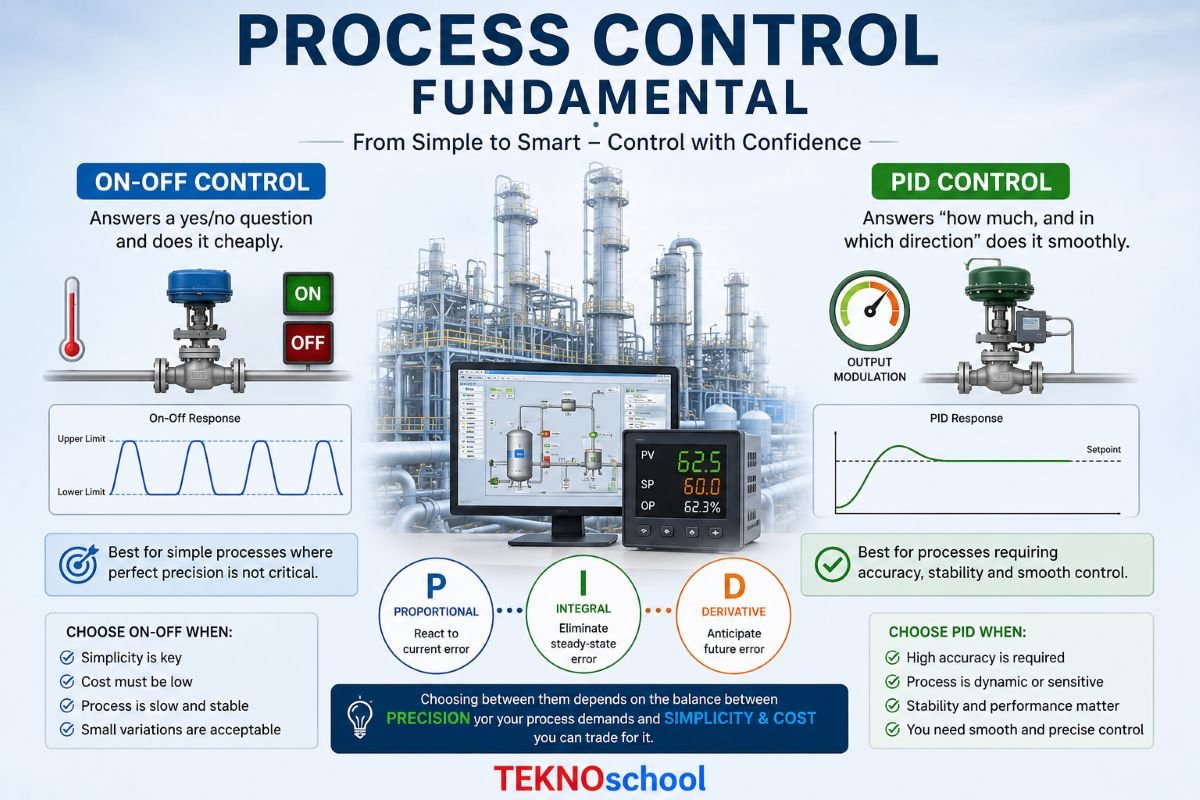
On-off control is the simplest form of automatic control. The output has only two states — fully ON or fully OFF — and nothing in between. The moment the measured value crosses the setpoint, the controller flips. Your home thermostat is the classic example: the heater runs at full power until the room reaches the target temperature, then switches off completely until the room cools down again.
If the controller switched exactly at the setpoint, it would chatter — turning on and off dozens of times per second as tiny fluctuations crossed the line. To prevent this, on-off controllers use a deadband (or hysteresis): a small gap around the setpoint. The output turns ON below the lower limit and OFF above the upper limit. A wider deadband means fewer switching cycles but larger swings in the process value.
The result is a process value that constantly cycles above and below the setpoint in a sawtooth pattern. It never truly settles — it just oscillates within an acceptable band. For many applications this is perfectly fine, and the simplicity is a genuine advantage: on-off control is cheap, robust, requires no tuning, and needs only an inexpensive switch or relay rather than a device that can modulate its output.
PID Control
Where on-off control only knows “too high” or “too low,” a PID controller produces a continuous, proportional output — it can call for 12%, 47%, or 88% of full power. PID stands for Proportional, Integral, Derivative: three separate calculations performed on the error signal, then added together to form the final control output. Each term looks at the error differently.
P — Proportional: reacting to the present
The proportional term responds to how big the error is right now. A large error produces a strong corrective push; a small error produces a gentle nudge. It is the workhorse of the loop, but on its own it leaves a persistent steady-state offset — the process settles slightly away from the setpoint, because some error is needed just to keep the output active.
I — Integral: reacting to the past
The integral term adds up the error accumulated over time. As long as any offset persists, the integral keeps growing and pushing the output harder until the error is driven to zero. This is what eliminates the steady-state offset that proportional control leaves behind. Too much integral action, however, causes sluggish overshoot and can lead to integral windup.
D — Derivative: anticipating the future
The derivative term watches how fast the error is changing and applies a braking action if it is moving quickly. This dampens overshoot and speeds up settling by anticipating where the process is heading. Because it amplifies noise, derivative action is often used cautiously — many industrial loops run as PI only, adding D only where fast, clean response matters.
Combined, the three terms give a controller that reacts strongly to present error, patiently erases lingering offset, and smooths out its own aggression. The art of getting them to work together is called tuning — adjusting the gains so the loop responds quickly without excessive overshoot or oscillation.
On-Off vs PID at a Glance
| Characteristic | On-Off Control | PID Control |
|---|---|---|
| Output | Two states: ON or OFF | Continuous, 0–100% |
| Accuracy | Cycles around setpoint | Holds setpoint precisely |
| Cost & complexity | Low, simple relay/switch | Higher, needs modulating device |
| Tuning required | None (set deadband only) | Yes — P, I, D gains |
| Wear on actuator | High (frequent switching) | Low (smooth modulation) |
| Best suited to | Slow, tolerant processes | Fast, precision-critical loops |
Where Each One Is Used
On-off control is the right choice when a small amount of cycling is harmless and simplicity or cost matters most. It runs domestic thermostats and water heaters, refrigerators and air conditioners, sump-pump level switches, and process tank filling where a high/low band is perfectly acceptable. The physical inertia of these systems smooths out the switching so the cycling is barely noticeable.
PID control takes over wherever precision, stability, or fast response is essential. It regulates temperature in industrial furnaces and reactors, controls flow and pressure in pipelines, governs motor speed in drives and CNC machines, stabilises flight in aircraft autopilots and drones, and manages countless closed loops inside chemical plants, power stations, and manufacturing lines. Anywhere a process must sit precisely on target despite changing loads and disturbances, PID is the standard tool.
On-off control answers a yes/no question and does it cheaply. PID control answers “how much, and in which direction” and does it smoothly. Choosing between them is really a question of how much precision your process demands versus how much simplicity and cost you can trade for it. Master the deadband on one side and the P, I, and D gains on the other, and you can control almost anything.