Positive Displacement Pumps
Positive Displacement Pumps
Positive Displacement Pumps (PDPs) are among the most fundamental fluid‑handling machines used across industries such as chemical, oil & gas, water treatment, pharmaceuticals, food processing, and power plants. Their ability to deliver a constant flow irrespective of discharge pressure makes them indispensable in applications requiring accuracy, metering, and high-pressure delivery.
1. Introduction to Positive Displacement Pumps
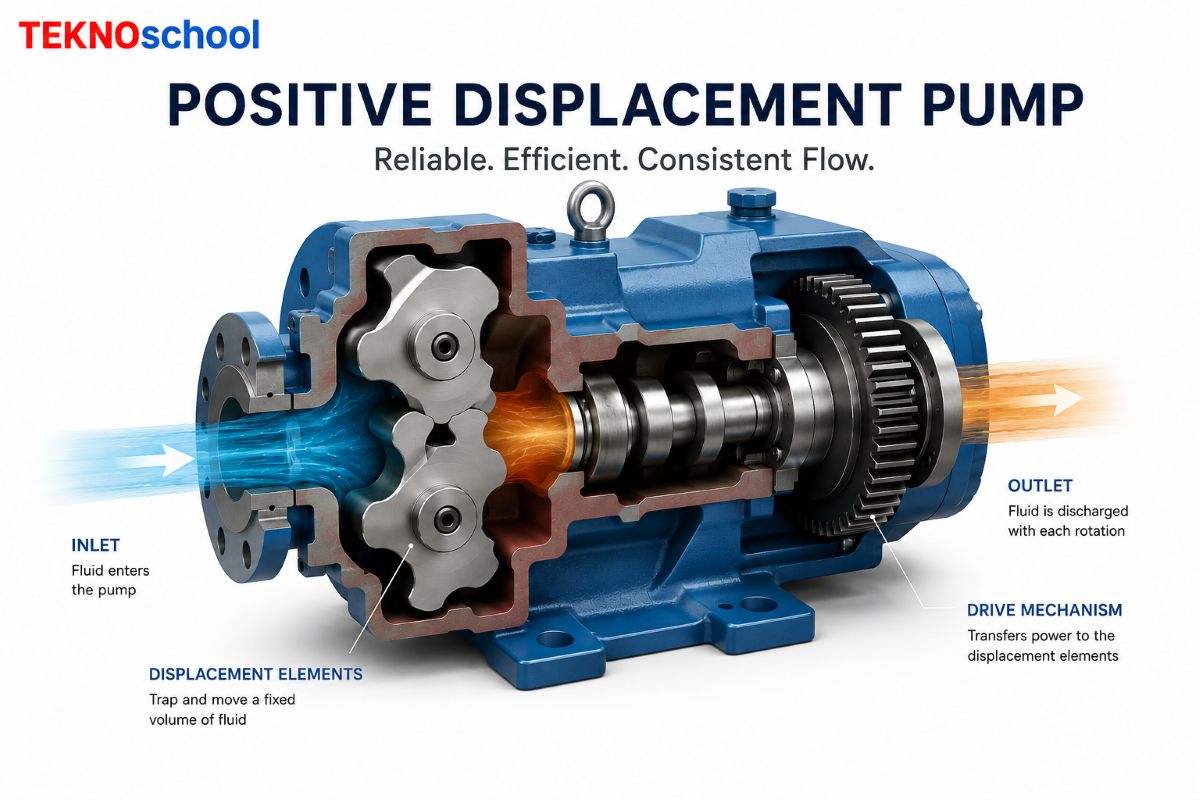
A Positive Displacement Pump moves fluid by trapping a fixed volume and forcing it from the inlet to the outlet. Unlike centrifugal pumps, which impart velocity to the fluid, PDPs deliver volumetric flow that is nearly constant.
Where They Are Used
- High‑viscosity fluids (oil, sludge, polymers)
- Metering and dosing systems
- Hydraulic systems
- Fuel injection
- Chemical transfer
- Lubrication systems
2. Principle of Operation
The working principle is simple:
- A cavity expands → fluid enters (suction).
- The cavity contracts → fluid is displaced (delivery).
This cycle ensures positive displacement of fluid every stroke or rotation.
3. Reciprocating Pumps
Reciprocating pumps use a piston, plunger, or diaphragm moving back and forth inside a cylinder.
They are used where high pressure and accurate flow are required.
3.1 Direct‑Acting Reciprocating Pump
A Direct‑acting pump is driven directly by a steam engine or hydraulic cylinder.
Features
- Low speed
- No crankshaft
- Simple construction
- Used in boiler feed and high‑pressure services
3.2 Indirect‑Acting Reciprocating Pump
An Indirect‑acting pump uses a crankshaft and connecting rod.
Features
- Higher speed
- More compact
- Better control
- Used in industrial water supply, oil transfer, and chemical dosing
3.3 Simplex, Duplex, Triplex Pumps
These classifications depend on the number of cylinders.
- Simplex Pump – One cylinder
- Duplex Pump – Two cylinders
- Triplex Pump – Three cylinders (common in high‑pressure applications)
More cylinders = smoother flow + reduced pulsation.
3.4 Single‑Acting vs Double‑Acting Pumps
Single‑Acting Pump
Fluid is displaced only in one direction of piston movement.
Double‑Acting Pump
Fluid is displaced in both directions of piston movement → double the discharge.
3.5 Power Pump
A Power Pump is driven by an electric motor or engine through a crankshaft.
Advantages
- High pressure
- Reliable
- Used in hydraulic fracturing, boiler feed, and high‑pressure cleaning
4. Rotary Pumps
Rotary pumps move fluid using rotating elements that trap and push fluid.
They are ideal for viscous fluids, smooth flow, and continuous operation.
4.1 Simple Gear Pump
A Gear Pump uses two meshing gears.
Types
- External gear pump
- Internal gear pump
Applications
- Lubrication systems
- Fuel oil transfer
- Hydraulic power packs
4.2 Other Gear Pumps
Includes:
- Helical gear pumps
- Herringbone gear pumps (smoother, quieter)
- Gerotor pumps (automotive lubrication)
4.3 Lobe Pump
A Lobe Pump uses two or more lobes rotating without contact.
Applications
- Food industry (gentle handling)
- Pharmaceuticals
- Cosmetics
4.4 Screw Pumps
Screw pumps use one or more screws to move fluid axially.
Two‑Screw Pump
Two intermeshing screws → smooth, pulsation‑free flow.
Three‑Screw Pump
One power rotor + two idler rotors → used in:
- Lube oil systems
- Fuel injection
- Hydraulic systems
4.5 Rotary Moving Vane Pump
A Vane Pump uses sliding vanes in a rotor.
Applications
- Fuel transfer
- Refrigeration
- Automotive power steering
4.6 Diaphragm Pump
A Diaphragm Pump uses a flexible diaphragm actuated mechanically or pneumatically.
Advantages
- Leak‑free
- Handles corrosive and toxic fluids
- Self‑priming
5. Characteristics of Positive Displacement Pumps
For a positive displacement pump:
- Ideal behaviour (theory): Flow is proportional to speed, not to pressure. At a given RPM, the pump displaces (almost) the same volume per revolution, so the theoretical flow is nearly constant even if discharge pressure changes.
- Real behaviour (practical): As discharge pressure increases, some liquid leaks internally from discharge back to suction (called slip). So, actual flow slightly decreases with increasing pressure, giving a slightly downward‑sloping line, not a perfectly flat one.
A positive displacement pump delivers nearly constant flow at a given speed; discharge pressure mainly affects internal slip, not the basic flow generation.
5.1 Flow vs Pressure
PDPs deliver a constant flow, and pressure depends on system resistance.
5.2 Self‑Priming
Most PDPs can self‑prime due to their sealed chambers.
5.3 High Efficiency at High Viscosity
Unlike centrifugal pumps, PDPs perform better with viscous fluids.
5.4 Pulsating Flow
Reciprocating pumps produce pulsations → dampeners required.
5.5 High-Pressure Capability
Reciprocating pumps can generate extremely high pressures.
6. Protection of Positive Displacement Pumps
Positive displacement pumps must never run against a closed discharge valve.
If they do, pressure rises instantly → the pump or pipeline may burst.
Essential Protection Devices
6.1 Relief Valve / Safety Valve
A Relief Valve is mandatory.
Function
- Opens when pressure exceeds the set limit
- Protects the pump, piping, and motor
6.2 Pressure Switch / High‑Pressure Trip
Stops the pump when pressure exceeds safe limits.
6.3 Suction Strainer
Prevents debris from entering the pump.
6.4 Pulsation Dampener
Used in reciprocating pumps to reduce pulsations.
6.5 Temperature Protection
For viscous fluids, overheating can damage pump internals.
6.6 Dry‑Run Protection
Especially important for:
- Screw pumps
- Gear pumps
- Vane pumps
Dry running causes rapid wear.
7. Advantages of Positive Displacement Pumps
- Accurate and constant flow
- High-pressure capability
- Suitable for viscous fluids
- Self‑priming
- Good suction lift
- Precise metering
8. Limitations
- Not suitable for large flow rates
- Requires a relief valve
- Pulsations in reciprocating pumps
- Sensitive to solids (except diaphragm pumps)
Conclusion
Positive Displacement Pumps are essential wherever precision, high pressure, and viscous fluid handling are required. Understanding their types — reciprocating, rotary, screw, gear, lobe, vane, and diaphragm — helps engineers select the right pump for the right application.