HVDC System Harmonics and Filters
HVDC System Harmonics and Filters
Harmonics and Filters: Why converters generate harmonics, and how AC and DC filters are designed to keep the network clean.
General Concept
A high voltage direct current converter is fundamentally a switching device. It repeatedly connects and disconnects the alternating current system to the direct current side in a precisely timed sequence, and this switching action is never perfectly smooth. The consequence is that the voltages and currents on both sides of the converter contain, in addition to the wanted component, a family of unwanted frequencies known as harmonics. On the AC side these appear as distortions of the current waveform at multiples of the supply frequency. On the DC side they appear as a ripple superimposed on the smooth direct voltage.
Left unchecked, these harmonics cause real problems. They heat transformers and capacitors, interfere with protection relays, distort the voltage supplied to neighbouring consumers, and, most notably, induce noise into nearby telephone and communication lines. The purpose of harmonic filters is to provide a low impedance path that traps these unwanted frequencies close to their source, preventing them from spreading into the AC network or along the DC transmission line.
Core idea: A converter is a harmonic generator by nature. Filters do not eliminate harmonics; they redirect them into a controlled path so the rest of the system stays clean.
Generation of Harmonics
The harmonics produced by a converter follow a predictable pattern set by the pulse number of the bridge. A converter built from a single six-pulse bridge produces, on the AC side, harmonics of the order 6k plus or minus one, meaning the 5th, 7th, 11th, 13th, and so on. On the DC side the same bridge produces harmonics of order 6k, namely the 6th, 12th, 18th, and higher. These are the characteristic harmonics, and their magnitude falls roughly in inverse proportion to the harmonic order.
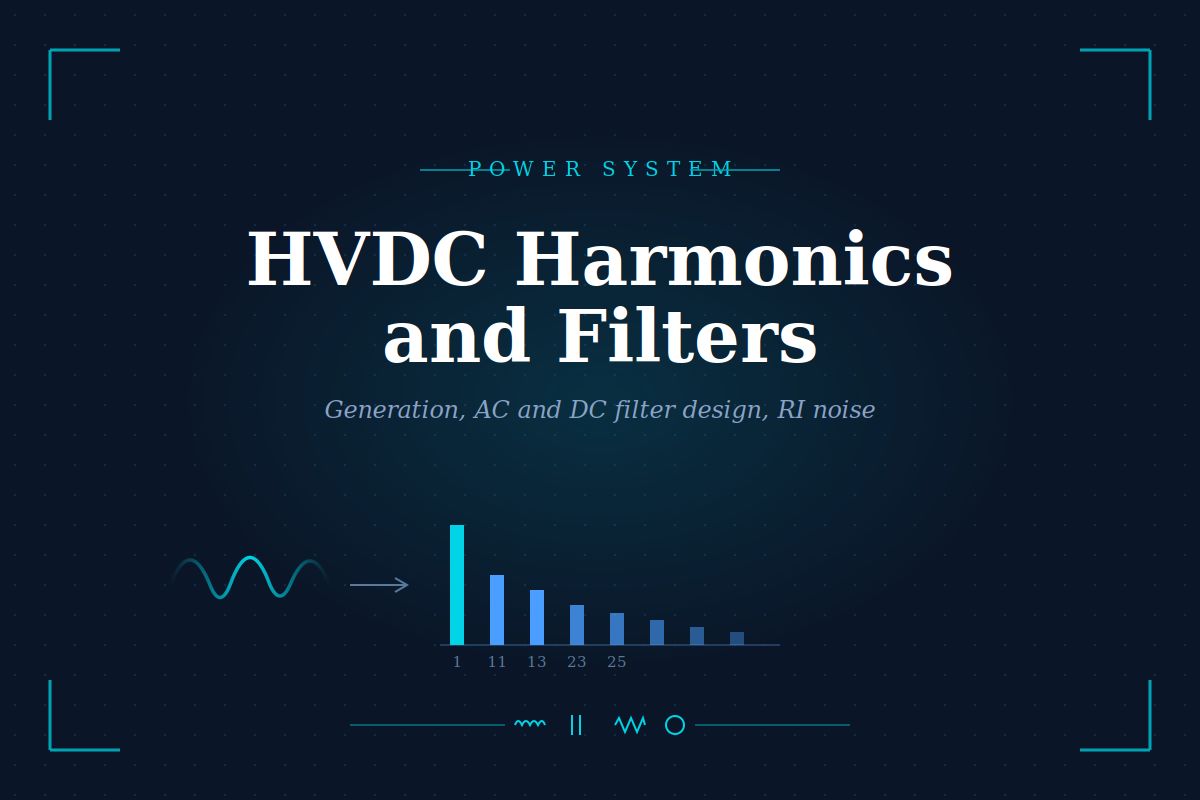
Modern HVDC schemes almost always use the twelve-pulse configuration, formed by connecting two six-pulse bridges through star-star and star-delta transformers so their outputs are phase shifted by thirty degrees. This arrangement cancels the lower order harmonics. On the AC side only the 11th, 13th, 23rd, 25th and higher orders remain, while on the DC side only the 12th, 24th and higher survive. Reducing the number of troublesome harmonics greatly simplifies filter design.
In practice a converter also generates non-characteristic harmonics, those outside the ideal pattern, caused by imperfections such as unequal firing angles, asymmetry in the AC supply voltage, and small differences between the two transformer windings. Although these are usually small, filter design must allow for them so that they do not accumulate to unacceptable levels.
Design of AC Filters
The AC filter serves two duties simultaneously. It absorbs the characteristic current harmonics injected by the converter, and it supplies a large part of the reactive power that the converter consumes during operation. Because a converter draws reactive power roughly equal to half its active power rating, the capacitors that form the filter are sized as much for reactive compensation as for harmonic absorption.
A typical AC filter installation combines several branches. Single-tuned branches are sharply tuned to a specific harmonic, most often the 11th and 13th, presenting very low impedance at that exact frequency. Double-tuned branches trap two frequencies with a single arrangement, saving space and losses. High-pass or damped branches cover the broad band of higher order harmonics, from around the 23rd upward, with a gentler response that is insensitive to frequency drift and component tolerances.
The designer must consider that tuning shifts with ambient temperature, capacitor ageing, and variations in system frequency. A filter tuned too sharply may drift off its target and lose effectiveness, so single-tuned branches are given a small margin and damped branches are added to cover the residual band reliably.
DC Filters
On the direct current side the smoothing reactor performs the first stage of harmonic control, limiting the ripple current and blocking the flow of harmonics into the transmission line. However, the reactor alone cannot reduce the voltage ripple sufficiently, so DC filters are connected between the pole and ground to shunt the remaining harmonic voltages.
DC filters resemble their AC counterparts in principle but differ in purpose. They do not supply reactive power, since none is needed on the DC side. Their sole task is to reduce the harmonic voltage that would otherwise drive currents along the line and into the earth. These filters are usually tuned to the characteristic DC harmonics such as the 12th and 24th, and modern designs often use active DC filters, in which power electronics inject a counter signal that cancels the residual ripple far more effectively than passive components alone.
Carrier Frequency and Radio Interference Noise
The concern about harmonics on the DC line is not limited to power frequency multiples. The transmission line often carries power line carrier signals used for communication and protection, typically in the range of a few tens to a few hundred kilohertz. Converter switching and its associated transients produce noise across this band, which can mask or corrupt the carrier signals. Special carrier-frequency filters and blocking devices are installed to keep this interference away from communication equipment.
At even higher frequencies, the sharp switching edges and the corona discharge around line conductors radiate energy that appears as radio interference, or RI. This broadband noise can disturb radio reception in the vicinity of the line and converter station. It is controlled by careful conductor design that limits corona, by shielding within the converter hall, and by RI filters that suppress high frequency emissions at their source. Together these measures ensure that an HVDC scheme, despite the intense switching at its heart, remains a quiet and well-behaved neighbour to the systems and communities around it.