Boiler Instrumentation
Boiler Instrumentation
Boiler instrumentation is the set of measuring instruments, controllers, alarms, interlocks, and protective devices used to operate a boiler safely, efficiently, and automatically. Its job is to keep the boiler within safe limits while supporting stable steam generation, efficient combustion, dependable feedwater control, and reliable shutdown during abnormal conditions.
Why Boiler Instrumentation Is Required
A boiler handles high pressure, high temperature, combustion, water circulation, and steam generation at the same time. Because of this, instruments are needed to measure actual process values, maintain safe operating ranges, provide automatic control signals, and protect the boiler if the operator does not respond quickly enough during an upset condition.
- Measure pressure, temperature, flow, level, draft, and flue-gas condition.
- Control steam production according to plant demand.
- Maintain safe drum water level over changing load conditions.
- Optimize fuel-air ratio for efficient combustion.
- Generate alarms, interlocks, and trips when dangerous conditions appear.
Basic Boiler Process
In simple terms, fuel burns with combustion air inside the furnace, heat converts feedwater into steam, and the hot flue gas then passes through heat-recovery sections before leaving through the stack. This overall steam-water and combustion process forms the basis for the main boiler control loops.
| Fuel | + | Combustion Air | → | Burner |
| ↓ | ||||
| Furnace: Heat Transfer | ||||
| ↓ | ||||
| Feedwater | → | Steam Drum | → | Main Steam |
| ↓ | ||||
| Economizer → Air Heater → Chimney | ||||
This simple diagram shows why a boiler cannot be controlled by only one variable. Steam production depends on coordinated control of fuel, air, feedwater, furnace conditions, and steam-side performance.
Main Parameters Measured in a Boiler
Modern boiler control relies on a group of core measurements rather than a single instrument. Common measurements include pressure, differential pressure, temperature, flow, level, flue-gas analysis, and steam-water analysis values such as conductivity.
| Measured Variable | Typical Instrument | Main Use |
|---|---|---|
| Steam pressure | Pressure transmitter, gauge, switch | Load control and protection [web:34] |
| Drum level | DP transmitter, level switch | Feedwater control and safety [web:6][web:41] |
| Steam flow | Flow transmitter | Load indication and feedforward [web:34][web:41] |
| Feedwater flow | Flow transmitter | Drum-level control [web:6] |
| Fuel flow | Flowmeter, control valve feedback | Combustion control [web:6][web:43] |
| Air flow / draft | DP transmitter, draft transmitter | Combustion and furnace-pressure control [web:37][web:38] |
| Flue-gas O₂, CO, SOx, NOx | Gas analyser | Efficiency and emission monitoring [web:4] |
Drum-Level Control
Drum-level control is one of the most critical boiler loops because both low and high level are dangerous. Low level can uncover heated surfaces, while high level can carry water into the steam system and affect steam quality.
| Steam Drum Water-level measurement |
| ↓ |
| LT-101 Level Transmitter |
| ↓ |
| LIC-101 Level Indicating Controller |
| ↓ |
| Feedwater Control Valve Adjusts feedwater flow |
| ↓ |
| Feedwater Enters Boiler |
Boiler plants commonly use single-element, two-element, or three-element drum-level control depending on how rapidly the load changes and how tightly the level must be controlled. Multi-element control improves response by combining level measurement with steam flow and feedwater flow information.
| Method | Signals Used | Typical Use |
|---|---|---|
| Single-element | Drum level only | Small or stable-load boilers [web:6] |
| Two-element | Drum level + steam flow | Better response to load changes [web:6] |
| Three-element | Drum level + steam flow + feedwater flow | Wide load range and demanding control [web:41] |
| Drum Level LT | Steam Flow FT | Feedwater Flow FT |
| ↓ | ||
| LIC / Feedforward Control | ||
| ↓ | ||
| FIC-101 Feedwater Flow Controller | ||
| ↓ | ||
| Feedwater Control Valve | ||
Combustion Control
Combustion control matches fuel input with combustion-air supply so that the boiler can meet steam demand while maintaining safe and efficient firing. Typical boiler control functions include combustion and draft control, feedwater control, and steam-temperature control.
| Steam Pressure |
| ↓ |
| Master Firing-Rate Controller |
| ↓ |
| Fuel Demand | Air Demand |
| ↓ | ↓ |
| Fuel Control Valve | Air Damper / Fan |
| ↓ | |
| Burner and Furnace | |
In practice, fuel flow and air flow must remain coordinated because too little air can lead to incomplete combustion, while too much air increases heat loss through the stack. O₂ measurement is widely used for flue-gas trim and performance improvement.
Furnace-Draft Control
Furnace-pressure or draft control keeps the furnace at the intended pressure condition by controlling induced-draft equipment or damper position. This is important because unstable furnace pressure affects combustion stability and can create unsafe operating conditions.
Steam-Temperature Control
Steam-temperature control is used mainly in boilers with superheaters, where the outlet steam temperature must be maintained within a narrow band. A common method is to regulate spray-water flow through an attemperator using a temperature controller.
| Superheated Steam |
| ↓ |
| TT-201 Temperature Transmitter |
| ↓ |
| TIC-201 Temperature Controller |
| ↓ |
| Spray-Water Control Valve |
| ↓ |
| Attemperator |
If the measured steam temperature rises above the target, the controller increases spray-water flow. If the temperature falls too low, it reduces the spray-water input.
Burner Management System
The Burner Management System, or BMS, is responsible for safe sequencing, permissives, purge, ignition, flame supervision, and shutdown. Boiler control documents consistently separate normal combustion control from the safety-oriented functions handled by the burner management logic.
| Safety Permissives and Interlocks | ||
| ↓ | ||
| Furnace Purge | Ignition | Flame Proving |
| ↓ | ↓ | ↓ |
| Airflow Proven | Pilot Flame | Main Flame |
| ↓ | ||
| Normal Burner Operation | ||
- Purge clears combustible mixture from the furnace before ignition.
- Ignition starts the pilot and then the main flame sequence.
- Flame detection confirms that safe combustion has actually been established.
- Loss of flame or failure of required permissives leads to fuel trip.
Boiler Safety Trip Logic
Boiler protection relies on alarms, interlocks, and trips. The purpose is to keep the process out of hazardous regions and, when needed, shut off fuel quickly enough to prevent escalation.
| Low-Low Drum Level | High-High Steam Pressure | Flame Failure |
| Low Air Flow | Fan Failure | Emergency Stop |
| ↓ | ||
| MASTER FUEL TRIP | ||
| ↓ | ||
| Close Main Fuel Valves | ||
Common trip initiators include flame failure, low combustion-air flow, dangerous drum-level conditions, fan failure, and emergency shutdown input. These functions are part of the protective layer rather than ordinary process regulation.
Water Chemistry and Blowdown Instrumentation
Boiler instrumentation also extends beyond pressure and flow to steam-water chemistry. Conductivity and other steam-water analysis parameters are used to monitor water quality and support blowdown control.
- Conductivity indicates dissolved solids in the boiler water.
- Water-chemistry monitoring helps limit scale, deposition, and corrosion.
- Blowdown removes concentrated dissolved solids from the boiler.
Flue-Gas Analysis
Flue-gas analysis gives the operator and control system a direct view of combustion quality. Oxygen, carbon monoxide, sulfur oxides, nitrogen oxides, and opacity are typical values referenced in boiler instrumentation material.
| Boiler Outlet |
| ↓ |
| Sample Probe |
| ↓ |
| Sample Conditioning |
| ↓ |
| O₂ | CO | NOx | SOx |
| ↓ |
| DCS / Emission Monitoring System |
Oxygen measurement is especially useful for combustion trimming, while CO helps reveal incomplete combustion. These measurements support both performance and environmental compliance.
Common Instrument Tags
Boiler drawings and loop sheets usually identify field devices and controllers using standard tag conventions. P&IDs list instruments such as transmitters, switches, gauges, indicators, controllers, and control valves.
TT = Temperature Transmitter
LT = Level Transmitter
FT = Flow Transmitter
PIC = Pressure Indicating Controller
LIC = Level Indicating Controller
FIC = Flow Indicating Controller
TIC = Temperature Indicating Controller
AIC = Analyser Indicating Controller
FCV = Flow Control Valve
PSHH = High-High Pressure Switch
LSLL = Low-Low Level Switch
Practical Boiler Instrumentation Checklist
A practical boiler instrument list usually covers at least drum level, steam flow, feedwater flow, steam pressure, fuel flow, air flow, furnace pressure, and the controller functions needed for proper operation. Minimum recommended boiler-plant instrumentation guidance also includes trending and totalization for selected variables.
- Steam-drum level indication and control.
- Boiler steam-flow indication and trending.
- Boiler feedwater-flow indication and control.
- Fuel-flow indication and control.
- Combustion-air-flow and furnace-pressure measurement.
- Steam-temperature control where superheat is present.
- Flue-gas O₂ and related analyser signals where efficiency optimization is required.
Final Understanding
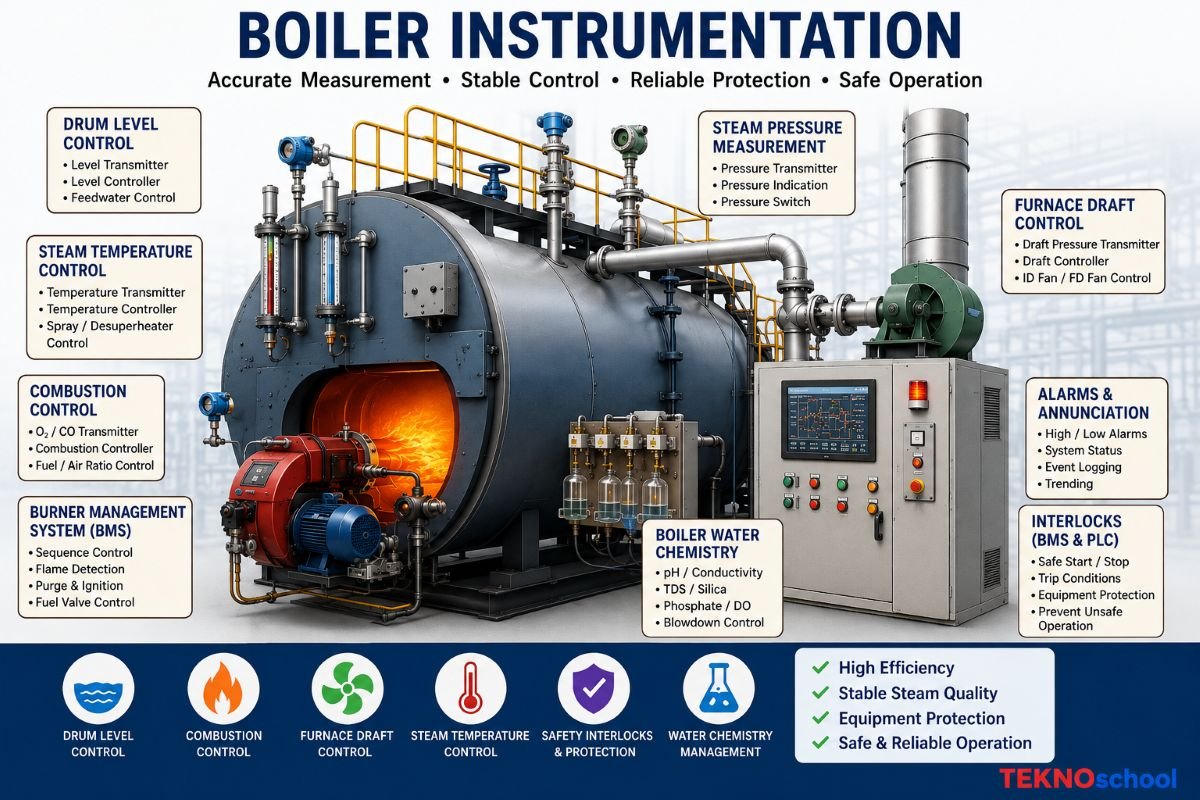
Boiler instrumentation is not just a collection of gauges and transmitters. It is a coordinated system that measures the process, drives automatic control, improves efficiency, and applies protective action when conditions become unsafe. The most important functional areas are drum-level control, combustion control, furnace-draft control, steam-temperature control, burner management, flue-gas analysis, and water-chemistry monitoring. ]